

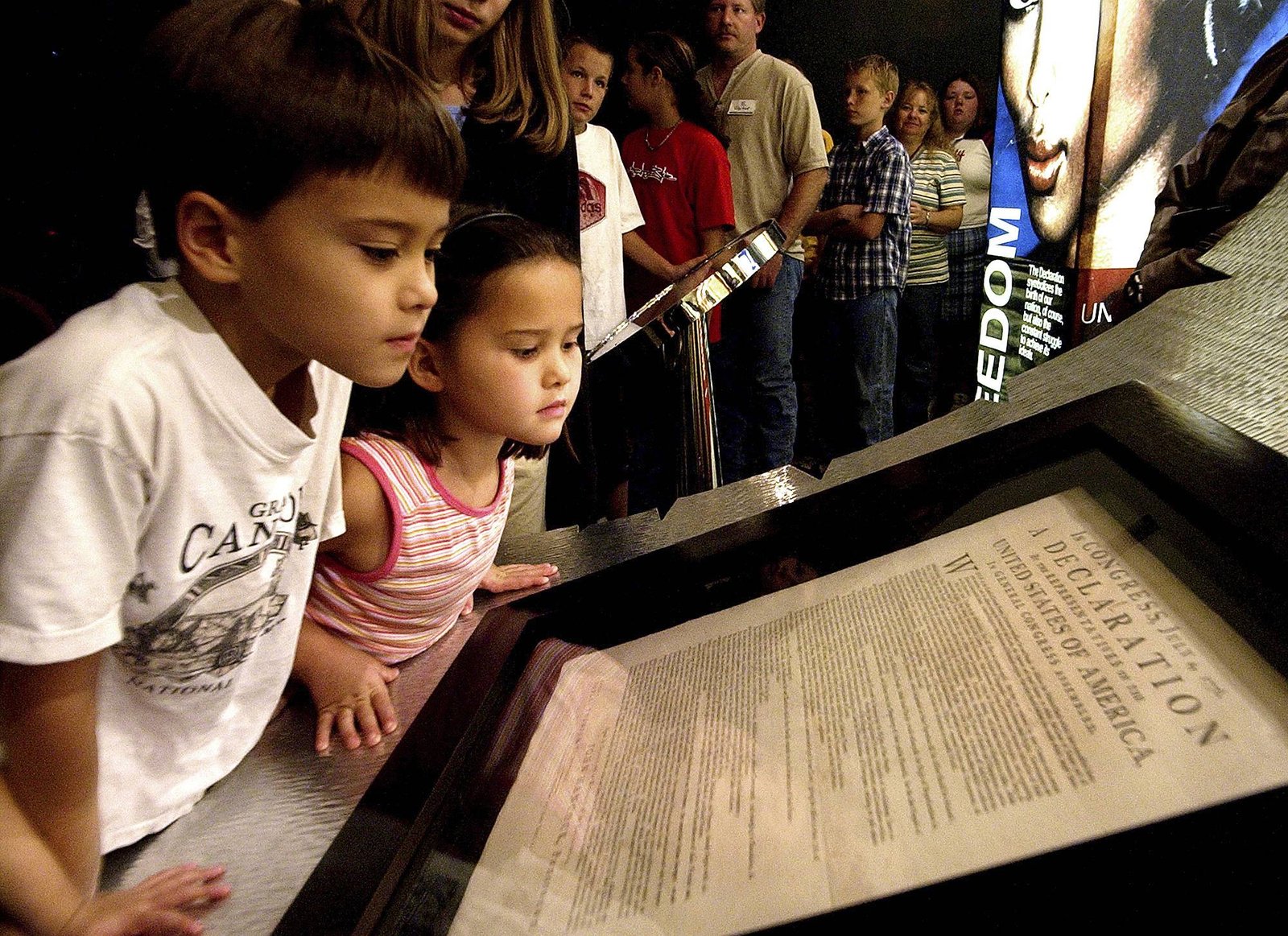
Grace McCaffrey Yeah. Well, this is a big year for the country and also for the National Archives. The National Archives is the permanent home of the Declaration of Independence, and that’s the document that is turning 250 years this summer on July 4th. The Declaration Of Independence is kept here in Washington, D.C. at the National Archives building all year round. It’s the permanent home of it, as I said. So we’re so excited to welcome folks from around the country around the world to see the document, but we’re also focused on how, in broader, ways we can also be celebrating this year.
Eric White Yeah, and while NARA is all about looking back and preserving history, taking some leaps forward here. You got a new flagship exhibit using AI-powered portals, immersive media, millions of digitized records to tailor to each visitor’s experience, while also having those original artifacts on display. This is sort of a multi-sensory approach that I haven’t seen from NARA before, but I could be mistaken. What can you tell me about that?
Grace McCaffrey You are right. You haven’t seen this from the National Archives, and you actually haven’t seen this in any other museum in Washington, D.C. We’re the first museum in Washington, D.C. to have an exhibit that is using artificial intelligence, AI, to personalize each visitor’s experience. So you can go in the National Archives rotunda and see the Declaration and Constitution, you know, over 200 years old, and then go into an exhibit and use artificial intelligence to pull from over two million documents and really personalize your experience. And that means that each time someone comes, they’re going to have a different experience. The person you’re going next to in the exhibit can be looking at different records than you are, but at the same time also seeing some really cool and interesting original documents in the National Archives. You know, for example, we have an original Louisiana Purchase out right now, so you are experiencing, you know, 21st century technology next to some of the fundamental documents of our country.
Eric White Could you utilize a ChatGPT to spruce up the Declaration of Independence?
Grace McCaffrey It would be great if it could, you know, use it to translate some of the cursive that’s hard to read, especially on the Declaration, which unfortunately is so faded now, but we’re trying to preserve it for another 250 years.
Eric White Yeah, and on that note, when Washington, D.C. was created, it was created as sort of being in the center of all the colonies. And that’s not the case anymore. So it can be a little difficult to get to D.C., so NARA is also loaning out some documents, as I understand, to presidential libraries across the country. What was the formulation of that idea like?
Grace McCaffrey Right. Well, you’ll notice for some of our America 250 initiatives, our real goal with this is recognizing that this is not just about Washington, D.C. this year in this celebration, it’s about the entire country. And you’re right, Washington, D.C. Isn’t the epicenter for everyone’s universe. So we are utilizing the presidential libraries, which fall under the National Archives umbrella. They’re part of our larger agency system. So we are loaning documents from the holdings that are in Washington D.C. and our College Park, Maryland facility out to the presidential libraries. Presidential libraries are home to the archival records and artifacts from that specific president, but each library is also doing specific America 250 exhibits in their various states around the country. So that means that if you are in California or Texas, you can go to your presidential library in your area and see things, even if you were there last year, you can see some different things this year with their America 250 exhibit and the documents that are being loaned to them for this year.
Eric White And outside of NARA, this is a multi-agency initiative, really. And, NARA obviously is on the semi-quincentennial commission — man, don’t make me say that fast. What can you tell me about some of the partnerships and other avenues of ways of getting the word out about this that you all are working with other agencies. And I imagine you sat in on some of those meetings, what were they like?
Grace McCaffrey Yes, for sure. So, the National Archives is an ex-officio member of the — I just say, America 250 Commission. I don’t even bother.
Eric White Okay, good. We can go with that the rest of the interview.
Grace McCaffrey It’s a mouthful — for the America 250 Commission. And we are grateful to all of our federal agencies, you know, in D.C. and around the country for partnering with us, and then there are also state-level commissions. So we’re also partnering with different states around the country, different governor’s offices, and loaning records to them as well. I won’t give anything away on that. So if you’re, you know, in a state, you’ll have to stay tuned to see if you have some founding documents related to your particular state coming to you. I won’t give that all away yet just to tease. So we are really grateful to our agency partnerships and how they’re able to really make all these initiatives happen. And we couldn’t do it — it’s a group effort. This is, it’s monumental to celebrate this. We wanna create projects that generations to come remember and that can’t be done all through one agency.
Eric White Yeah. And getting back to a look towards the future, you know, with AI powered exhibits, national outreach, branching out into other avenues of getting these documents in front of the American people, how will these investments continue to shape NARA’s future and future endeavors. And, you know, we can’t have anniversaries every year, right? Or can we? What can you tell me about what NARA is using this moment to shape how it formulates the rest of its lifespan?
Grace McCaffrey Yeah, well, it’s kind of like 4th of July here every day since we have the Declaration. But you’re right, we can’t, it is not America 250 every year. And we are really grateful that this celebration is giving us, you know, an opportunity to really highlight the work that we do, share documents around the country. And we’re also, you know, as you said, we’re in the 21st Century. How can we use other technology? One thing that we’ve recently announced is an AI tool in some of our record collections, making it easier for people to search within our documents. We are continuing to increase our record digitization. We had, you know, for the last year, we’ve had a record setting amount of record releases online, making these records available to folks so they don’t actually have to come in person to a NARA facility. People are always welcome to come, but we know that’s not always feasible. So we are increasing our online digitization and again, that AI tool, just continuing to make things as accessible as possible, because while we love our museum side of the archives and we love having people come and visit us, our job is to preserve, protect, and make accessible the records of the American government.
Eric White And if you don’t mind, I’d like to just kind of bring the spotlight to yourself for the moment. You know, this is a unique role in government and not a lot of political science majors, you know, start out looking to be an America 250 representative for NARA. How’d you find yourself here? And, you know, you, this is an acting role, so it’s a political role, you got to get appointed. Just talk a little bit about how you found yourself where you’re at now.
Grace McCaffrey Yeah, so I’m coming up on two years in the National Archives. It’s really been an honor to serve here. I feel really strongly about the mission of the National Archives. And you’re right, when I was a political science major in undergrad, you know, I didn’t know what was going to be coming my way, but it’s just been such an exciting year. And … for the past year, leading up to this role, and then, when it was January 1 of this year, it was kind of waking up and realizing that this has been the big year we’ve been working for. The commission, the America 250 Commission, has been around for over a decade. So those folks have really been working on this really long term. It’s not something that can just come together overnight. You know, it’s really exciting for me personally as well, and just great to see what’s coming together. And, you know, you never know where you know where might land rule-wise.
Copyright
© 2026 Federal News Network. All rights reserved. This website is not intended for users located within the European Economic Area.
