

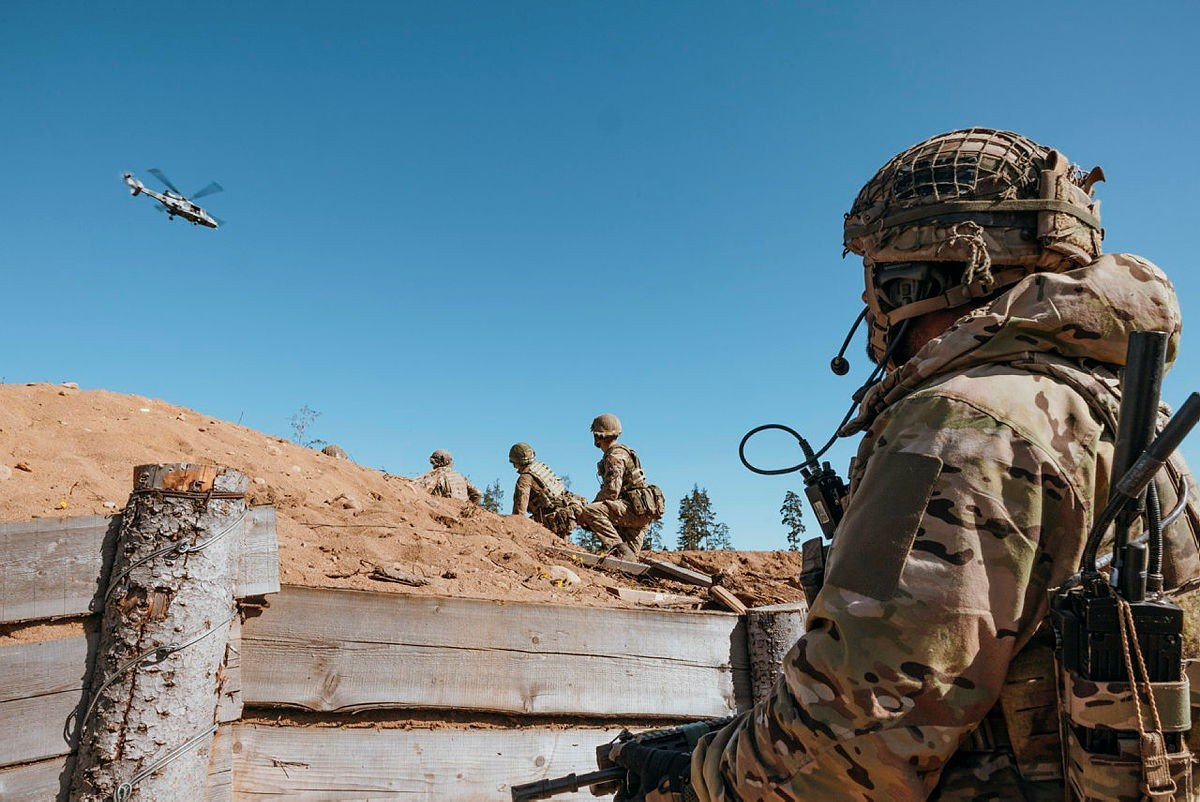

Two recent contract announcements by the UK Ministry of Defence herald a much-needed modernisation for the country’s land manoeuvre force tactical communications.
In February, Armada published an article about a thorough and detailed assessment of the United Kingdom’s failure to adequately obtain a replacement for the aging Bowman combined communications, and Command and Control (C2). Bowman is used extensively by UK land manoeuvre forces. One month earlier, another Armada article detailed the UK Ministry of Defence’s roadmap to field a Bowman replacement. The MOD is now moving at pace to overhaul the tactical communications British land manoeuvre forces rely on.
On 10th March, Persistent Systems announced its selection by the MOD to provide its MPU5 multiband tactical radios and ancillary equipment under the auspices of Project Cain. Project Cain is enhancing the tactical communications used by the British Army’s 16th Air Assault Brigade. MPU5 radios provide several wavebands in 1.35 gigahertz/GHz to 1.39GHz, 2.025GHz to 2.150GHz, 2.2GHz to 2.507GHz, 4.4GHz to five gigahertz and 5.1GHz to six gigahertz, as noted in the company’s brochures. On the same day, the MOD announced that TrellisWare will provide its TW-860 Spirit and TW-135 Shadow radios to the army. The TW-860 is also a multiband, handheld system. The transceiver covers wavebands of 225 Megahertz/MHz to 450MHz, 698MHz to 970MHz and 1.250GHz to 2.6GHz, according to the company’s official literature.

Eve Shapiro, Persistent Systems’ director of international business development, told Armada that the radios will mainly be used by the brigade’s dismounted troops, but that these will “also support wider elements of the communications infrastructure”. Matt Fallows, TrellisWare’s vice president of global business development and customer support, said that the company had already sold 800 radios to the MOD in 2025. The March order could see 5,000 transceivers eventually being supplied as “part of a much larger modernisation effort by the British Army that will end up equipping every UK soldier with a radio”.
Mr. Fallows continued that TrellisWare is supplying its TSM and Katana waveforms as part of the order. According to the company, the TSM waveform is a robust, Mobile Ad Hoc Networking (MANET) waveform carrying voice, data and position information. Katana provides long-range, narrowband voice, data and position information using a robust MANET waveform. The MPU5 radios will accommodate Persistent Systems’ Cloud Relay MANET system. Cloud Rely can use a selection of conduits such as satellite communications, cellular networking, along with conventional tactical radio links, to move Internet Protocol (IP) data across line-of-sight and beyond line-of-sight distances.
Project Cain defined
According to an April 2025 report, Project Cain is providing a digital network to 16th Air Assault Brigade. The selection of the MPU5 and Cloud Relay makes sense in this regard, particularly given the latter’s ability to handle IP traffic. The report continues that lessons learned via Project Cain will inform the wider development of the digital backbone technologies to be acquired through the MOD’s Land Environment Tactical Communications and Information Systems (LETACCIS) initiative. LETACCIS is also the initiative of which Bowman’s replacement is one part. Digital communications architectures are assuming growing importance across the UK’s armed forces given the MOD’s commitment to introduce a joint Digital Targeting Web (DTW). The DTW forms a key part of the United Kingdom’s commitment to embrace the North Atlantic Treaty Organisation’s (NATO’s) Multi-Domain Operations philosophy.
The delivery of TrellisWare’s TW-860 Spirit and TW-135 Shadow radios will give a much-needed boost to UK land manoeuvre force tactical communications. Armada understands that concerns have been voiced in the UK land forces community about the resilience of existing Bowman transceivers and networks to Russian electronic warfare. The step change provided by TSM and Katana in this regard will be palpable from an electronic protection perspective. The MOD should be commended not only for the order, but for getting these radios and waveforms into the hands of soldiers as quickly as possible. The TSM waveform is also equipping Canadian and US land forces, deepening UK interoperability with her counterparts.
That the UK now has a roadmap to update its tactical communications, in the form of the MOD’s Tactical Communications Systems contract vehicle, will hopefully ensure that UK land forces get the systems they need when they need them. Time is of the essence. Tensions between NATO and Russia are unlikely to reduce any time soon. Ensuring that the alliance’s communications and networks can survive on a future battlefield likely to be inundated with Russian jamming is paramount.
by Dr. Thomas Withington
