

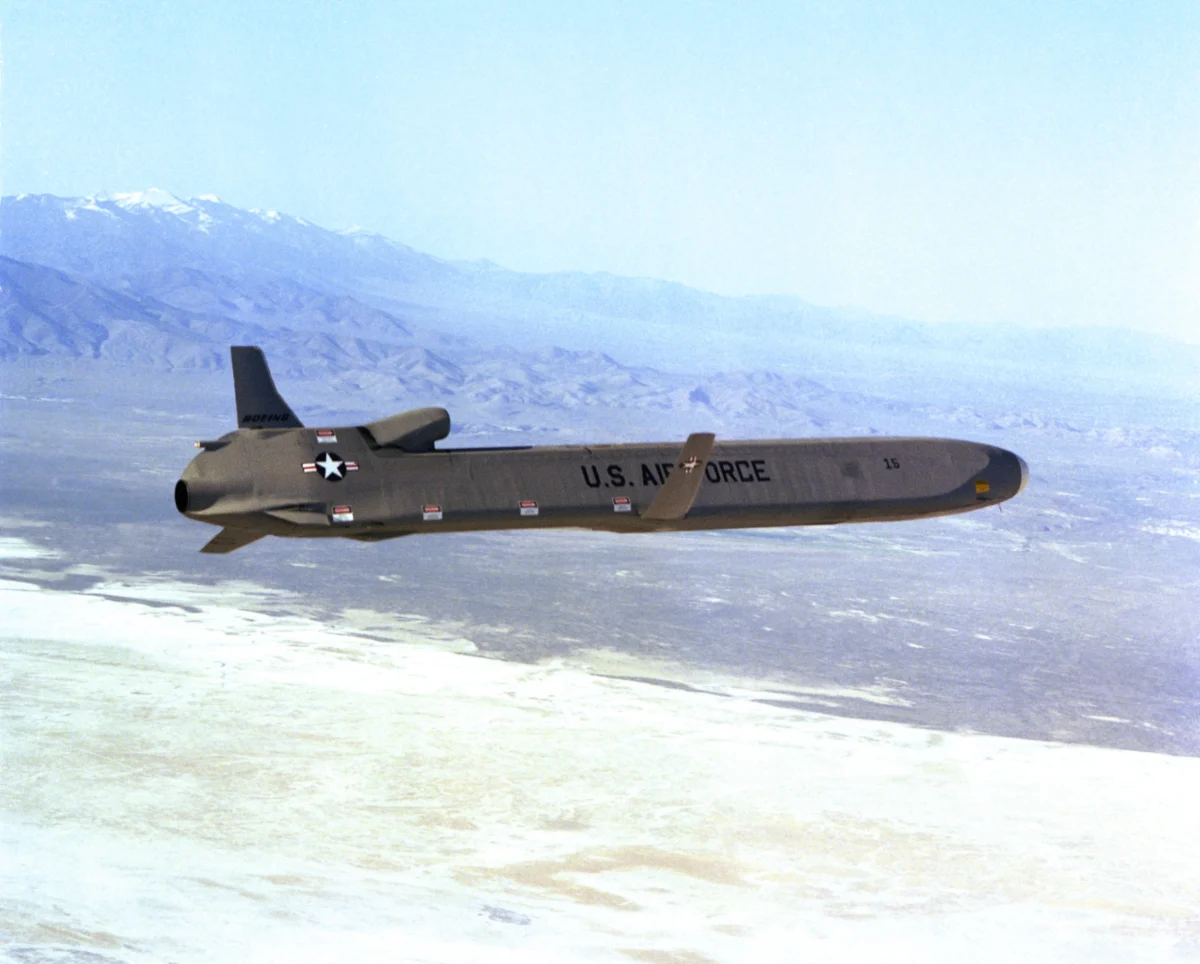
Defense Feeds, Washington — Boeing AGM-86B nuclear cruise missile sustainment was initiated on March 6, 2026, by the US Air Force Nuclear Weapons Center to extend operational life through 2033.
The effort focuses on remanufacturing critical flight control electronics including Elevon Actuator Controllers for continued bomber-based nuclear deterrence. This action maintains credible stand-off strike capability while the next-generation AGM-181 Long Range Standoff missile remains in gradual production phases.
The AGM-86B has served as a cornerstone of America’s air-delivered nuclear arsenal since entering service in December 1982. More than 1,700 units were produced across all variants, with the nuclear B variant forming the core of strategic bomber capabilities.
Boeing secured a sole-source, seven-year Indefinite Delivery Indefinite Quantity contract structured from July 2026 to July 2033 for component remanufacturing.
Electronic Component Obsolescence Drives Sustainment Need
Boeing AGM-86B nuclear cruise missile sustainment addresses failure-prone legacy electronic subsystems that have reached obsolescence after decades of operation. Original circuit card assemblies and discrete electronics installed in the 1980s no longer meet reliability requirements. The program targets replacement of all major electronic components within each Elevon Actuator Controller.
The Elevon Actuator Controller functions as the central interface between the missile’s guidance computer and aerodynamic control surfaces. This component converts digital guidance commands into electrical actuation signals controlling pitch and roll simultaneously. Failure of this critical component results in loss of closed-loop flight control, preventing the missile from maintaining programmed trajectory to target.
Each controller contains three primary circuit card assemblies that are completely replaced along with associated discrete components including power transistors, resistors, and bridge rectifiers.
The remanufactured units undergo complete teardown, component replacement, reassembly, environmental testing, and functional validation. Production is capped at 550 Elevon Actuator Controllers with a planned production rate of 94 units annually.

Technical Architecture and Flight Control Integration
Boeing AGM-86B nuclear cruise missile sustainment preserves legacy analog-digital hybrid electronic architecture rather than modernizing to contemporary systems.
The elevons are dual-function control surfaces located on the missile’s trailing edges combining elevator and aileron roles. The guidance computer continuously processes navigation inputs from terrain contour matching systems and generates actuation signals transmitted through the controller.
The missile relies on TERCOM guidance instead of pure GPS, enabling low-altitude flight profiles that reduce radar detection probability. This terrain-following capability requires continuous real-time control adjustments from the guidance system through the Elevon Actuator Controller. Any degradation in controller response time or signal fidelity directly impacts flight path accuracy and mission success probability.
Modern integrated circuit systems could replace discrete electronics, but certification and software constraints prevent complete redesign. Preserving the original architecture requires restoration of legacy components using identical form, fit, and function standards. Boeing’s Guidance and Repair Center is identified as the only qualified source capable of performing this specialized remanufacture work on nuclear-configured systems.
Operational Employment and Deterrence Role
Boeing AGM-86B nuclear cruise missile sustainment directly supports B-52 Stratofortress strategic bomber operations carrying nuclear stand-off strike capability.
The B-52G and H variants carry up to 20 AGM-86B missiles in multiple-missile configurations launched from stand-off distances outside enemy air defense engagement envelopes. This capability remains integrated into US Air Force Global Strike Command mission sets alongside other deterrence elements.
The missile carries a W80-1 thermonuclear warhead with selectable yield ranging from 5 to 150 kilotons. Launch distances between 2,400 and 2,800 kilometers allow bombers to remain safely beyond modern air defense systems while maintaining credible nuclear strike options.
The subsonic cruise speed of approximately Mach 0.7 to 0.75 enables penetrating flight profiles that enhance survivability through defensive tactics. Continued AGM-86B availability ensures the bomber fleet retains credible deterrent capability during the transition period before AGM-181 Long Range Standoff missiles become fully operational.
The sustainment program directly supports force structure continuity across bomber squadrons. Operational employment remains tied to existing training, maintenance, and deployment structures that have supported AGM-86B operations for over four decades.
