

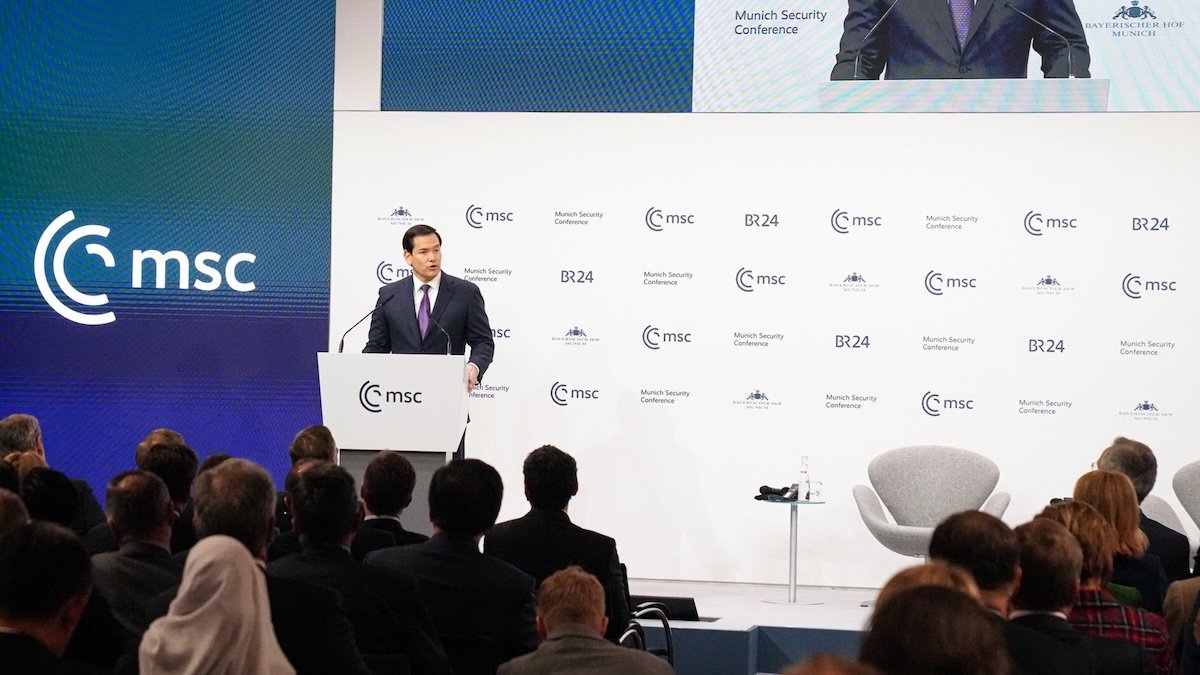
Munich was warmer than Washington this weekend, both in weather and in sentiment. Neither development was widely forecast. The sense of crisis in transatlantic relations was plain, especially on the European side, and the world descended on the Bayerischer Hof hotel to sort it all out. At the Munich Security Conference there was beer to drink, brats to eat, statements to make, and bilateral meetings to hold. February’s foreign policy freneticism kicked off in earnest.
And frenetic it was. Bilateral meetings were set at 25 minutes apiece and the most hyperactive delegates kept them shorter than that. Heads of state and foreign ministers mingled while the rest of us were jostled by their security details. One Middle Eastern official suggested a walking meeting. He and I weaved through delegations, passed the smoking section under a light rain, trudged up and down a metal staircase, and finally parted at the elevator. It was actually rather productive.
Officials from both sides of the Atlantic arrived in force. The German chancellor spoke, as did French President Emmanuel Macron, Ukraine’s Volodymyr Zelenskyy, NATO Secretary General Mark Rutte, and many more. Secretary of State Marco Rubio came to Munich, as did U.N. Ambassador Mike Waltz, Undersecretary of Defense Elbridge Colby, and Environmental Protection Agency Administrator Lee Zeldin. A bipartisan Congressional delegation attended, and other nations were well-represented: Venezuela’s Maria Corina Machado, Chinese Foreign Minister Wang Yi, and others.
That wasn’t all. A raft of possible U.S. presidential candidates summoned their inner Otto von Bismarcks, and for a moment it seemed like New Hampshire already. Rep. Alexandria Ocasio-Cortez came, as did California governor Gavin Newsom, Gretchen Whitmer of Michigan, former commerce secretary Gina Raimondo, and former Virginia governor Glenn Youngkin. No one offered to eat a fried pretzel at the Bavarian state fair, but we’re still three years away from election day. Oval Office ambitions spring eternal.
I’ve now participated in Munich for more than 20 years: a record that betrays advancing age, fondness for pretzels, and a tolerance of secondhand smoke. The zeitgeist is always different, and always illuminates the state of our world. This time, four themes struck me most.
Lord, Make me Independent, but Not Yet
Early in the proceedings, former Canadian Foreign Minister Chrystia Freeland summed up the sentiment of many there. The era of capitulation, she said, is over. No more appeasing Donald Trump, hoping that a combination of flexibility and flattery would dull the American president’s rough edges. Some European officials concurred. A year of appeasement, they said, had yielded only tariffs, threats against Greenland, and negotiations over Ukraine that leave allies out. The president belittled their contributions to the war in Afghanistan, established a new Board of Peace to end-run the United Nations, and mocked them at Davos. Nein more.
The alternative, they said, was to generate leverage, stand your ground, and increase their strategic autonomy. Derisk ties with the United States, just as Europeans have started to do with China and should have done with Russia. Europeans have seen the dangers of overdependence on America — for defense, technology, market access, investment, and weapons sales. The answer to Europe’s situation was greater self-reliance. Time to break free.
The Bayerischer Hof at moments sounded like a latter-day Independence Hall. British Prime Minister Keir Starmer said that the United Kingdom should reduce its dependencies on U.S. military capabilities. “As Europe,” he said, “we must stand on our own two feet.” Austria’s foreign minister said that “Europe has to become more independent and assume more responsibility.” The French foreign minister pledged, “We will deliver a strong and independent Europe,” and European Commission President Ursula von der Leyen said, “Europe must become more independent – there is no other choice.” In all this, finally there was something on which Europeans and the Trump administration could agree.
Except not so fast. St. Augustine was no European, but his Confessions showed that the task of conversion is difficult and riddled with inner contradictions. The same European leaders who pledged greater independence from the United States fretted openly about abandonment by Washington. German chancellor Friedrich Merz offered to “repair and rewrite transatlantic trust.” “We cannot,” he said, “guarantee our security by ourselves.” Starmer clarified his intent: “I’m talking about a vision of European security and greater European autonomy that does not herald U.S. withdrawal.” At least some European leaders seek more independence from the United States, but to avoid America becoming too independent of them.
World Order Died Today. Or Maybe Yesterday; I Can’t be Sure.
If officials on both sides of the Atlantic agree that Europe should become more self-reliant, they also concur on the state of international order. It is, many observed, dead. Departing for Munich, Rubio said that “the old world is gone, frankly.” Merz said that the post-World War II world order, “as imperfect as it was at its best times, no longer exists.” Von der Leyen referred to the “rapidly changing world order,” and delegates from the Middle East and Asia observed similarly. While it was never entirely clear what precisely each speaker meant by the notion of “world order,” nearly all were convinced that whatever it was, it is no more.
Many also said that the order undermined their countries. American officials complained that the U.S. unfairly bore the lion’s share of the burden in upholding world order. Free trade led to deindustrialization, globalization to dangerous dependencies, multilateral institutions to paralysis, and alliances to freeriding. Chinese observers, for their part, see international order as unjustly Western-dominated, with rules and institutions that do not accord Beijing and others their rightful status and standing. Indian foreign minister Subrahmanyam Jaishankar pointed out that his country has been free of alliances and a central role in many prevailing institutions all along — self-reliance for India is nothing new. In this requiem for a rules-based international order, Europeans regret its alleged demise the most.
Rubio to the Rescue!
Just as Europeans were lamenting the Trump administration’s recent turns and pledging to reduce their U.S. dependence, the secretary of state took the stage. After Vice President J.D. Vance’s barn-burning denunciation of Europe one year ago, the audience braced itself for more. This time around, however, Rubio brought honey instead of vinegar.
The United States and Europe, he said, “belong together.” America will “always be a child of Europe” and a country where Italian explorers, Spanish horses, French fur traders, British rock music, and German beer came together to help build a new nation. Their very destinies are intertwined and, as a result, Americans seek “not to separate but to revitalize an old friendship.” Trump’s criticism of Europeans refusing to fight in Afghanistan? The allies, Rubio said, “bled and died side by side on battlefields from Kapyong to Kandahar.” That “civilizational erasure” the National Security Strategy talked about? The forces pushing it “menace both America and Europe alike.” America is charting a new path, Rubio said, and “we want to do it together with you, our cherished allies and our oldest friends.” The audience rose to its feet in applause.
Other administration officials piled on: The United States is “absolutely” committed to Europe’s defense, Waltz said. Colby said that “the U.S. extended nuclear deterrent continues to apply here and to our allies. That is clear.” Ambassador to NATO Matthew Whitaker insisted, “The Americans are not leaving.” And Sen. Thom Tillis told the audience, “We’re not in a civil war with our partners and allies in Europe.”
After the initially warm reception to Rubio’s remarks, Europeans seemed split. Some welcomed the change in tone, hoping it augured a new and more sober era in transatlantic diplomacy. Others warned their continental brethren not to be so naïve. The substance of the administration’s approach remains the same, they observed, even if the rhetoric is friendlier. After all, the secretary of state expressed a desire to work with Europe, but added that “we are prepared, if necessary, to do this alone.” The administration wants a changed Europe.
Here, There Be Dragons
Delegates in Munich generally concurred that a new, more uncertain and more dangerous world lies ahead. The post-1945 world order might be ending, but the war in Ukraine is not. Nor are trade wars, economic coercion, great power competition, U.N. paralysis, the possibility of new attacks on Iran, technology disputes, and much else. The near-universal response is to beef up national insurance plans.
Geopolitical insurance policies — higher defense budgets, multiple relationships with differently aligned powers, diversified trade partners and sources of investment, small coalitions to manage issues and crises, reduced risk in weapons suppliers, and more — are newly attractive and very pricey. The attempts to buy down risk in some areas may generate it in others. But the trend is clear already.
Sweden, Norway, Germany, and the Netherlands, for example, have held talks about an independent European nuclear deterrent, possibly built on France’s force de frappe. “Nuclear deterrence can give us new opportunities,” Latvia’s Prime Minister Evika Siliņa said in Munich. “Why not?” Speculation abounds that Macron may extend the French umbrella to other European countries in a speech he has planned for March. And nuclear deterrence is just one dimension of the full-coverage insurance plans countries increasingly seek.
Order On, Dear Friends
The conference began with Europeans claiming an unprecedented crisis in transatlantic relations. After Greenland, questions about Article Five, tariffs and all the rest, the trust, they said, is gone. The allies have never faced such a profound sense of division.
There indeed is much trust eroded across the Atlantic, but the allies have seen major crises before and endured despite them. Suez, France’s withdrawal from NATO’s integrated military command, the Vietnam War, the deployment of Pershing II missiles to Europe, and the invasion of Iraq: All those episodes generated genuine crisis. Observers say that this time is different. But many said that before, too. Things that are rotten tend to collapse under pressure. Things that have value tend to endure. The transatlantic security, economic, and political partnership has value, and it will endure.
At the same time, the allies would be mistaken for confusing a change in tone for one in philosophy. The secretary of state’s speech gave a generally warm and welcoming address, amplified by other senior officials. The Trump administration is proposing deeper friendship with Europe, but on new and different terms. Washington wants an end to mass migration, to reduce its financial burdens and increase its barriers to trade, to negotiate directly with Russia without Europe, to preserve a form of Western civilization that emphasizes Christian traditions, and to employ its power unconstrained by outdated norms and institutions and instead in accordance with the judgment of the president. It’s not clear that Europe wants any of those things.
The upshot is that major cleavages will endure between the United States and Europe. But the transatlantic partnership will remain as well, weakened and less predictable. And it will all take place against a backdrop of global uncertainty, with international behavior less constrained today than in decades. The United States should seek a Europe that is more capable, to be sure. But U.S. leadership and a degree of European dependence has, for all its downsides, kept the peace for 80 years. We might well miss it if it’s gone.
A year is a long time in today’s geopolitics. Next February, Munich will come around again. The issues will be difficult. Relationships strained. The future unclear. But there will be beer, schnitzel, and conversation. At least we can hold on to that.
Richard Fontaine is the chief executive officer of the Center for a New American Security.
Image: U.S. Department of State via Wikimedia Commons
