

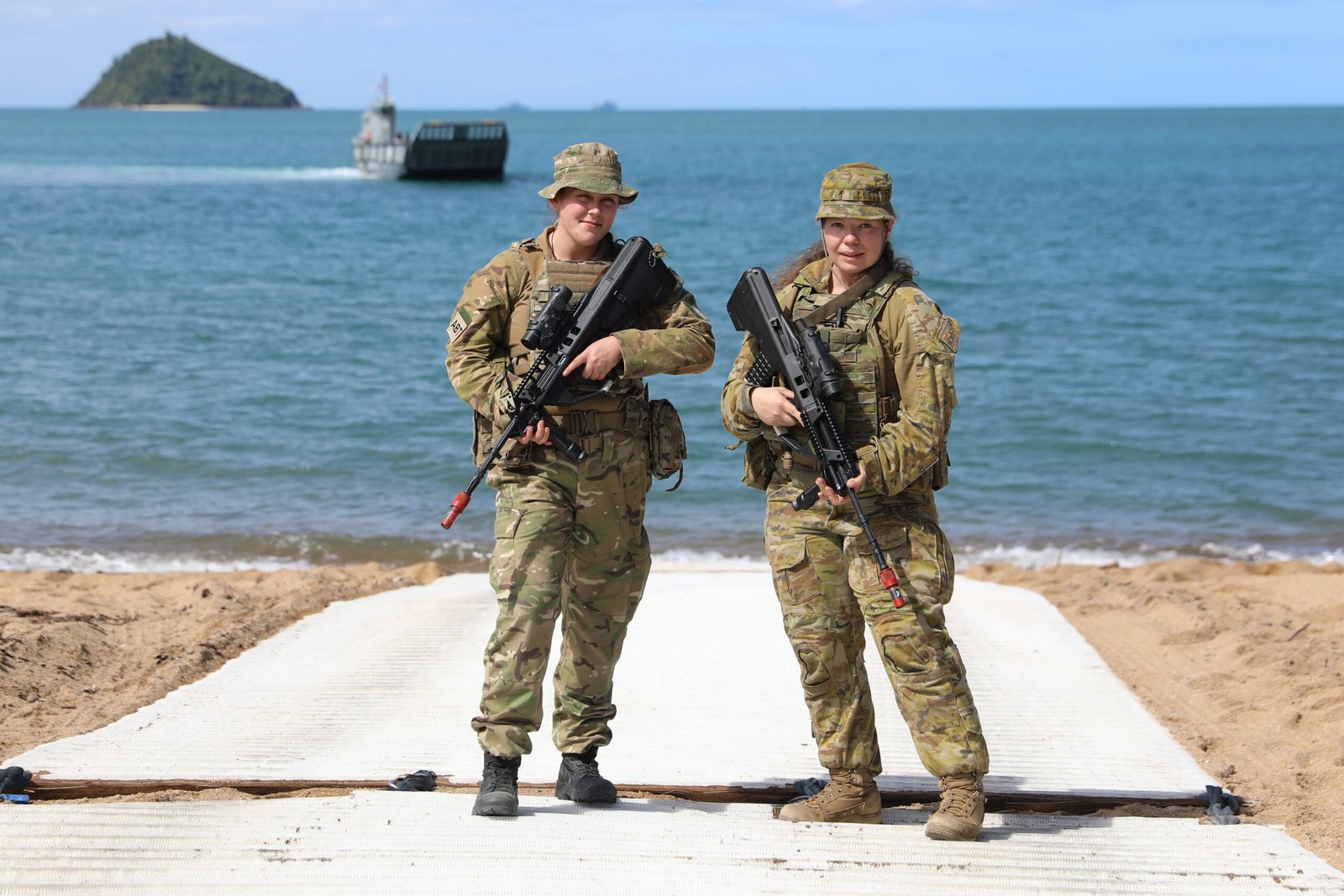
ANZAC partners Australia and New Zealand held foreign and defence ministerial consultations in Canberra on 17 March, with one outcome being a decision to forge even closer military ties.
Australia’s Minister of Defence Richard Marles and New Zealand’s Minister of Defence Judith Collins operationalised the alliance with what they called the Anzac 2035 Vision.
The aim of the vision is to be “able to operate seamlessly as an increasingly integrated, combat-capable Anzac force by 2035, while remaining respectful of our status as two sovereign countries”. Work has already been well under way to deepen interoperability and interchangeability, including through common procurement and development of platforms and systems.
The statement said the two defence forces “will be force multipliers for each other and combine our military forces in defence of our sovereignty, shared interests and common values and territory”.
Anzac 2035 Vision comprises six lines of effort.
The first line of effort is force posture activities so that the Australian Defence Force (ADF) and NZ Defence Force (NZDF) enjoy enhanced abilities to train and operate from each other’s territory. By 2035 they will be holding rotational activities, scope ways to increase participation in each other’s activities, and have set up an Australia-NZ Force Posture Working Group to develop recommendations.
Secondly, the allies will conduct increasingly complex combined operations and exercises in the Indo-Pacific region to help deter potential threats and promote stability. This encompasses combined mission planning, combat readiness and synchronisation mechanisms, including embedded staff in opposite headquarters.
Currently, for example, the second-in-command of Australia’s Joint Operations Command is a Kiwi, and an Australian is the equivalent in NZ. Exercise Talisman Sabre forms part of this effort too.
The two nations said they will “procure and employ common and complementary capabilities on our exercises and operations”. Commonality has already been seen in NZ’s decision last year to purchase MH-60R naval helicopters.

The statement lumped the next three lines of effort together. Specifically, they include force preparedness, resilience and defence industry integration. In order to sustain military operations over time, self-reliance and cooperation are both important.
By 2035, the two will reduce barriers to defence industry participation in each other’s territories, and enhance resilience in sovereign industry bases and supply chains. Shared logistics and sustainment for equipment such as P-8As and C-130Js is part of this, as this will provide redundancy. The statement promised to “optimise collective training, education, exchanges and attachments to focus on common operating platforms”.
The sixth and final line of effort is Pacific security. “Our security is inextricably linked with the security of the broader Pacific region. Recognising our shared geography and the importance of our defence relationships with our Pacific partners, we will continue to support combined operations and exercises in the Pacific,” declared the joint statement.
By 2035, the two nations will have increased defence force interoperability, including a Pacific Response Group acting as a regional asset for more efficient co-deployments in a time of crisis, such as a natural disaster. They also pledged to bolster regional maritime security.
The latter is an important point, as Canberra and Wellington have been alarmed at the diplomatic and security inroads that China has been making in the South Pacific. For example, Beijing has concluded a security agreement with Solomon Islands, and its naval vessels often visit places such as Vanuatu.
China adamantly says it does “not interfere in the internal affairs” of other countries. However, it broke its self-proclaimed policy when the Chinese Embassy in Wellington accused the two countries of “inexplicable colonial-style arrogance” after the foreign and defence ministerial consultations.

Beijing was particularly unhappy with the two defence ministers raising concern about “intensification of destabilising activities and instances of unsafe and unprofessional behaviour by China in the South China Sea”. For instance, a Chinese naval helicopter approached dangerously close to an Australian MH-60R in the Yellow Sea on 4 March, forcing the latter to take evasive action.
The Chinese Embassy complained: “A small number of extra-regional countries have travelled vast distances to the South China Sea to engage in shows of force and deliberately stoke tensions under various untenable pretexts, thereby serving as a primary source of instability in the region.”
Then again, a Chinese naval task group sailed through the Tasman Sea in early 2025. The ships performed live gunnery, forcing dozens of commercial flights to take avoiding action. Some might throw China’s words back at it and say “an extra-regional country travelled vast distances to the Tasman Sea to engage in shows of force and deliberately stoke tensions”!
by Gordon Arthur
