

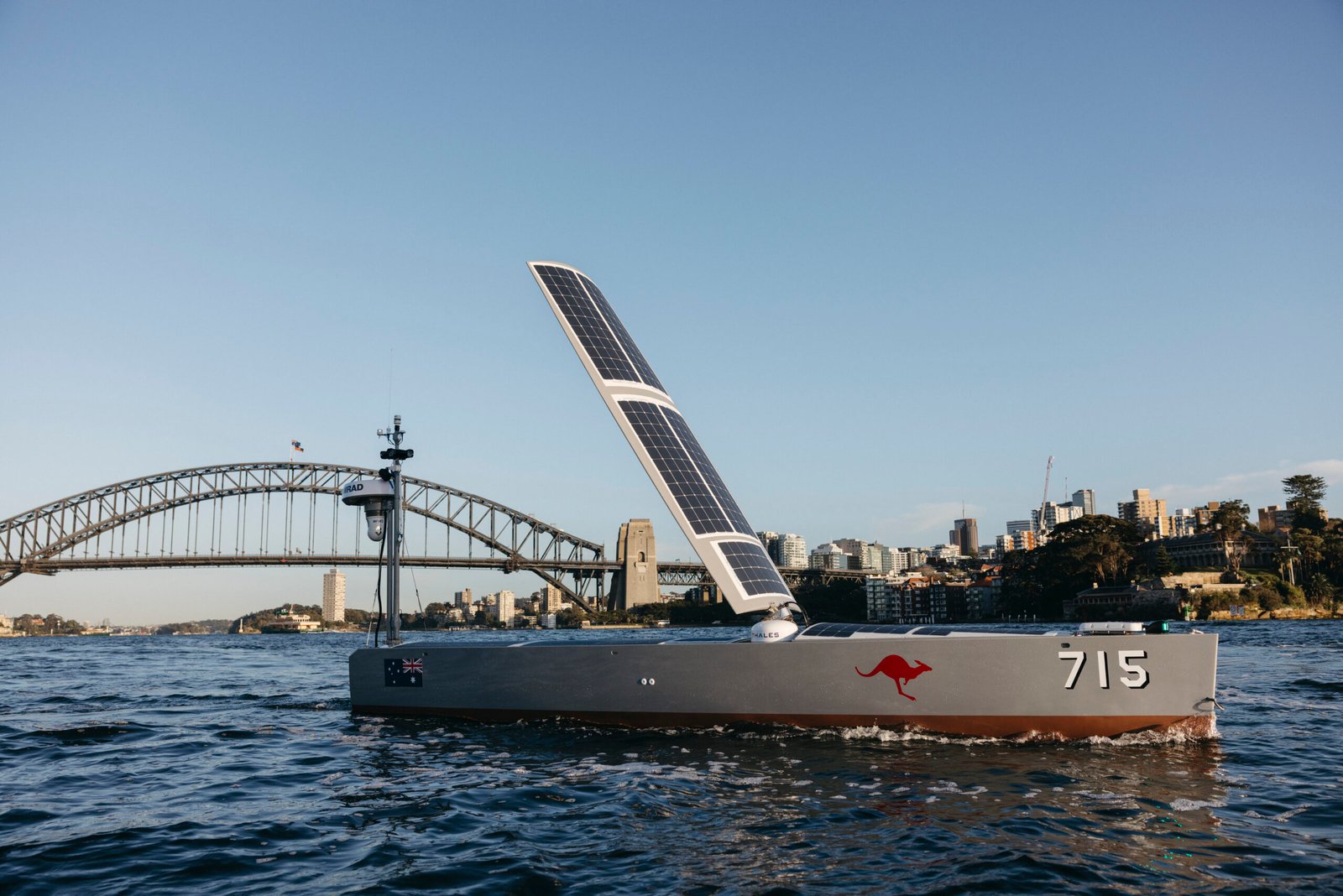
Australia will expand its fleet of Ocius Technologies Bluebottle unmanned surface vessels (USV) from 15 to 55, following the award of a five-year, A$176 million (US$138 million) contract to the company.
The Australian Department of Defence said the programme will strengthen the country’s “long-range intelligence, surveillance and reconnaissance capability across Australia’s vast maritime domain”.
The Bluebottle uses renewable energy sources to power the vessel, enabling long-endurance operations. Equipped with a keel winch, the USV can lower sensors below the surface, including payloads suited for anti-submarine warfare tasks. The platform can carry a 300kg mission payload for persistent maritime surveillance missions.
These “satellites of the sea”, which currently spend an average of 75 days at sea per mission, will be built at a production facility in Sydney. They have the ability to deploy thin-line sonar arrays too, which can detect submarines.
In 2025, Ocius also introduced the Bluebottle Hybrid variant, which incorporates a diesel engine to supplement renewable power and to provide greater operational flexibility.
Collaboration between Australia and Ocius began as early as 2018 and, by 2025, 15 systems had entered service with the Royal Australian Navy (RAN).
The navy operates the newer 24-foot variant, with these deployed from Darwin to monitor Australia’s northern approaches under Operation Resolute.
“Ocius Bluebottle uncrewed surface vessels will provide the Australian Defence Force with flexible, persistent and capable long-range intelligence, surveillance and reconnaissance,” said Rear Admiral Stephen Hughes, Head of Navy Capability.
“The Bluebottle provides operational advantage and flexibility, being able to carry multiple modular payloads for multiple missions. These vessels can autonomously monitor designated areas for extended periods in dangerous and harsh maritime conditions,” he added.
Beyond Australia, the New Zealand Defence Force and NZ Customs Service operationalised two Bluebottle USVs in 2025 for maritime security missions.
Japan has also expressed interest in the capability, as regional militaries expand their use of autonomous systems to enhance their often vast maritime interests.
by Chen Chuanren
