

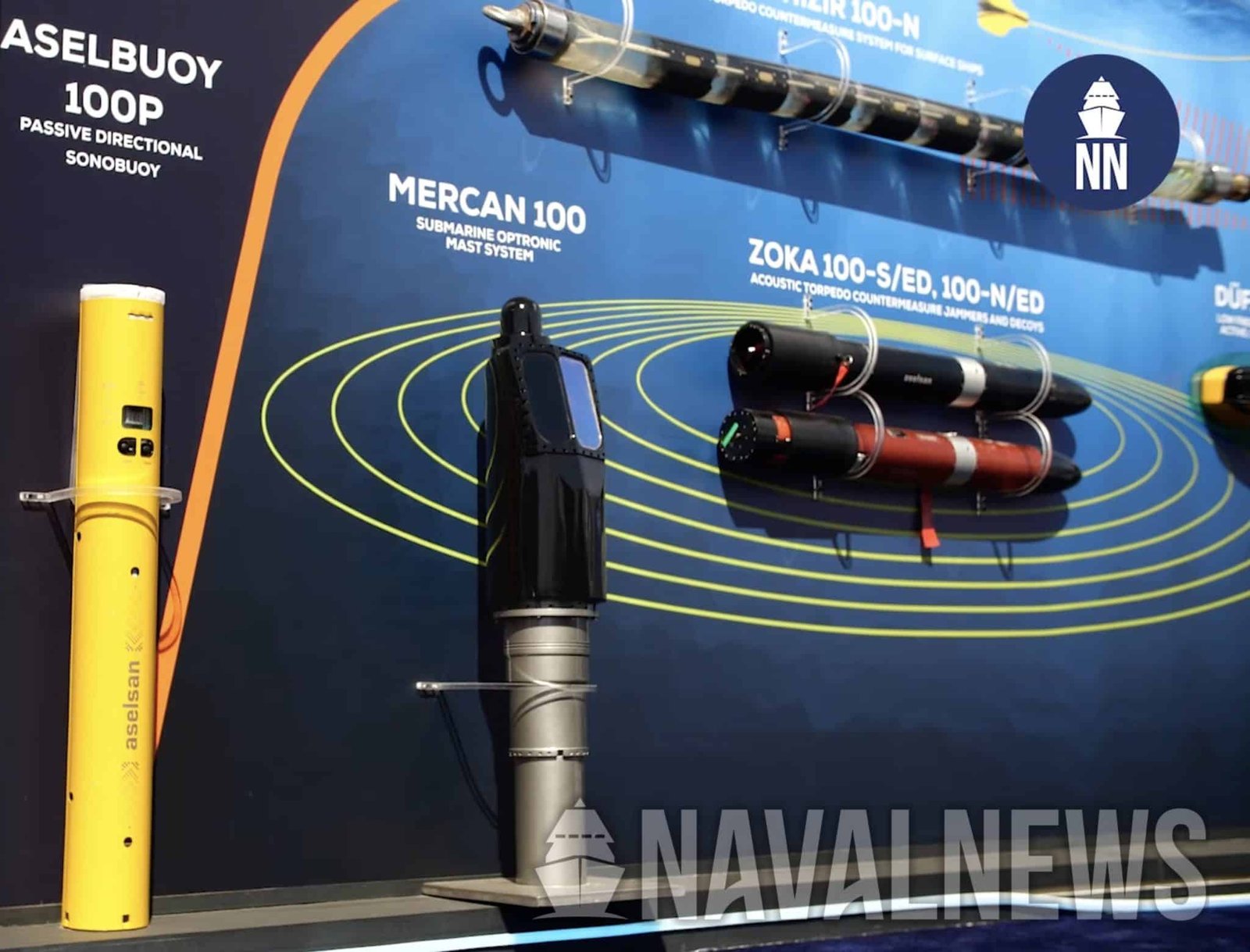
Aselsan will conduct the first live tests of the aselBUOY passive sonobuoy from an unmanned aerial vehicle in the coming weeks. The information comes from Aselsan’s CEO Ahmet Akyol in an interview with Naval News during World Defense Show.
Speaking to Naval News at the World Defense Show 2026 in Riyadh, Mr Akyol said the UAV integration is currently in the testing phase and results will be visible soon.
The announcement marks a new phase for the aselBuoy program, which has been in development for approximately ten years. According to Akyol, all initial tests and development activities have been completed, and the system entered serial production earlier this year after Aselsan signed its first production contract with the Turkish Naval Forces Command. Akyol also mentioned that Aselsan will integrate Aselsan-made launching pods to the Turkish UAVs to launch deploy the sonobuoys.
AI acoustic signature center
During the interview, Aselsan’s CEO revealed an important aspect of the company’s underwater systems development: An AI center is currently being set up in cooperation with the Turkish Navy to implement domain-specific artificial intelligence models for underwater systems. He noted the challenge of obtaining big data in underwater environments and explained that Aselsan is working directly with the Turkish Navy to collect acoustic data, train machine learning models, and then implement these models into their acoustic solutions.
This collaboration addresses one of the key challenges in developing AI-powered underwater detection systems—the need for large datasets of real-world acoustic signatures from various submarine and surface vessel types, under different sea conditions and environments. The Turkish Navy’s operational data provides the training material necessary for developing more accurate detection and classification algorithms.
Technical background of the aselBUOY project and future aspects

The aselBUOY 100P is a NATO A-size passive directional sonobuoy designed for anti-submarine warfare, search and rescue operations, and underwater acoustic research. The system measures 915mm in length, 120mm in diameter, and weighs 10kg. It operates in the 5-2400 Hz frequency band and can be deployed at two different depths: 30 meters and 150 meters.
Once deployed, the sonobuoy transmits acoustic data to receiving platforms using one of 96 VHF communication channels (136-173.5 MHz) with a communication range of up to 20km. Operators can program the system’s operating time (0.5, 1, 2, 4, or 8 hours) and other parameters before deployment through an electronic interface. The settings can also be adjusted remotely after launch. The system is expendable and self-scuttles at the end of its programmed operating period.
Aselsan began developing the aselBUOY in late 2015 as a self-financed project, building on its underwater acoustics work that started in 2006. Initial air-launch tests were conducted in 2018 using a launcher mounted on a Cessna turboprop aircraft. The system is designed for deployment from multiple platforms, including maritime patrol aircraft, UAVs, unmanned surface vessels, and surface ships.
The upcoming UAV integration tests represent a shift in how sonobuoys can be deployed. Traditional deployment methods rely on dedicated maritime patrol aircraft, which require significant operational costs and resources. By integrating sonobuoys with UAVs, operators can conduct anti-submarine warfare missions with smaller, more cost-effective platforms. Currently, Turkish Aerospace has been working on the ASW (anti-submarine warfare) version of AKSUNGUR UCAV, and the drone fitted with pods has been showcased at several exhibitions since 2021.
Mr Akyol characterized the UAV integration as a “game-changer” for the naval domain, noting that it would make maritime patrol activities more cost-effective and efficient in detecting underwater systems. The integration involves Aselsan’s specialized sonobuoy pod designed for UAV platforms.
Aselsan is one of a limited number of companies globally with the capability to design and manufacture sonobuoys. The company has positioned the aselBUOY as part of its broader naval systems portfolio, which includes various underwater acoustic systems and sonar technologies.
In addition to the passive version currently in production, Aselsan has also been developing an active sonobuoy variant intended for detecting passive and silent submarines, though specific details about that program’s current status were not discussed in the WDS 2026 interview.
The upcoming live dropping tests from UAVs will provide the first real-world data on how the system performs when deployed from unmanned platforms, including deployment dynamics, parachute performance, and operational integration with UAV systems.

