

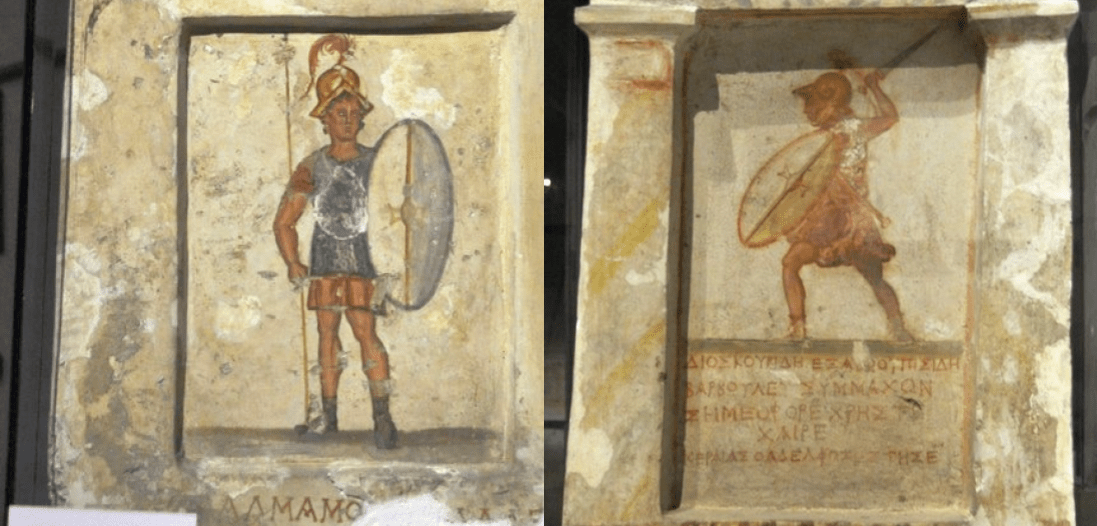
This week we’re going to take a look at mercenaries in the ancient Mediterranean world! This was one of the runners-up in the latest ACOUP Senate poll, coming out of quite a few requests to discuss how mercenaries functioned in antiquity. In order to keep the scope here manageable and within my expertise, I am going to confine myself to mercenaries in the Classical (480-323) and Hellenistic (323-31) Mediterranean, but we’ll have more than enough to talk about within that framework.
Mercenary soldiers make frequent appearances in our sources for these periods and as a result also are often prominent in modern representations of warfare in the ancient Mediterranean, showing up, for instance, as a standard feature of strategy games (Rome: Total War; Imperator, etc.) set in the period. That said, while our sources often note the presence of mercenaries, the actual mechanics – who serves, how are they recruited, how are they paid and so on – are often more obscure (though not entirely so!). So that is what we are going to focus on here, not an exhaustive list of every known mercenary outfit in antiquity (you can consult the short bibliography below for that) but rather an outline of the subject with a focus on mechanics.
I do want to note there are two things I couldn’t fit in here. The first was a complete discussion of the Carthaginian army and the different soldiers who served in it. We’re going to do that, but not here and not right away (this year, though, I think). The second is that I do not really get into here how specific mercenary troops fought – Tarantine cavalry tactics, Cretan archery, thureophoroi and so on. We’ve discussed some of that, actually, in our treatment of Hellenistic armies, but the rest of it will have to wait for another day. In my defense, this post is already 7,600 words long.
But first, as always, if you like what you are reading here, please share it; if you really like it, you can support me on Patreon; members at the Patres et Matres Conscripti level get to vote on the topics for post-series like this one! If you want updates whenever a new post appears or want to hear my more bite-sized musings on history, security affairs and current events, you can follow me on Bluesky (@bretdevereaux.bsky.social). I am also active on Threads (bretdevereaux) and maintain a de minimis presence on Twitter (@bretdevereaux).
(Further Reading Note: For a very long time, the standard references on this topic were H.W. Parke, Greek Mercenary Soldiers from the Earliest Times to the Battle of Ipsus (1933) and G.T. Griffith, The Mercenaries of the Hellenistic World (1935). These days, Parke has largely been replaced as a reference by M. Trundle, Greek Mercenaries: from the late archaic period to Alexander (2004), while Griffith remains the standard reference for mercenary service in the Hellenistic period. For a somewhat broader but still Mediterranean focus, S. Yalichev, Mercenaries of the Ancient World (1997) offers a lot of coverage. Note also S. English, Mercenaries in the Classical World to the Death of Alexander (2012), which is one of those examples of a quite solid book languishing as a Pen & Sword title; I’d say Trundle is to be preferred to English, but the latter is by no means bad – I detected no great or terrible errors in it and it may be easier to get a hold of.)
Defining Mercenaries
However before we can even dive into outlining mercenary service in antiquity, we need to clarify exactly who we mean when we discuss mercenaries. One of the challenges in discussing mercenaries is that some of our sources – most notably Polybius – are deliberately slippery with their use of terms. As a result, it is often very easy to end up in a situation where a translation (faithfully translated!) describes a given set of soldiers as ‘mercenaries’ who are not, by modern definitions, mercenaries at all! Indeed, much of the notion of ‘mercenary armies’ evaporates when we actually investigate the conditions under which many of these so-called ‘mercenaries’ were recruited.
The primarily culprit here is a Greek word, μισθοφόρος (misthophoros), which is often translated as ‘mercenary’ and indeed had that meaning in antiquity, but our sources – again, particularly Polybius – play fast and loose with the broad meaning of the term and the narrow meaning. The narrow meaning of misthophoros is that of a mercenary soldier – a soldier serving purely for pay with no real attachment to the state they fight for – but the broad meaning is its literal one: ‘wage-bearing’ (a μισθός being a wage, distinct from σίτος or σιτώνιον, both literally “bread [money/supply]” and thus ‘basic maintenance’ – μισθός is pay in excess of basic maintenance). So while a misthophoros could be a foreign mercenary serving for pay – that misthos – they could equally be a domestic soldier who, for whatever reason, was paid a wage.
When we think of mercenaries, we generally think of foreign soldiers fighting for a country for the sake of money, rather than any commitment to the cause. Greek authors can easily make this clear by describing soldiers as ξενικός, (xenikos, ‘foreign’), but they often don’t or blur these categories. The issue is that, of course many soldiers who are not mercenaries might still be paid a wage in excess of basic maintenance.
And that brings us to Polybius, the worst offender in the ‘fudging the definition of mercenaries’ category. Polybius is famously the source for the claim that Carthage’s armies were both “foreign” (xenikos) and “mercenary” (misthophoros). Generations of readers and scholars have carelessly accepted that description but it is fundamentally a deception. This isn’t the place to fully describe the Carthaginian military system (I discuss this more in my book project!) but the backbone of Carthaginian armies were infantry drawn from Carthage’s North African territories. Polybius is happy to describe these fellows as misthophoroi and let his readership follow his lead into assuming the narrow (‘mercenary’) definition, which is wrong, rather than the broad definition (‘wage-bearing’) where he is accurate.
Polybius rarely lies to your face, but he absolutely bends words and facts to make his arguments seem more plausible. In particular, Polybius is looking to set up a contrast between what he views as the inferiority of Carthage’s ‘mercenary’ armies as compared to the martial excellence and moral purity of Rome’s armies of citizen soldiers. So he wants to emphasize the mercenary nature of Carthage’s armies and minimize the same about Rome.
But here’s how those North African troops were organized. Carthage had expanded its control over many communities in North Africa and evidently alongside the taxes they had to pay to Carthage, part of subordination was that they were liable for conscription. When Carthaginian generals raised armies, after enrolling any Carthaginian citizen volunteers, they would head out into Carthage’s African subject communities and conscript troops (ἐπιλέγειν, ‘to pick out’) from these communities. These conscripts were then evidently paid a wage for their service and seem to have functioned something like semi-professional forces, often serving on quite long campaigns. These are not mercenaries by our definition! They are not foreign, but rather subject communities being conscripted from within the territory that Carthage controlled – not very different from how Rome raised the forces of the socii (the main difference being Rome made the socii communities pay their soldiers; Carthage taxes its subjects and then pays the soldiers out of those taxes).
Likewise, we know that early on in Carthaginian history, the Carthaginians recruited Iberian soldiers – men from the Mediterranean coast of Spain – as mercenaries for their armies. Fair enough. But by the Second Punic War (218-201), Carthage – or more correctly the Barcids – control the Iberian homelands in Spain. The Barcids – Hamilcar, his son-in-law Hasdrubal the Fair and biological son Hannibal – have moved in with an army, defeated the locals and set themselves up essentially as ‘warlords of warlords’ in a non-state military hierarchy. So when Hannibal and his brother Hasdrubal (different Hasdrubal) raise absolutely massive numbers of Iberians to fight for them, these aren’t mercenaries either, but the native military forces of what are essentially Hannibal’s vassal warlords (what the Romans term reguli, ‘petty kings’). At this point, these Iberians are forces again internal to Carthage’s empire.
Meanwhile Hannibal’s Gauls are also mostly not mercenaries but rather they understand their polities to be allies of Carthage in a joint war against Rome which Hannibal is leading, something made clear in the treaty Carthage makes with Philip V of Macedon, which specifies these allied forces. Under that framework relatively few of Carthage’s soldiers in the Second Punic War are actually mercenaries! Instead, Carthage’s army is a patchwork of subject-community conscripts, local allies, vassal levies and troops raised by individual generals through personal relationships – a system that is more akin to the Roman army than any other force in the Mediterranean.
But saying that does nothing for Polybius’ arguments either about Roman martial virtue or his glorification of the Roman citizen-soldier ideal (which one rather gets the impression he thinks the Greeks back home ought to adopt), so he – without ever quite lying – lets the reader believe Carthage’s armies are mostly mercenaries and this is why they are less effective in the field (Polyb. 6.52). It’s a definitional fudge to heighten the contrast.
It isn’t even the only time Polybius plays this trick! In his description of the Ptolemaic army at the Battle of Raphia, Polybius (5.65.6) groups together the cavalry ‘from Greece’ (actual mercenaries from Greece hired by the Ptolemies) with the ‘mercenary [misthophoroi] cavalry’ in a single unit, making it sound like this is a single unit of mercenary cavalry from Greece and elsewhere. But in fact the misthophoroi hippeis, ‘wage-bearing cavalry’ are a well-attested unit of Greek-speaking military settlers in Egypt serving as cavalry. Polybius’ narrative is one in which the moribund Ptolemaic army is whipped into shape but a set of mercenary Greek commanders (Polyb. 5.63.8-14), a fresh infusion of Greek martial spirit into the army and this fudge lets him make it seem that while the ‘native’ (Macedonian) Ptolemaic cavalry on the left was wholly defeated it, the battle was won by the – he will let the reader understand incorrectly, mostly mercenary – cavalry on the right, when in fact much of the cavalry on the right is also ‘native’ Greek-speaking cavalry from Egypt.
In practice, Ptolemaic victory at Raphia seems to depend a lot more on the fact that, having at last incorporated native Egyptians into the phalanx, the Ptolemies arrive on the field with almost twice as many heavy infantry phalangites as the Seleucids, forcing Antiochus III to try to oppose the Egyptian phalanx with much lighter forces, to his misfortune.
The result of all of this is we need to be quite careful about how we define ‘mercenaries’ in ancient armies, since our sources are very slippery with their terms, sometimes willing to term any soldiers paid a wage beyond basic maintenance – even if native to the state they fight for – mercenaries. In particular, when we say mercenaries, we mean soldiers recruited from outside a given state, serving for pay. That is to say, these are not domestically recruited professional soldiers (like the legions in the Roman imperial period) or domestically recruited non-citizen auxiliaries (like the imperial Roman auxilia or Egyptians in the Ptolemaic army) or allied forces fighting in an army because their own state is a party to the conflict (like Hannibal’s Gauls or Eumenes II’s Pergamon troops at Magnesia) or vassal levies present because their own polity is subordinated to the main party in the war (like the Roman socii or Hannibal’s Iberians). All of those soldiers are notionally fighting for the state to which they belong. We want soldiers fighting purely for money, for a state to which they do not belong.
That said, there were absolutely mercenaries by this definition in service in the ancient Mediterranean, so lets talk about them!
Early Mercenaries
Our evidence for mercenaries in broader ancient Mediterranean world prior to the Classical period is quite thin, but certainly suggests – as we’d expect – that the profession is an old one, perhaps as old as the state itself. We have evidence, for instance, of foreigners on the standing royal guard of Sargon of Akkad (r. 2334-2279), including a unit of Amorites (a foreign people), which would seem to suggest the hiring of mercenaries even at this early point. We can’t be certain why Sargon resorted to foreign soldiers, but it may well have been the same reason that many kings through history maintained foreign, mercenary bodguards: a guard of foreign mercenaries would lack any political connections, making them notionally entirely reliant on the king for their status and thus more loyal. Likewise we have some evidence from the Old Kingdom onward of Nubians in Egyptian military service who were probably mercenaries and even a tomb inscription commemorating an Egyptian Harkhuf who brought back – among other goods – mercenaries for the Egyptian King Merenre Nemtyemsaf I (r. c. 2300) from his trade expeditions into Nubia, an early mercenary-recruiter.
Greeks seem to have served as mercenaries across the Eastern Mediterranean from an early point as well – we have evidence for Ionian Greeks, seemingly on mercenary service, in Babylon and for Greeks in Egyptian mercenary service by the seventh century. We often cannot see these early mercenaries very well – their terms of service, methods of recruitment and so on are obscured to us by the limited evidence – but they serve as a useful reminder that mercenary service was not invented in the Classical period (480-323) when it becomes increasingly visible to us.
That said, I want to focus on how ancient mercenaries might function in the Classical (480-323) and Hellenistic (323-31) periods because this is where my expertise is best.
Recruiting Mercenaries
The first thing that is worth stressing here is that we shouldn’t think of the ancient Mediterranean world in either the Classical or Hellenistic periods as having something like a single linked ‘mercenary market’ that all states had access to. Instead, mercenary recruitment was generally highly localized, with each state having access to different regional ‘pools’ of manpower they could hire. This limitation is somewhat obscured by the tendency both in our sources and in modern scholarship to focus on Greek mercenaries, which can be somewhat deceptive simply because the Aegean ‘mercenary market’ was the one that almost every central or eastern Mediterranean state had some access to. But this is just a complicated way of saying that the states which had contact with Greece (and thus are of concern to our Greek sources) had contact with Greece (and were thus able to contract mercenaries there).
There is a tendency in the popular imagination to image mercenaries functioning as an entirely separate ‘pool’ of manpower from ‘regular armies.’ That is how they function in most strategy games, for instance. But in practice, of course, the supply of men in any of these societies able to equip themselves to fight – something that demanded either a degree of wealth or social standing – was always limited. A ruler recruiting mercenaries was thus reaching into the ‘manpower pool’ of other polities, sometimes in similar ways to how those polities would themselves have recruited their residents. So the question here is essentially how does a leader gain access to the military manpower supply of a foreign polity?
In practice there were two main methods. The first and easiest was through diplomacy: a ruler might, because they already had an existing diplomatic relationship with another power, be able to negotiate access to the military population (however composed socially and economically) that their friendly neighbor controlled. For most of the Classical period in particular, friendship with Sparta acted as the key that unlocked access to Greek mercenaries from the Peloponnese – with various Mediterranean powers being relatively eager to hire Greek mercenaries presumably because the Greek style of heavy infantry combat had proved quite effective during the Greco-Persian Wars (492-478).
Thus for instance in 380, when both Egypt (under the Pharoah Hakor (r. 392-379)) – having revolted from Persian control in 404 – and the Persians were seeking Greek mercenaries, they both courted Athens for access to them: the Egyptians reached out to the Athenian general Chabrias to command a force for them and the Persians responded by sending envoys encouraging the Athenians to recall Chabrias and instead send the general Iphicrates to put together a force for them (Diod. Sic. 15.29.1-4). Likewise, when the Egyptian king – Egypt having revolted from Persian control in 404 – Nectanebo I (r. 379-360) wanted to raise a force of Greek mercenaries in c. 361 he did so directly through one of the Spartan kings, Agesilaus II (Xen. Ages. 2.28-31). This was hardly only a game for non-Greeks: Dionysius I, Tyrant of Syracuse (r. 406-367) used his friendly relationship with Sparta to enlist substantial numbers of mercenaries from the Greek mainland to supplement his Sicilian-Greek army (Diod. Sic. 14.44.2).
The above, of course, is hardly an exhaustive list. That said, as you might imagine, it is often really tricky to separate this kind of mercenary recruitment – where the mercenaries are sometimes coming under the leadership of a ‘mercenary captain’ who is also a political leader in another state – from allied or vassal forces. I keep saying we need to discuss the Carthaginian army another time (we will, I promise), but Carthage recruits this way all the time, with Carthaginian generals maintaining friendly relationships with Numidian princes or Iberian warlords who they can then call upon for soldiers – the line between a mercenary force, an allied force or a vassal force gets extraordinarily blurry in these sort of situations. You have some clear examples of mercenaries drawn up this way – the 4,000 Celtiberians raised by Hasdrubal Gisco, for instance are clearly external mercenaries (Polyb. 1.67.7), the Celtiberian Meseta being outside of Carthage’s political control – but other examples, like the 2,000 Numidians Hamilcar Barca gets in exchange for a pledge to marry his daughter to the Numidian prince Naravas seem to be more allies-and-vassals than mercenaries (Polyb. 1.78.1-9).
Those lines can even blur over time: early on Carthage is sending ambassadors to Spain to negotiate for mercenaries using trade goods (Diod. Sic. 13.44.6, 13.80.2) in what is clearly the sort of mercenaries-recruited-through-diplomacy relationship, which appears to be how Carthage recruits Iberians at least through 241 (Polyb. 1.66-7). But then of course the Barcids go and conquer the place and so post-237 the Iberians we see in Carthage’s army – probably the largest single manpower source in the Second Punic War (218-201) – are not external mercenaries but rather internal vassal levies, raised by local warlords who have been subjugated by the Barcids.
Again, I promise we’ll talk about Carthage’s military machine in detail. Later.
For leaders who could not take the expedient of recruiting mercenaries directly through the state apparatus like this, the alternate method was to recruit mercenaries through the dispatch of a ‘mercenary captain,’ though I should be clear that ‘mercenary captain’ was not generally a specialized career – these tended to be exactly the same sort of men who might hold high office (like that of general) in a Greek polis or be major elites with retinues in a non-state polity. Often these particular men might be politically on the outs, in exile, or in similar conditions – which would put them in the court of a foreign leader who might trust them and want the use of their talents – but of course they retained the kind of experience, influence and connections to put out the call for fighting men in a given region or within a given polity.
The classic example of this sort of recruitment, rendered unusually visible to us by Xenophon’s report of it, was the recruitment of the 10,000 by Cyrus the Younger for his attempt on the throne of Persia in 401. Cyrus recruited his mercenary force in a number of separate detachments to conceal his preparations for civil war. His own territory – he was satrap in Asia Minor – included the poleis of Ionia, where he recruited domestically (Xen. Anab. 1.1.6), but to supplement this Cyrus used his connections to employ a number of prominent Greeks as mercenary recruiters and captains. He sends Clearchus, a Spartan exile into Greece with a large sum of money to recruit troops (feigning that they were for a war in Thrace, Xen. Anab. 1.1.9) in the Chersonese (but probably drawing primarily Peloponnesians). To Thessaly, he sent Aristippus, a Thessalian in political difficulties to recruit there (Xen. Anab. 1.1.10); to Boeotia a Boeotian named Proxenus and in Achaea two Achaeans named Symphalian and Socrates (Xen. Anab. 1.1.11). Again, what we’re told about these fellows implies they were all men of local political significance, who had become friends (read: political allies) of Cyrus and so by giving them access to his money Cyrus could use them to access the manpower pool of Greece.
The system of recruitment doesn’t really change all that much for mercenary recruitment outside of Greece or later in the Hellenistic period. As Griffith notes, for the major Hellenistic powers, access to Greek manpower was an important strategic consideration and so the relations of these Macedonian dynasts with friendly Greek cities often included promises to allow free transit for mercenary recruiters (ξενόλογοι) in their territory and to bar the same from the king’s enemies. Equally, we regularly see the appearance of men who – although we do not get the detail Xenophon gives us for the early leaders of the 10,000 – appear to be the same sort of mercenary recruiters discussed above. Thus for instance we get the roster of mercenary captains involved in preparing the Ptolemaic army for Raphia: Echecrates from Thessaly, Phoxidas of Melita, Eurylochus the Magnesian, Socrates the Boeotian and Cnopias of Allaria (Polyb. 5.63.11-12). In 203, Ptolemy V’s court dispatches an Aetolian mercenary captain, Scopas, to his native country in an effort to recruit more Greeks (Polyb. 15.25.16).
Sources of Mercenaries
Given those two primary means of getting access to sources of men willing to fight for pay – either using diplomatic channels to gain access or employing a local notable who already has access – it is now not hard to see why each state or leader is going to have access to different ‘pools’ of mercenaries, based on who is in their court available and sufficiently trustworthy to be tasked to do mercenary recruiting or on what diplomatic arrangements they have. On the latter point, while in some cases these diplomatic arrangements are essentially between states and basically treaty arrangements, you will note above in many cases they are fundamentally personal in nature: not just ‘is your state friendly with Sparta’ but ‘do you, personally, have a relationship with, or a way to contact a key leader like Agesilaus II personally to have him broker the arrangement.
That said in the Hellenistic Mediterranean there are so very ‘standard’ sources of mercenaries we see show up frequently in a lot of armies. The most obvious and persistent one is Greeks, particularly Greeks from the Aegean – that is, mainland Greece, the Aegean Islands and Ionia. Alexander the Great’s conquests and the states that his empire fragmented into meant that effectively every major Eastern Mediterranean power was Greek-speaking with substantial cultural and personal ties in Greece. Because these kingdoms relied substantially on a ruling class made up to at least some degree (primarily made up in the case of the two largest, Ptolemic Egypt and the Seleucid Kingdom) by Greek military settlers meant that they had a rapacious demand for these fellows. But at the same time, for states whose capitals (Alexandria, Seleucia-on-the-Tigris and the Syrian tetrapolis (which included Seleucia Pieria and Antioch)) were new, large Greek-speaking urban foundations with a river of royal money flowing through them, it meant that any Hellenistic ruler had an ample supply of the sort of fellows who could be sent with a bunch of cash (or promises of cash) to Greece to put out the call to enlist men.
Indeed, if you were such a fellow from Greece – a politically important exile or an experienced military commander on the outs – the obvious place to go was one of the Hellenistic capitals, whose kings could pay you lavishly for your abilities and connections.

The odd result of this persistent demand for Greek mercenaries was the very brief emergence of a fixed ‘clearing house’ of sorts for Greek mercenaries in the fourth century: Taenarum (modern Cape Matapan, on the very southern tip of the Peloponnese). I find that interested students of antiquity often assume, encountering Taenarum in this function, that it must have been one of many such ‘mercenary marketplaces’ but in fact it really does seem to be the only spot quite like it. It was hardly the only place to recruit mercenaries, but it is the only place where it seems like large numbers of prospective mercenaries simply hung out, waiting to be recruited. It seems to have filled this role from at least the 320s onward (see Diod. Sic. 17.108.7, 17.111.1). That said, Taenarum itself seems to have faded in importance and we get no references to it continuing as a mercenary rallying point in the third century, nor does any other place take up its role. Instead, the recruitment of Greeks largely continues along the lines above: through diplomacy or recruiting captains.
A notable sub-component of Greek mercenaries were units of ‘Cretan’ or ‘Neo-Cretan’ troops. These seem invariably to be archer mercenaries, although it is not always clear if ‘Creten’ here signifies them being from Crete or trained to fight in the Cretan manner. Nevertheless such soldiers show up with regularity in the armies of Alexander, the Antigonids, the Ptolmies, the Seleucids and the states of Greece proper, inter alia. This is one thing that is tricky in assessing mercenary units: they’re almost always described with an ethnic marker, but it is sometimes unclear if this indicates where the men are from, or how they fight or both.
The nature of polis armies clearly has something to do with why the Greek world seems to produce mercenaries, perhaps rather more than we might expect. These states, after all, maintain citizen militia forces with both heavy infantry hoplites (much in demand) and lighter infantry troops (peltasts in the Classical period, thureophoroi in the Hellenistic). Since these fellows all self-equip, that means in peacetime there is no shortage of men with the necessary equipment and experience to fill these battlefield roles who might – either out of a desire for adventure or the need for the money – be tempted into mercenary service. The turmoil of polis politics must also have often thrown off these men when they found themselves on the wrong side of a political restructuring in their community – and of course it will also have produced no shortage of exiled or politically unpopular generals and captains to organize them.
We shouldn’t overstate their numbers: Greece was not awash with tens of thousands of mercenaries. It is striking that when Cyrus the Younger essentially attempts to recruit everyone he can in 401, he ends up with 10,000 of them. For the Battle of Raphia (217), when Antiochus III, the Seleucid King, and Ptolemy IV (of Egypt) essentially both try to recruit everyone they can get their hands on, the Seleucids have 5,000 Greek mercenaries and another 1,000 Cretans and the Ptolemies have around 8,000 Greek mercenaries and another 1,000-3,000 Cretans and Neo-Cretans (some number of whom may be settlers) for a total of something like maybe 3,000 or so Cretans and 13,000 Greek mercenaries available. So we might say something to the effect that after 404 or so, there were around 10,000 to 15,000 or so mercenaries available to be had in the Greek world. Obviously not a small number, but also not a number so large that one could predicate an entire major army on them (but plenty for a small polis to figure they could get away with a mostly mercenary army and spare the rich citizens the annoyance of hoplite service, as some seem to have done).
Another key source of mercenaries were non-state or early/weak-state peoples caught in the orbit of these large kingdoms. We’ve talked about how ‘tribal’ polities – which sometimes consolidated into weak kingdoms (e.g. Odrysian Thrace) – recruit internally through the networks of individual powerful aristocrats (with their retinues). That volatile mixture means these societies have a bunch of local notables who could potentially raise a significant amount of military force for a private agenda, whose power and influence is in part based on their ability to demonstrate martial valor. At the same time, those men also have sons, the ‘youths’ in our sources who also have a social need to demonstrate military virtue and who might get more than a bit ‘antsy’ if there is no conflict at present in which to do so.
Meanwhile neighboring states have access to cash (that is, actual coined money) and prestige goods that these non-state/weak-state societies – with less economic specialization – often do not produce. Those prestige goods are quite valuable for aristocrats (and their sons) in the non-state societies because they can use them to demonstrate their own wealth and connections or as valuable gifts to retainers. The potential for a state to leverage that to recruit these aristocrats – with their retinues – as mercenaries are fairly obvious and through this interaction mercenaries from these societies become a standard feature of Mediterranean armies in the Hellenistic period.
Carthage, of course, has the most notable reputation for this kind of recruitment, recruiting substantial numbers of Iberians and Gauls this way, before Barcid expansion in Spain and Hannibal’s invasion of Italy fundamentally change those relationships into a non-mercenary character (Diod. Sic. 13.44, 13.80; Polyb. 1.17.4, 1.67.7). As an aside because this fits nowhere else, Carthage also seems to have been able to access at least some sources of Greek mercenaries, but one gets the sense these were never a major part of their manpower pool.

The three major Hellenistic powers utilized these sources as well, with the most consistent non-state/weak-state mercenary draws being Gauls and Thracians. The Seleucids also regularly employed Gallic mercenaries, but whereas Carthage’s Gauls were drawn from what today would by southern France and northern Italy, the Seleucid supply came from the Galatians, a Gallic people who had migrated from the lower Danube through Greece (quite violently) before settling in central Anatolia; some 3,000 infantry and 2,500 cavalry of this sort are part of the Seleucid array at Magnesia. The Ptolemies, able in the third century to project substantial naval power of the Eastern Mediterranean, also employed smaller numbers of Gallic and Thracian mercenaries, which show up at the only Ptolemaic order of battle we have, the one for Raphia. The Antigonids, controlling the Macedonian heartland – which is next to Thrace and Gallic peoples in the Danube River Basin – also employed substantial numbers of these as mercenaries. Perseus (r. 179-168) when he brought his whole army together for review, had 2,000 Gauls and 3,000 ‘free’ Thracians (along with 2,000 allied Thracians from the Odrysian Kingdom) in his army, alongside 3,000 Cretan mercenaries and around 1,000 Greeks from various places.

You can see the Galatian infantry on either side of the phalanx and the Galatian cavalry on the left.
Other sources of mercenaries appear only briefly in our sources rather than showing up consistently. The Seleucid King Demetrios I recruited Jewish mercenaries (I. Macc. 10.36). The Seleucids also employed a substantial number of troops from areas around the edges of their empire – Dahae, Thallians, Carians, Cilicians – who might be mercenaries but in many cases might equally by subjects or vassals (Livy 37.40). The Mamertines, who will end up starting the First Punic War were a body of Campanian mercenaries who were hired by Agathocles, tyrant of Syracuse (r. 317 – 289) and afterwords set themselves up as the rulers of Messina in Sicily.
That said, Italy is notable by how it doesn’t throw off large numbers of mercenaries (neither does Carthaginian North Africa, once we cut through Polybius’ fudging). The Carthaginians employ some mercenaries (but again, fewer than generally supposed), but they do not seem to allow anyone else to really hire from their own recruiting pools, while the Romans largely do not employ any meaningful number of mercenaries and also appear to keep their military resources locked up. The fact that the Roman Republic is essentially a non-actor in the mercenary market – neither a supplier nor a consumer – is remarkably striking, though it makes a degree of sense when you remember that the Roman military-economic machine generated soldiers in tremendous quantity (with their equipment) but relatively little hard cash. Why pay for the one thing you have in abundance? The more curious question is why no one else tries (or succeeds?) to hire Romans. In any case, Rome and Carthage both seem notably not to generate the sort of ‘floating supply’ of mercenary military men that Greece does.
Terms of Service
We can conclude very briefly with a sense of how mercenaries might serve and be paid.
For the most part, when we hear about mercenaries, they are being raised for specific campaigns, but every so often we get hints of standing bodies of mercenary troops as well. I’ve already mentioned mercenary royal guards, but we also see mercenaries serving as effectively garrison forces for states they did not want to keep their citizen-militia or military-settler population (raised for major campaigns) ‘in rotation’ in peacetime. The Ptolemies seem to have maintained substantial garrisons this way – we’re told in preparation for the Battle of Raphia that the advisors of Ptolemy IV put together a force of some eight thousand mercenaries which seem to mostly have been drawn from garrison duty, particularly in Ptolemaic overseas holdings (Polyb. 5.65.4). Interestingly, we also see the Greek poleis, still fighting their smaller wars in the shadows of Hellenistic giants, sometimes raising small standing units of paid citizen soldiers and they sometimes employed mercenaries (Athens quite frequently), but the impression, sometimes given in the older scholarship that the Hellenistic period was an age of Greek warfare-by-condottieri is overblown: citizen soldiers remained the mainstay of polis forces.
Mercenaries seem generally to have served in defined units under the captains who recruited them. In our sources, these units generally show up with ethnic signifiers, which often indicate both where mercenaries were from and also how they fought. Mercenaries were expected to provide their own equipment for a specific style of fighting, which naturally restricted who could be a mercenary. If you wanted to be a hoplite mercenary, you needed to have hoplite equipment! However this meant mercenary forces could be a way for a state to ‘buy’ a kind of warfare it could not produce effectively itself, with the most obvious example – but hardly the only one- being the Persian appetite for Greek heavy infantry.
The precise terms of payment varied and were often negotiated and sometimes renegotiated as campaigns wore on. Unfortunately, we cannot see the payment terms of basically any non-Greek mercenaries clearly, so we’re largely in the dark about how Iberian, Thracian, Gallic, etc. mercenaries were paid. Diodorus’ indication that Carthaginian mercenary recruiters went to Spain μετὰ πολλῶν χρημάτων, “with lots of stuff” is frustrating in its vagueness, since χρήματα could equally be trade goods or actual coined money (Diod. Sic. 13.44.6). What is, I think, fairly clear is that Carthage is not – pace Hoyos – paying their mercenaries nearly as much or in the same way as the Hellenistic states of the East, if for no other reason than their budget probably could not support it.
By contrast, we can see the arrangements for the pay of Greek mercenaries fairly well. Compensation, while subject to negotiation generally came in two components: what we might term ‘maintenance’ (σίτος, ‘bread [money]’ in the Classical period, σιτώνιον or σιταρχία sometimes in Hellenistic sources, with the same meaning), essentially an allowance for the soldier to survive, and the actual wages for labor (μισθός, ‘wages’ or ὀψώνιον, ”relish [money] ‘salary,’ literally ‘relish money,’ from ὄψον, ‘relish, delicacies, sauces’ – anything used to go with bread to make a tasty meal – making ὀψώνιον wonderfully evocative phrase, essentially ‘pay for the nicer things in life’).

Naturally, the maintenance pay had to be handled at least a little bit in advance and had to be doled out to any kind of soldier in installments as their service progressed. Any kind of wage payment in our sources is almost always expressed as a daily sum, but mercenaries probably did not receive their σιτώνιον on a daily basis but probably in larger pay periods. These expenses could, of course, be handled in two ways: mercenaries might receive an allowance with which to buy rations from local markets (in cash this is the narrow meaning of σιτώνιον) or, of course, they might be issued rations and other basic supplies, which goes by the term σιτομετρία (literally ‘measured bread’ but really ‘rations’).
By contrast Greek and Macedonian soldiers expected wages – the μισθός – to be paid in cash, specifically in silver. Whereas maintenance pay came in advance (albeit sometimes in installments), μισθός came at the end – either of a pay-period or a campaign. The ideal way to handle wage expenses was to keep them ‘on the books:’ soldiers were issued their maintenance pay at regular intervals but merely had their actual wages credited to their account – the idea being that soldiers would then be ‘cashed out’ at the end of the campaign. That freed the army (and the soldiers) from the requirements to carry huge amounts of minted silver coinage with them wherever they went…but of course also gave the employer all sorts of cheeky opportunities to withhold or delay payment. Generals might often promise to find the money for wages from the loot and spoils of a successful campaign (e.g. the Spartan Teleutias, Xen. Hell. 5.1.14-18); this worked fantastically well if you fought for Alexander the Great and perhaps less so if you fought for basically anyone else.
We can see the obvious catch that system creates in the start of Carthage’s Mercenary War (241-237; Polyb. 1.66-72). Under the terms of the peace at the end of the First Punic War (264-241), Carthage had withdrawn its army from Sicily and brought it back to North Africa, but Carthage was financially exhausted by the war and caught in a bind: the campaign being over, it now had to settle the arrears of the men’s pay. Those arrears were considerable – this had been a really long war – and Carthage simply didn’t have the money. The Carthaginians initially are able to kick the can down the road by scraping together money for the maintenance pay – they can scrape together the σιτώνιον – but absent the ability to pay the arrears of μισθός, the army – both mercenaries and also regular North African soldiers (who made up the bulk of the force, but were paid a wage as well) – mutinied and then backed a revolt of Carthage’s subject communities in North Africa, which was eventually put down by Hamilcar Barca.
For a mercenary employer who found himself unable to pay out the silver demanded by his mercenaries, the normal result was either mutiny or the mercenary unit melting away. However for larger states, there was an alternative to pay in something other than silver the soldiers would accept and here the obvious candidate was land. This certainly seems to be a significant part of what is happening with Hellenistic military settlements: Greek and Macedonian soldiers, serving in East (where Macedonian dynasts have land and peasants in abundance) are being paid at the end of their service in part by lavish plots of land (often large enough to live as rentier elites, rather than as farmers!) presumably in lieu of hard cash the king might not be prepared to spend. And as an added bonus the land both sustains the former-mercenary-now-settler’s household in perpetuity and at the same time renders him (and his descendants) liable for future military service. That said, such settlements could run into problems: recall that many of Alexander the Great’s less-than-fully-willing military settlers revolted when he died, seeking to just go home (Diod. Sic. 18.7.1).
We have a few examples of attested pay rates, invariably for Greek or Macedonian soldiers. While maintenance was often handled in kind, the standard rate of μισθός for military service is almost invariably a drachma (=six obols) a day, which as we’ve noted before was a good wage – a bit above typical – for a day’s work. The evidence for maintenance pay as a money-amount is exceedingly tricky (epigraphic and papyrus evidence that often comes with interpretive problems) but 2-3 obols per day seems to be the ‘cash value’ of a mercenary’s maintenance, making a Greek or Macedonian mercenary’s ‘gross pay’ around 8 or 9 obols per day. That was also, coincidentally, seems to be about what the Seleucid and Ptolemaic kingdoms – competing for the scarce supply of ethnically Greek and Macedonian manpower – seem to have paid their domestic Greek and Macedonian (but not native) soldiers (once you adjust for the lighter Ptolemaic currency standard). By contrast, the Antigonids and Romans, conscripting their own peasants, seem to have paid them 4 and 2 obols (=3 Roman asses) per day, respectively.
If you are wondering why the Seleucids and Ptolemies are ‘overpaying’ so badly for their military manpower…questions answered in my book project! Which I promise will, at some point, actually come out! Doubtless it will arrive at roughly the same time your mercenary pay arrears are cashed out.
No one is getting rich on a drachma a day (plus maintenance), but on the flipside a mercenary serving on a campaign or garrison deployment already had their expenses covered and might get to the end with some loot and – once they were ‘cashed out’ – a chunky pile of very spendable silver. For substantially unmonetized non-state peoples, this might be one of the few ways to get a chunk of cash, which in turn could be a significant status marker and provide economic and social opportunities otherwise unavailable at home. Assuming your employer actually paid your wages, this was not a bad economic bargain.
The rise of Rome brought a slow but steady end to this system, because the Romans largely didn’t use it and in any case steadily extinguished all of the other states that did. While it is common to see the armies of the Late Roman Republic or early Imperial period also termed ‘mercenary armies,’ that is really a misnomer. The armies of the Late Roman Republic were still mostly citizen-soldier armies, while the army Augustus and Tiberius created was a long-service professional standing army recruited from citizens and subjects of Rome, not a mercenary force. It is striking that the braggart mercenary soldier – a staple stock character of Hellenistic comedy – appears in Roman comedy in Plautus’ Miles Gloriosus (set in Ephesus in the Greek world), written in the late third century BC as the Romans are beginning to expand beyond Italy in a two-century run of conquest that will render the braggart mercenary himself a thing of the past.
