

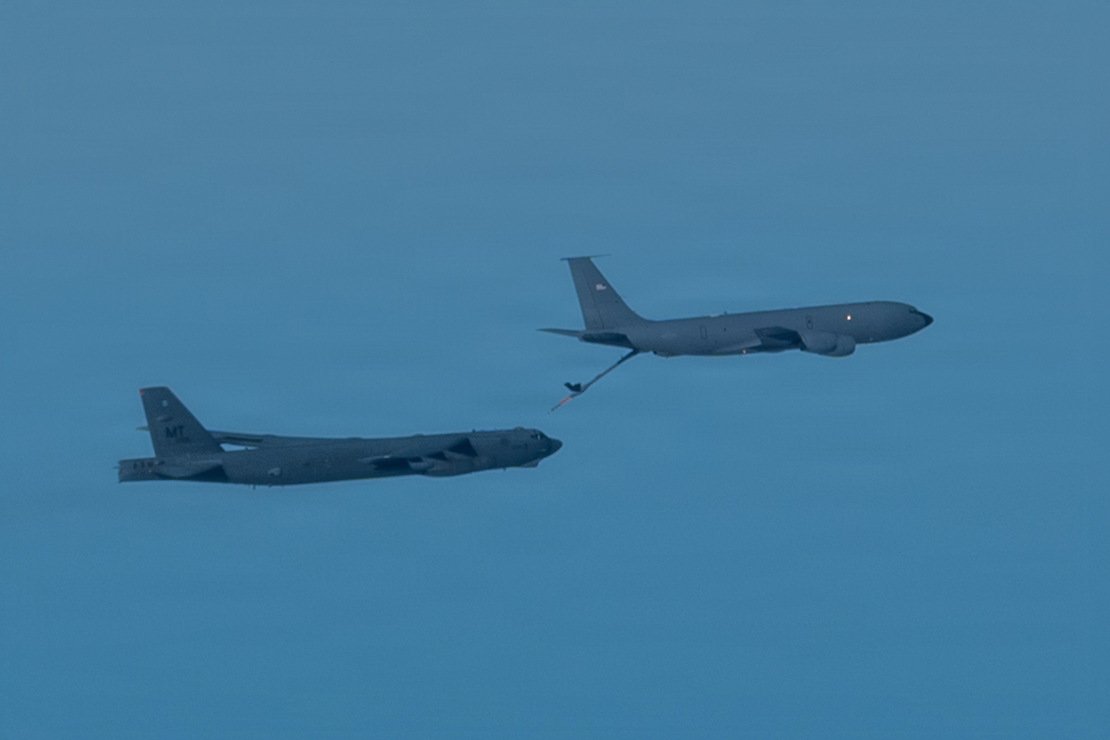
In an effort to improve connectivity aboard Air Force tanker and mobility aircraft, the Pentagon’s commercial technology innovation unit wants a system to install new applications on aircraft, such as a moving map display that helps aircrew see through the fog of war.
KC-135 Stratotankers and other older mobility aircraft currently lack an “in-flight common operating picture” that allows them to see evolving battlespace conditions such as incoming threats as well as the changing locations of friendly forces, according to a project announcement from the Defense Innovation Unit this week.
“This requires crews to rely heavily on pre-mission planning products, voice updates, and aging platform-specific displays that cannot dynamically integrate with enterprise battlefield intelligence, communications, and logistics networks, or ingest mission-relevant updates”—a problem that “degrades aircraft survivability, limits dynamic retasking, and constrains the ability of commanders to project and sustain force,” the announcement states.
The DIU effort invites tech firms to submit prototypes of a modular, open mission engine, or OMEN, that’s designed to power a suite of “new mission applications and plugins for aircrew operating in contested environments.”
The first application on the platform will be an aviation tactical moving map tool that “improves in-flight situational awareness, threat understanding, and mission decision support under [degraded, disrupted, intermittent, or limited] environments,” the announcement states. “The moving map tool will serve as a baseline for future mission capabilities.”
AMC leaders have argued that for too long, the Air Force has been slow in addressing the connectivity challenges of the air mobility fleet.
As it stands now, mobility crews have to rely on unsecure, publicly available methods to make sure they’re seen by others, which can leave them exposed to enemy detection, former AMC boss and retired Gen. Mike Minihan, posted on LinkedIn in late March.
“We should never put mobility crews, especially tanker crews, in a position during combat operations where they have to choose between being seen by everyone, including the enemy, or being seen by no one, including the joint force and civil aviation,” Minihan wrote.
“Enough. Mobility force connectivity now. Write the damn check.”
The goal of the DIU effort is to award initial prototype other transaction agreements with the potential for a “significantly larger” follow-on production contract “without the use of further competitive procedures,” the announcement states. Frms have until April 15 to submit proposals.
The OMEN should be designed to be government-owned and be equipped with an open software development kit and secure software delivery, observability, and operation in connected, disconnected, and degraded environments, the announcement states.
Solutions for the tactical moving map application should combine relevant operational data into a single aircrew display that includes friendly-force awareness, threat and airspace overlays, mission updates, and route decision support, the announcement states. Companies should prioritize user experience and ensure moving map apps are “future-proofed with an open software architecture baseline allowing for easy software integration and adoption across developer communities,” the announcement states.
Key differentiators for proposals include speed to prototype, interoperability with existing Defense Department systems, compatibility with government security protocols and the ability to team and collaborate with government developers and other industry performers, the document states.
OMEN prototypes should be designed for rapid development, deployment and sustainment of Defense Department approved platform agnostic, networking and interoperability systems such as “on-board compute and store with aircraft data bus interfaces,” software-defined radios, and commercially available display systems, the announcement states.
As the AMC commander, Minihan set a goal of equipping a quarter of the mobility fleet with modern connectivity and situational awareness gear by fiscal 2025. But in 2024, Minihan acknowledged to lawmakers that AMC would fall well short of that goal. Stressing that it remained an urgent need, he said the $500 million needed for the upgraded failed to make that year’s unfunded priorities list for the Air Force because the service was trying to crack down on unbudgeted requests. Then-Chief of Staff Gen. David W. Allvin saw spare parts to boost readiness as a higher priority, said Lt. Gen. David H. Tabor, who was director of programs at the time.
This February, AMC’s interim leader Lt. Gen. Rebecca J. Sonkiss said the Air Force has been “woefully negligent” for far too long in failing to invest in connectivity for the air mobility fleet.
“We have to do better for our crews, it’s linked to survivability,” she said. “Our C-5s can be more effective if they know what’s going on, and they can remission in real time.”
