

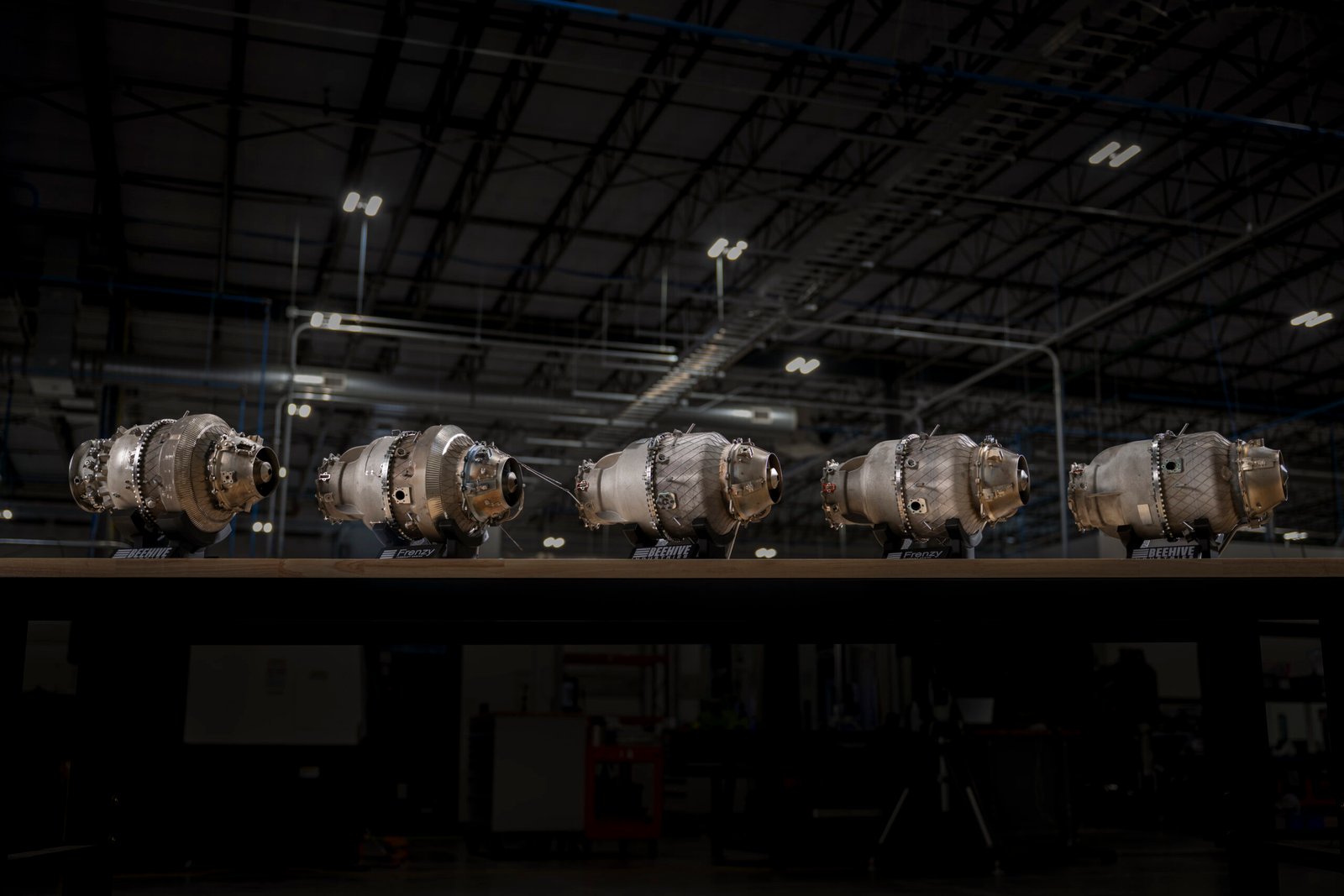
The Air Force has awarded a $29.7 million contract to engine startup Beehive Industries to complete work on a new disposable jet engine meant to power drones and munitions. The contract is just the latest step in the service’s effort to massively scale up production of cheap new missiles and drones.
That effort kicked off in earnest in the fiscal 2026 budget with the debut of the Family of Affordable Mass Missiles program, backed by $620 million in procurement and research and development funding. Beehive says its 200-pound Frenzy 8 engine is part of the FAMM program through a prototyping effort to develop small expendable turbines.
The Frenzy 8 can hit 100-300 pounds of thrust. Beehive says it is also developing a 100-pound variant, Frenzy 6, which has 100 pounds of thrust. The new contract is to complete vehicle integration, flight testing, and qualification of Frenzy 8 and begin manufacturing a test version of Frenzy 6, with options for for further development.
Beehive is one of at at least half a dozen companies working on small engines capable of producing between 200 and 3,000 pounds of thrust for Air Force programs like FAMM and Collaborative Combat Aircraft—and that push is poised to expand in fiscal 2027; the service is requesting $973 million for FAMM between R&D and procurement and $1.37 billion for developing CCAs, among other efforts.
Founded in 2020, Beehive is staking out its lane in the competition with a heavy focus on additive manufacturing like 3D printing to build its engines fast.
Chief Product Officer Gordie Follin told Air & Space Forces Magazine that work on Frenzy 8 began in October 2024, and the engine completed First Engine Test, or FET, in May 2025 and altitude testing in October 2025. The first flight is slated to take place in a few weeks.
The firm is currently working on vehicle integration with several manufacturers and expects to conduct a barrage of flight tests over the coming months, Follin said. It has already built manufacturing capacity and is producing hundreds of engines to have ready to ship following flight testing, he said.
“We expect production for 2027 to be on the order of 3,000-5,000 engines with some potential upside,” Follin said. Because of its focus on additive manufacturing, the company can scale quickly, allowing it to double that capacity in about 12 months.
The Frenzy 6 program kicked off on April 9 and is expected to enter production by 2027, he said. The program draws heavily on the Frenzy 8 work, and Follin expects it to pass FET in three months.
“The U.S. urgently needs solutions to enable affordable mass and, as you can see, we are committed to moving at unprecedented speed to help solve this problem,” Follin said.
The FAMM program for which Frenzy 8 is meant is focused on “integration and flight demonstrations of affordable and highly manufacturable small turbine engines, seekers/sensors, networked datalinks, collaborative autonomy behaviors, and ordnance [warhead/fuse],” according to budget documents.
Separately, the Defense Advanced Research Projects Agency posted a notice to industry on March 31 asking for information on “state-of-the-art development and manufacturing processes for missile propulsion systems.” And back in February, the Air Force awarded Beehive and three other engine-makers contracts to do design work on engines for powering the next increment of CCAs.
