

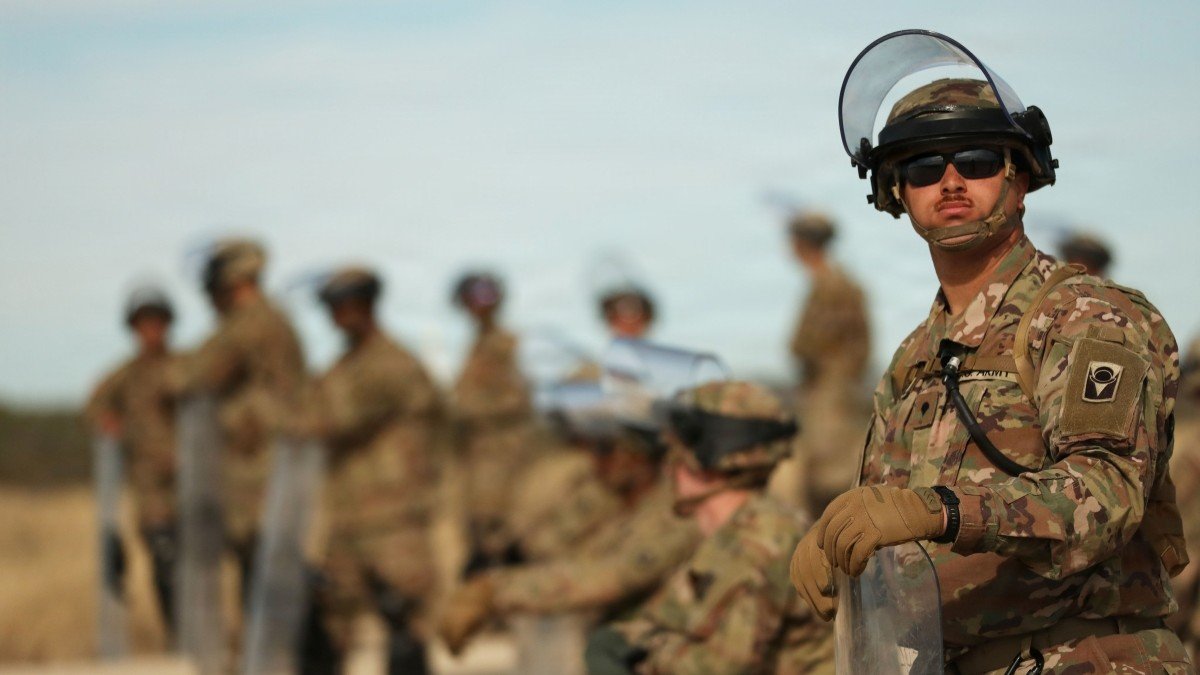
Late last year, the Supreme Court blocked an attempted National Guard deployment into the Chicago area — but months earlier, far from the headlines, a federal memo was already reshaping what Guard “readiness” means at home. The Supreme Court’s order was procedural, not a final merit ruling. But it delivered a rare, immediate check on a Guard deployment that Illinois state officials argued violated the legal limits on federal power over state forces.
The Chicago case matters but the more consequential development occurred months earlier, largely outside public view. In August 2025, the National Guard Bureau directed each state to establish a National Guard “quick reaction force” for civil-disturbance operations, standardizing timelines, curriculums, and equipment that, once treated as the minimum for readiness, can quietly become permanent.
Governors, as commanders-in-chief of their state National Guards when operating in State Active Duty or Title 32 status, bear the ultimate accountability for domestic deployments. Federal directives that redefine readiness around civil-disturbance missions and equipment do more than standardize training: They can narrow state flexibility and pull governors into a federally authored template. Over time, that shift can create mismatched priorities that undermine public trust and complicate local partnerships, particularly when Guard forces operate alongside civilian law enforcement.
Governors should not treat the quick reaction force as a technical training matter or a partisan dispute, but as a problem of federalism and risk management. Proactive state policy, ideally codified in statute or executive guidance, can define mission priorities, narrow and bound civil-disturbance roles, and set clear conditions for Guard support to civil authorities. Without that clarity, federal standards will harden into defaults, leaving states to manage the consequences.
Nothing in the recent quick reaction force guidance required new legislation. It relied on existing authorities that already shape Guard training and equipping, as earlier guidance has for counter-drug missions, cybersecurity support, and overseas mobilizations. But this directive carries a distinct consequence: It reshapes the baseline for what “ready” means for domestic employment, effectively placing governors on the hook for missions and timelines written in Washington. If a Guard deployment goes wrong, public anger, litigation, and political fallout will land at the steps of statehouses — not the Pentagon.
Much of the coverage framed the Chicago story as a debate over civil unrest. The deeper issue is federalism and the Guard’s dual purpose. Guard forces remain under a governor’s control unless they are formally federalized under the Constitution’s “calling forth the militia” authority and implementing statutes. In state status, it is the governor — not the federal government — who determines domestic missions, training priorities, and employment rules.
The Legal Structure Favors the Actor Who Moves First
The Supreme Court’s decision in Perpich v. Department of Defense (1990) affirmed that the federal government may train and deploy Guard units for national purposes without gubernatorial consent. In practice, that gives Washington leverage to push standardized requirements onto states when those requirements are tied to federal funds, equipment, or readiness assessments.
When Guard units remain under state authority, however, governors hold sweeping control. They can determine how forces are organized, trained, and equipped; what missions they prioritize; how they integrate with state and local emergency management and law enforcement; and what limits apply to any domestic activation. Those powers are reflected in state law and, for Title 32 forces, in the basic command relationship: state command with federally supported training and resourcing.
This balance works only when both levels of government actively do their part. Federal authorities will always shape national-level readiness through funding, equipping, and mobilization requirements. States, however, must translate those inputs into policy for domestic employment: which missions are primary, what guardrails apply to civil-disturbance support, and how the Guard integrates with civilian agencies. The federal government has an enormous procedural advantage, so without deliberate state policy governors default into reacting to federal templates rather than shaping their own state-centric plan.
That is how administrative drift can happen. A federally directed quick reaction force becomes normalized. Capabilities that already exist for public-order support become more widely resourced, standardized, and exercised as a default rather than an exception. Timelines written in Washington shape expectations in state and local agencies. And the Guard’s public identity can shift from a primarily state-focused flexible emergency management partner to a federal military force increasingly associated with domestic security functions.
All of this would remain legal. The question is whether it is wise.
Governors Should Act Like Commanders, Not Customers
Many governors treat the Guard as a specialized emergency resource, calling on it when hospitals overflow, when fires grow too large, or when roads are buried in snow, without directing what the force should prioritize and train for year-round. That model overlooks important responsibilities of command: deciding what a military force is for, what it should be ready to do first, and what it should do only under narrowly defined conditions.
Military commanders do not merely deploy troops — they decide what those troops are asked to prepare for. Once a mission becomes the training default, it becomes the institutional default. Quick reaction forces built around formations, shields, and nonlethal crowd-control tools will refine those skills until they feel routine. If governors want their Guard to excel in wildfire aviation, cyber incident response, medical surge support, and infrastructure protection, those should be standing missions. Conversely, civil-disturbance support should be clearly bound and focused on public safety — protecting civilians and responders from immediate harm and activated under explicit rules rather than treated as a primary readiness benchmark.
There is precedent for states to proactively shaping the guard for potential federal activation. California built “Task Force Rattlesnake” to integrate Guard units into wildfire response. Multiple states developed Guard cyber assistance teams after ransomware attacks on hospitals and local governments. These missions built public trust because they matched the Guard’s traditional role as a partner to civil authorities rather than a coercive instrument in domestic politics.
Federal law and longstanding practice authorize the Guard to support civil authorities during disorder, including under federalization authorities in extreme cases. The question is not whether civil-disturbance missions exist — the key is balance.
Supporters of a standardized quick reaction force make fair points: speed, interoperability, and a common “floor” for training can help governors respond to riots, mass violence, or cascading emergencies that overwhelm local capacity. A quick reaction force can also reduce ad hoc decision-making by ensuring units have pre-trained leaders, equipment, and communications plans. But those benefits depend on policy. Without state-defined mission priorities and guardrails, the same standardization that improves speed can also institutionalize a posture that governors did not choose. While supporters highlight these benefits, critics argue the quick reaction force concept is a dangerous step toward easier federalization for suppressing domestic unrest, fusing state Guards into a tool for national control. Governors should counter this by defining their own policies.
Without State Policy, Crisis Improvisation Becomes the Rule
The United States has already seen the consequences of unclear Guard policy. During the 2020 unrest in Minneapolis, state and local leaders issued conflicting instructions about Guard authority, coordination with police, and use-of-force standards. A legislative review described inconsistent guidance and limited integrated planning with civil authorities, producing slow mobilization, unclear chains of command, and elevated risks for civilians and soldiers.
Courts can block specific deployments, but judicial rulings remain a temporary patch, not a structural fix: reactive, fact-bound, and dependent on litigation posture. The Supreme Court’s December order in the Illinois case underscored the point. The judiciary can hold the line case-by-case, but it cannot supply the state policies governors need to prevent federal templates from hardening into “readiness” norms. In Portland, Oregon, a federal judge issued an injunction in early November 2025 blocking a National Guard deployment while she assessed the administration’s asserted legal basis — and later issued a final order permanently barring the deployment. The details differ by case, but the pattern is consistent. Courts intervene only after the deployment decision has already become a crisis.
When policy is absent, improvisation can fill the vacuum. And improvisation under political pressure often rewards visible, coercive action over slower de-escalatory options. For instance, during the 2014 Ferguson, Missouri protests, an absence of clear state guidelines led to a heavily militarized police response with armored vehicles and tear gas, escalating tensions instead of prioritizing de-escalation through community dialogue. Similarly, in the 2020 Portland protests, federal agents’ ad hoc tactics —unmarked vans and aggressive crowd control — amplified violence, as later investigations revealed.
The time to decide the Guard’s role is before the template hardens.
A State-Level Policy Framework for De-Risking the Guard
A credible state policy framework — ideally enacted through state statutes for durability across presidential administrations for domestic Guard employment — rests on five principles grounded in existing law and recent experience. While the federal quick reaction force imposes a uniform standard, this proposal empowers each state to customize its own, avoiding irony by prioritizing federalism over top-down control.
The first principle is mission design. Governors should issue written guidance that the Guard’s primary state missions are wildfire suppression, flood response, cyber incident assistance, medical surge capacity, and critical infrastructure resilience. Civil-disturbance missions should be defined narrowly and framed in support terms — perimeter security, evacuation routes, logistics, and medical aid — with any crowd-control role specified only under explicit conditions and legal constraints. Under Title 32 training authorities, governors may direct training curriculums that reflect these priorities.
The second principle is disciplined civil–military coordination. Habitual training relationships between Guard units and local police should be established and led by civilian instructors specializing in de-escalation, communications, and constitutional rights. Colorado’s 2020 law restricting certain uses of chemical agents and requiring detailed reporting provides a model for integrating civil-rights protections into Guard policy. The goal is a shared operating picture with distinct roles, not a state-federal merged force.
The third principle is interstate alignment. The Emergency Management Assistance Compact, approved by Congress in 1996, allows governors to exchange Guard resources during disasters. It also allows states to pre-agree on mission limits. Governors should negotiate a regional compact specifying that Guard deployments across state lines will occur only for life-safety missions and that any support for public-order operations must be explicitly authorized in writing by both governors. These agreements should also establish common standards for documentation, use of force, and the public release of after-action reviews.
The fourth principle is parallel capacity. Federal law allows states to create State Defense Forces that cannot be federalized. Even a small unit focused on cyber assistance, logistics, shelter operations, and basic medical support provides resilience when federal mobilizations draw heavily on the Guard. Parallel forces strengthen governors’ hands by ensuring that some emergency capacity always remains under state control.
The fifth principle is accountability through law. State legislatures can require timely public reporting of Guard deployments, establish clear thresholds for activations, mandate civilian oversight, and codify life-safety priorities. Transparency is not a burden — it is a prerequisite for public trust.
The Moment to Act Is Now
Chicago shows the judiciary can sometimes stop a National Guard deployment. The quick reaction force guidance shows how Washington can still rewrite a domestic default setting without deploying anyone at all.
The quick reaction force memorandums were legal, but legality is not the standard by which state governors should measure risk. Administrative precedents settle quickly. Once the Guard’s posture shifts toward rapid domestic coercive capability, it will not shift back without political cost.
Governors have only a short period to articulate policy before the federal default becomes the national norm. They do not need confrontation, but clarity. They need to define missions, training standards, oversight mechanisms, and partnerships before federal guidance fills the void. And they need to act collectively — across party and state lines — before the institution they command evolves into something they never debated or approved.
The Guard remains one of the most trusted public institutions in America precisely because it has anchored itself in local community, not national politics. The citizen-soldiers who rescue neighbors from fires, staff shelters in winter storms, rebuild washed-out roads, and restore hospital communications after cyberattacks embody the Guard’s historic purpose. Domestic coercion is the edge of that mission, not its core.
If governors want to keep it that way, they should begin acting like commanders-in-chief now, not when the next federal memo arrives. That means acknowledging the legitimate case for speed and interoperability while still insisting that states define mission priorities, thresholds, and guardrails for domestic employment. State policy and statutes are how governors keep the Guard trusted, mission-effective, and aligned with the communities it serves.
Jesse Humpal is an active-duty Air Force officer and assistant professor at the U.S. Air Force Academy. He can be followed @jessehumpal on X.
The views are his own and do not necessarily reflect the official policy or position of the U.S. Air Force Academy, the Air Force, or the Department of Defense.
**Please note, as a matter of house style, War on the Rocks will not use a different name for the U.S. Department of Defense until and unless the name is changed by statute by the U.S. Congress.
Image: Pfc. Azavyon McFarland via DVIDS
