

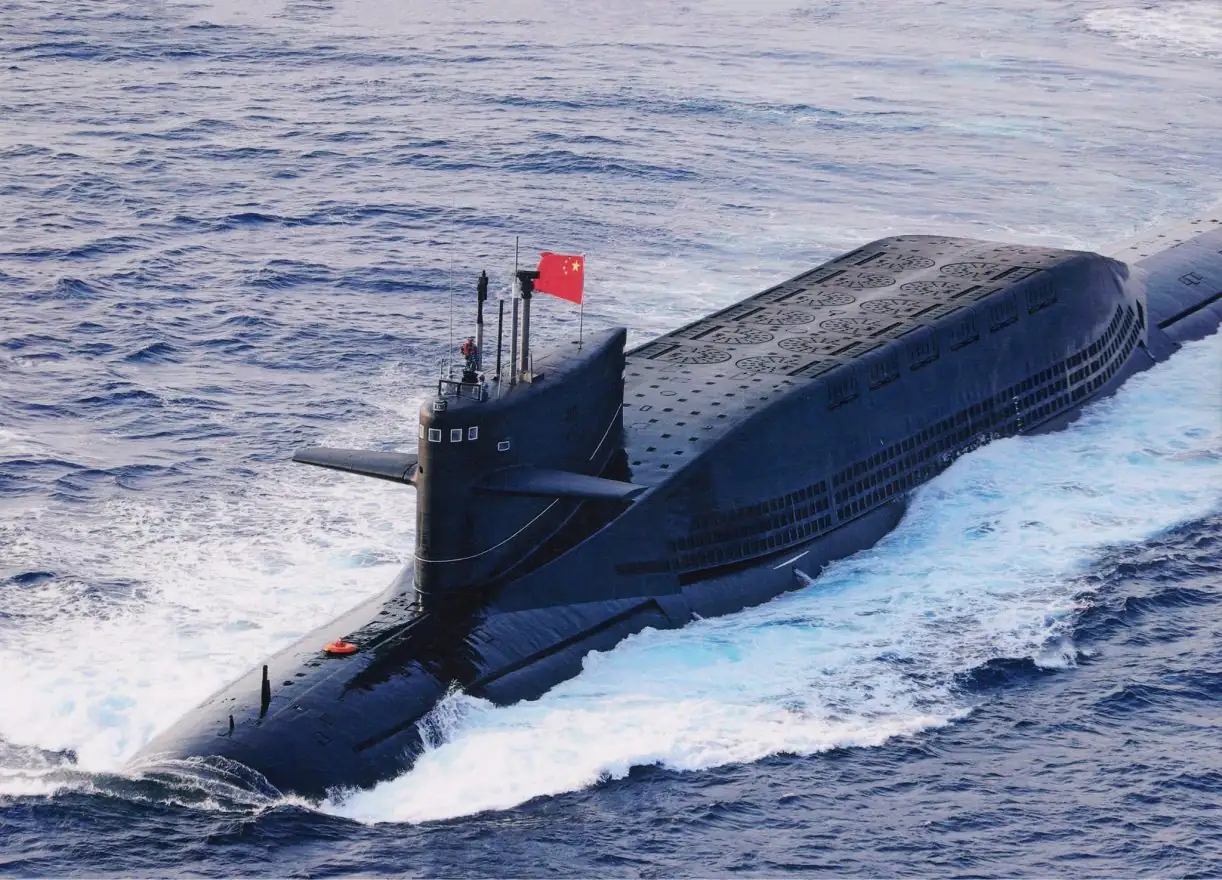
The most powerful weapons on Earth don’t roar. They glide.
Somewhere beneath the Pacific’s restless skin, the Type 094 submarine moves without ceremony, no flags, no parades, no viral videos. Just steel, silence, and consequences. This is not a ship built to win battles in the traditional sense. It’s built to make sure certain battles never happen at all.
At first glance, the Type 094 might seem like just another entry in the long list of nuclear submarines. Look closer, though, and it becomes clear why analysts pay such obsessive attention to it.
This class represents China’s first operationally credible sea-based nuclear deterrent, a turning point in how the People’s Liberation Army Navy thinks about survival, escalation, and global reach. In nuclear strategy terms, that’s a big deal, borderline historic.
What makes the Type 094 Jin-class SSBN especially interesting isn’t just its missiles or reactor. It’s the role it plays in a much larger story: China’s slow, deliberate shift from coastal defense to persistent, blue-water presence.
These submarines aren’t meant to sprint or show off. They’re meant to endure. To stay hidden long enough that no adversary can ever be sure they’re gone.
In this post, we’ll unpack the Type 094 from a fresh angle, less brochure, more reality, how it fits into China’s nuclear triad. Why its patrol zones matter as much as its weapons. And what this submarine quietly signals about the future of undersea deterrence.
How the Type 094 Submarine Came to Life
To understand the Type 094 Jin-class submarine, you have to rewind to a period when China’s undersea nuclear ambitions were… let’s say, aspirational.
China’s first attempt at a ballistic missile submarine, the Type 092, was technically impressive for its time but operationally limited. It rarely conducted deterrent patrols and struggled with reliability, noise, and missile performance.
For a country serious about a survivable second-strike capability, that simply wasn’t good enough. The lesson was clear: if China wanted a true sea-based nuclear deterrent, it needed a clean slate.

The Type 094 program emerged in the late 1990s as that reset button. Instead of chasing perfection, designers focused on deployability.
The goal wasn’t to match U.S. or Russian SSBNs leap for leap, but to field a platform that could actually leave port, stay submerged, and carry nuclear missiles reliably. By the early 2000s, hull construction was underway at Huludao, China’s primary nuclear submarine shipyard.
The first Type 094 Jin-class SSBN entered service around 2007. That date matters. It marked the moment China crossed from theoretical deterrence to something far more tangible.
Over the next decade, additional boats followed, with incremental refinements rather than dramatic redesigns, classic evolutionary engineering.
One interesting quirk: the Type 094 wasn’t rushed into constant patrols right away. Early years were dominated by crew training, missile testing, and quiet system validation. Think of it as rehearsals before opening night. Only in the mid-to-late 2010s did regular deterrent patrols become routine.
In strategic terms, the Jin-class didn’t just replace the Type 092. It erased it. And in doing so, it laid the foundation for everything that comes next, especially the future Type 096 program waiting in the wings.
What the Type 094 Jin-Class Submarine Is Really Built For
Specifications are where submarines stop being abstract ideas and start feeling real. Steel thickness. Reactor output. How many people live inside a pressurized tube for months.
The Type 094 submarine is a study in tradeoffs, range versus stealth, payload versus discretion, and every number tells a small story.
Below is a snapshot of the commonly cited technical data. Exact figures remain classified (as they should), but consensus estimates give us a solid working picture.
Core Specifications Overview
| Feature | Estimated Data |
| Class Type | Nuclear-powered ballistic missile submarine (SSBN) |
| Length | ~135–137 meters |
| Beam | ~12.5 meters |
| Submerged Displacement | ~11,000–11,500 tons |
| Propulsion | Pressurized water nuclear reactor, single shaft |
| Maximum Speed | ~20–22 knots (submerged) |
| Test Depth | Estimated 300+ meters |
| Crew | ~120–140 personnel |
| Missile Tubes | 12 vertical launch tubes |
What stands out isn’t raw performance.
The Type 094 isn’t chasing speed records or extreme depth. Instead, it’s engineered for persistence. Nuclear propulsion gives it theoretically unlimited range; endurance is limited mainly by crew stamina and food storage. That’s the real currency of deterrence, time spent hidden.
The hull design reflects this philosophy. It’s larger than China’s earlier SSBNs, allowing room for better habitability, more stable missile systems, and improved reactor shielding.

The tradeoff is the acoustic signature. While quieter than its predecessor, the Jin-class is still widely assessed as louder than U.S. or Russian equivalents. China appears to have accepted this, at least temporarily, in exchange for operational reliability.
Think of the Type 094 as a long-distance truck rather than a sports car. It doesn’t need to be flashy. It needs to start every time, stay on the road, and never break down where someone might notice.
Armament & Weapons Systems: The Real Power Behind the Type 094 Submarine
Strip away the hull, the reactor, the sonar mystique, and what you’re left with is the reason the Type 094 submarine exists at all: its missiles.
Each Jin-class boat carries 12 vertical launch tubes, purpose-built for submarine-launched ballistic missiles (SLBMs). Early units were armed with the JL-2, a solid-fueled missile with an estimated range of 7,000–7,400 kilometers. That range matters. It allows the submarine to strike strategic targets without leaving relatively protected waters near China’s coastline, particularly when operating from bastions like the South China Sea.

Later boats, and likely refitted earlier ones, are believed to support the JL-3 Missile, a far more capable missile. Analysts estimate the JL-3’s range could exceed 10,000 kilometers, pushing the Type 094 firmly into intercontinental territory. From a deterrence standpoint, that’s a step change. It means fewer risky patrol routes and more flexibility in launch geometry.
Here’s how the missile options compare:
| Missile | Estimated Range | Warheads |
| JL-2 | ~7,000–7,400 km | 1 (possibly MIRV-capable later) |
| JL-3 | 10,000+ km (est.) | Multiple (likely MIRV) |
Beyond ballistic missiles, the Type 094 Jin-class SSBN is equipped with 533 mm torpedo tubes, primarily for self-defense. These can launch heavyweight torpedoes or anti-ship missiles. Still, let’s be honest, combat is not the plan. Survival is.
A useful analogy: the Jin-class isn’t a sword. It’s a sealed envelope. You don’t open it unless everything else has already gone terribly wrong. And because adversaries know that envelope exists, sealed and hidden, they hesitate.
That quiet threat is the weapon system that matters most.
Variants & Upgrades: How the Type 094 Submarine Quietly Evolved
From the outside, one Type 094 submarine looks a lot like the next. That’s intentional. But beneath the pressure hull, the class has been quietly, and steadily, refined.
The earliest boats are often referred to simply as Type 094, while later units are labeled Type 094A by analysts. China doesn’t officially use these suffixes, but the differences are real enough to earn a new letter. Think of the 094A not as a redesign, but as a software update… except the software weighs thousands of tons and lives underwater.

One of the most discussed upgrades centers on acoustic performance. Early Jin-class submarines were criticized for relatively high noise levels, particularly when compared to U.S. Ohio-class or Russian Borei-class SSBNs.
The response wasn’t flashy. Instead, engineers focused on incremental fixes: improved machinery isolation, better propeller shaping, and subtle changes to hull flow dynamics. Nothing revolutionary. Everything cumulative.
There’s also evidence of enhanced electronics and sonar processing, improving situational awareness in cluttered littoral waters. That matters if your patrol zones are relatively confined. A submarine doesn’t need perfect stealth, it needs enough stealth to avoid being confidently tracked.
Missile compatibility is another key evolution. Later Type 094 boats are widely believed to be JL-3 capable, either from launch or through refit. That single change dramatically extends strategic reach without altering the hull’s basic layout. Smart, economical, effective.
What’s interesting is what didn’t change. The overall size, missile count, and mission profile stayed stable. This signals a design philosophy focused on reliability and predictability, qualities prized in nuclear deterrence.
In short, the Type 094 submarine matured the way real-world systems do: not through dramatic leaps, but through quiet fixes layered one on top of another. Underwater, that’s often how the most important progress happens.
Operational History: From Symbol to Silent Routine
The operational story of the Type 094 submarine is less about dramatic encounters and more about something far subtler, normalization. And in the world of nuclear deterrence, “normal” is the ultimate goal.
When the first Jin-class boats entered service in the late 2000s, they didn’t immediately begin full-scale deterrent patrols. Instead, the early years were cautious. Crews trained. Systems were stress-tested.
Missiles were launched under controlled conditions. This slow ramp-up wasn’t hesitation; it was discipline. A ballistic missile submarine is only credible if it works every time, under crushing pressure, with no room for improvisation.
By the mid-2010s, that transition was complete.
The Type 094 Jin-class SSBN began conducting regular deterrent patrols, a milestone quietly acknowledged by foreign defense officials rather than trumpeted by Beijing. These patrols are widely believed to operate from bases like Yulin Naval Base on Hainan Island, offering direct access to deep water and relatively protected operating areas.

What’s notable is where these submarines likely don’t go. Unlike U.S. or Russian SSBNs that roam vast ocean spaces, the Jin-class appears optimized for regional bastion patrols. Staying closer to home reduces detection risk and simplifies command-and-control, both crucial for a force still refining its at-sea nuclear doctrine.
Fleet size is estimated at six operational boats, enough to support continuous patrol cycles while allowing time for maintenance and crew rotation. That number isn’t arbitrary. It’s the minimum needed to ensure that at least one submarine is always at sea, unseen, and ready.
There are no battle honors. No intercepted targets. Just long, uneventful patrols. Which is exactly the point. For the Type 094 Jin-class submarine, success looks like silence, and so far, that silence has been steady.
Controversies & Challenges: The Friction Beneath the Calm Surface
For all its strategic importance, the Type 094 submarine has never been free from criticism. In fact, some of the loudest debates about the Jin-class revolve around what it can’t do, or can’t yet do as well as its peers.
The most persistent issue is the acoustic signature. Western analysts have long argued that early Type 094 boats were significantly noisier than U.S. Ohio-class or Russian Borei-class SSBNs.
In plain terms: easier to hear, easier to track. In the undersea world, that’s a serious vulnerability. A ballistic missile submarine only deters if it can plausibly disappear. If an adversary believes they can shadow it, the deterrent effect weakens.

China hasn’t denied this outright, but it also hasn’t panicked. Instead, improvements appeared gradually in later hulls, better machinery isolation, quieter propellers, cleaner hydrodynamics.
Still, even optimistic assessments suggest the Jin-class trails Western SSBNs by a generation in stealth technology. Whether that gap matters depends on where and how the submarine operates.
Another challenge is command and control. Maintaining secure, reliable communication with a deeply submerged nuclear submarine is hard for every navy. Doing it while preserving stealth is harder.
China’s approach appears cautious, favoring controlled patrol zones where communication infrastructure is strongest. That’s sensible, but it also limits operational flexibility.
There’s also the shadow of rare but unsettling incidents, such as reports of accidents during early development phases. Details are scarce, and speculation fills the gaps. Fair or not, those stories stick.
Yet here’s the counterpoint: perfection isn’t required. The Type 094 submarine doesn’t need to be invincible. It only needs to be uncertain. And despite its flaws, uncertainty is exactly what it delivers.
