

Modern synthetic biology and AI represent both medicine’s greatest breakthrough and warfare’s most terrifying evolution. In this new landscape, where biological weapons can be designed faster than traditional defenses can be developed, recent government decisions risk abandoning our only countermeasure that can keep up: messenger ribonucleic acid, better known by its acronym, mRNA.
Known most famously for the prominent role it played in vaccinations against SARS-CoV-2 (the virus that causes COVID-19), mRNA is a medical platform that can generate new defenses in days rather than years. In layperson’s terms, mRNA amounts to a temporary set of instructions that tells cells how to make a specific protein.
It should be said upfront that as co-founder of Tevard Biosciences, a company developing tRNA-based (helper molecule that carries the right building blocks to the cell’s protein-making machinery) therapeutics for genetic diseases, I have a commercial stake in the broader RNA medicines field. I also co-founded the Alliance for mRNA Medicines, a nonprofit organization advancing mRNA technology. My perspective, however, is based on three decades of research in RNA biology — including work in my laboratory that contributed to the design of Spikevax, Moderna’s COVID-19 vaccine — and direct experience with the public-private coordination that made Operation Warp Speed possible.
To maintain this advantage, Congress should restore recently cut mRNA research funding, and the Pentagon should establish mRNA biodefense manufacturing as a priority — before America’s adversaries close the gap.
The Accelerating Threat
What once required advanced national laboratories — designing dangerous pathogens or engineering novel biological agents —can now be done with modest time and resources. Adversaries can design and deploy engineered threats in weeks, while traditional countermeasures can still take years to develop.
This widening gap — between the speed of potential attackers and the sluggishness of America’s defenses — is one of the most urgent national security challenges of our generation. And that gap continues to widen with each new technological advance.
Researchers recently created the first AI-designed viruses — bacteriophages that kill bacteria — using models trained on millions of viral genomes. Out of 302 computer-generated designs, 16 proved not only viable but superior to their natural counterparts.
These experiments were carried out under strict safeguards and for beneficial purposes. The bacteriophages targeted bacteria, not humans, and the researchers deliberately excluded human virus data from their AI training. However, the proof of concept is what matters. The underlying methods — training generative models on viral genomics — are becoming increasingly sophisticated and not limited to safe applications.
What now requires a sophisticated team of researchers will become accessible to smaller actors. What is technically challenging today will become operationally straightforward in the future. While the ability to weaponize these techniques is not imminent, the trajectory is clear. AI capabilities advance rapidly. Responsible planning requires preparing countermeasures before threats fully materialize — not after.
If the threat landscape is accelerating, our biodefense strategy should accelerate even faster. One way to stay ahead of emerging threats is mRNA technologies, which offer a powerful platform for rapid, adaptable, and scalable countermeasures.
During COVID-19, researchers quickly obtained the viral genetic sequence, providing everything needed to begin developing an mRNA vaccine. The vaccine was also designed quickly, even though it would still take clinical trials involving tens of thousands of patients to prove its safety and efficacy. Close coordination between the government and private sector under President Donald Trump’s leadership made the unthinkable possible.
The speed advantage of mRNA stems from its simplicity. mRNA therapies work with the body’s existing protein-making machinery. Instead of taking months to make a new therapy in labs, mRNA provides genetic instructions for cells to produce the protective protein that alerts the immune system. Because mRNA is a natural part of human biology, vaccine development is faster and easier. In fact, once a pathogen’s genetic sequence is known, the mRNA code can be designed in hours.
The same technology that enabled a rapid response during the pandemic can be decisive against engineered threats. Our national defense can operate on timelines matching the development of offensive weapons — saving American lives, including those of military servicemembers in wartime. Experience shows this isn’t an abstract concern.
Take the USS Kidd: In 2020, the U.S. destroyer was taken offline when SARS-CoV-2 infections spread through the crew. The incident demonstrates how biological threats can neutralize military personnel as effectively as kinetic weapons.
mRNA platforms offer a meaningful defensive advantage, but deterrence by denial in biodefense differs from its kinetic counterpart. The challenge is three-fold: detecting or identifying an attack before symptoms appear, developing a countermeasure against the specific threat, and deploying countermeasures under operational conditions.
mRNA technology addresses the second challenge decisively. Once the genome of a pathogen is sequenced, countermeasures can be designed in hours. Consider a carrier strike group with deployable mRNA synthesis capability. Even if an adversary achieves initial surprise, rapid countermeasure production limits the attack’s duration and military impact. Traditional countermeasure timelines were predictable — attackers could plan around a months-long development window with confidence. mRNA collapses that timeline unpredictably. Adversaries can no longer reliably estimate how long a biological attack will remain effective, undermining the operational calculus that makes such weapons attractive in the first place.
Detection and deployment are harder problems to solve. Incubation periods for biological agents can range from days to weeks, during which an attack may not be fully recognized. Administering vaccines or therapeutics in contested environments poses logistical challenges. Researchers, however, are making progress.
Unlike traditional vaccines dedicated to specific pathogens, mRNA manufacturing pivots rapidly between new countermeasures by changing only the RNA sequence — like updating software while keeping its hardware constant. Advances in miniaturization are moving toward deployable systems able to operate in forward bases or even battlefield conditions.
With continued federal investment and private-sector collaboration, these challenges can be addressed to better protect the American people and America’s warfighters. Yet just as the mRNA capability becomes essential and its expansion critical, the United States is retreating from it. In August, the U.S. Department of Health and Human Services discontinued approximately $500 million in mRNA research funding. The decision sent a chill through the biotechnology sector, undermining continued American innovation.
The $500 million cut represents more than a budget line — it has dismantled a coordinated research pipeline. The department’s mRNA research portfolio supported the development of multiple potential vaccines, manufacturing scale-up, and clinical trial infrastructure that no single defense contract replicates. These programs also operate on longer time horizons than typical defense procurement, sustaining the basic research and workforce development that private industry builds upon but rarely funds independently.
Defense funding alone cannot fill this gap. Biodefense programs funded through the U.S. Department of Defense are mission-specific and threat-focused. These programs procure capabilities rather than sustaining the broad research base that enables rapid pivots to new threats. For biodefense countermeasures, the federal government is the market. When the Biomedical Advanced Research and Development Authority (BARDA) stopped funding mRNA development, the signal to industry was clear: Move your resources elsewhere. The pre-pandemic mRNA ecosystem worked because civilian health agencies provided foundational research that both defense and commercial applications could draw upon.
Unless the federal government reverses course, the United States risks losing its hard-earned competitive advantage in a technology that enables an effective, timely response to future biological threats at precisely the moment our country can least afford to fall behind. Progress achieved through significant risk and taxpayer expense would be squandered.
Our global competitors are not making the same mistake. China has made significant investments in mRNA technology, with 46 percent of mRNA vaccines in clinical development globally now coming from China — a remarkable shift in a field where American firms held clear leadership just five years ago.
China is not merely trying to catch up but actively competing for dominance in a critical dual-use technology. In a biological crisis involving engineered threats, nations will either refuse to supply countermeasures to their adversaries or do so at great cost. Maintaining our leadership in mRNA research, development, and production is a national security imperative.
The decision to walk away from mRNA research comes at exactly the wrong moment. Former officials — including those who served under Trump — have said the move undermines deterrence and weakens national defense. While the U.S. Department of Defense continues funding some mRNA research, fragmentation of what was previously a coordinated civilian-military ecosystem threatens future progress and readiness.
Restoring this capability requires two complementary actions. First, Congress should restore the $500 million in lost mRNA research funding. This would not only help rebuild the civilian research base but send a strong message from Capitol Hill that policymakers understand the strategic value of mRNA technology. Second, the Department of Defense should establish a dedicated biodefense manufacturing initiative. The goal is not to replace efforts underway at other agencies, but to ensure continuity of surge capacity regardless of shifting civilian priorities. The Defense Department’s BioMADE program supports bioindustrial manufacturing — fuels, textiles, chemicals — but mRNA countermeasures require fundamentally different infrastructure. No current Defense Department program provides this capability.
Neither action alone is sufficient, but both are necessary to maintain American leadership in mRNA innovation and the integrated capability that the public and private sectors demonstrated under President Trump’s past leadership.
The mRNA technology necessary to face future biological threats already exists. Its strategic value is clear. The question facing policymakers and the American public is not whether engineered biological threats will emerge, but whether America will surrender this critical asset and be defenseless when they do.
Jeff Coller, PhD, is the Bloomberg distinguished professor of RNA biology and therapeutics at Johns Hopkins University. He is also co-founder of the Alliance for mRNA Medicines and co-founder of Tevard Biosciences.
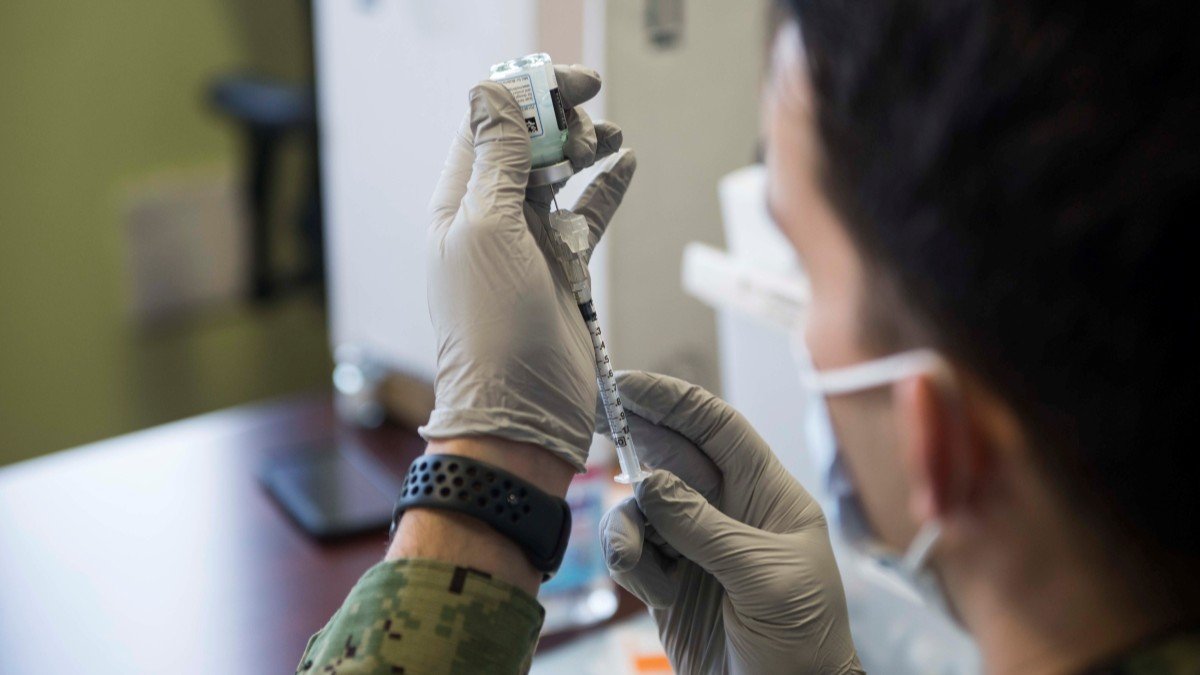
Image: Petty Officer 2nd Class Shannon Burns via DVIDS.
