

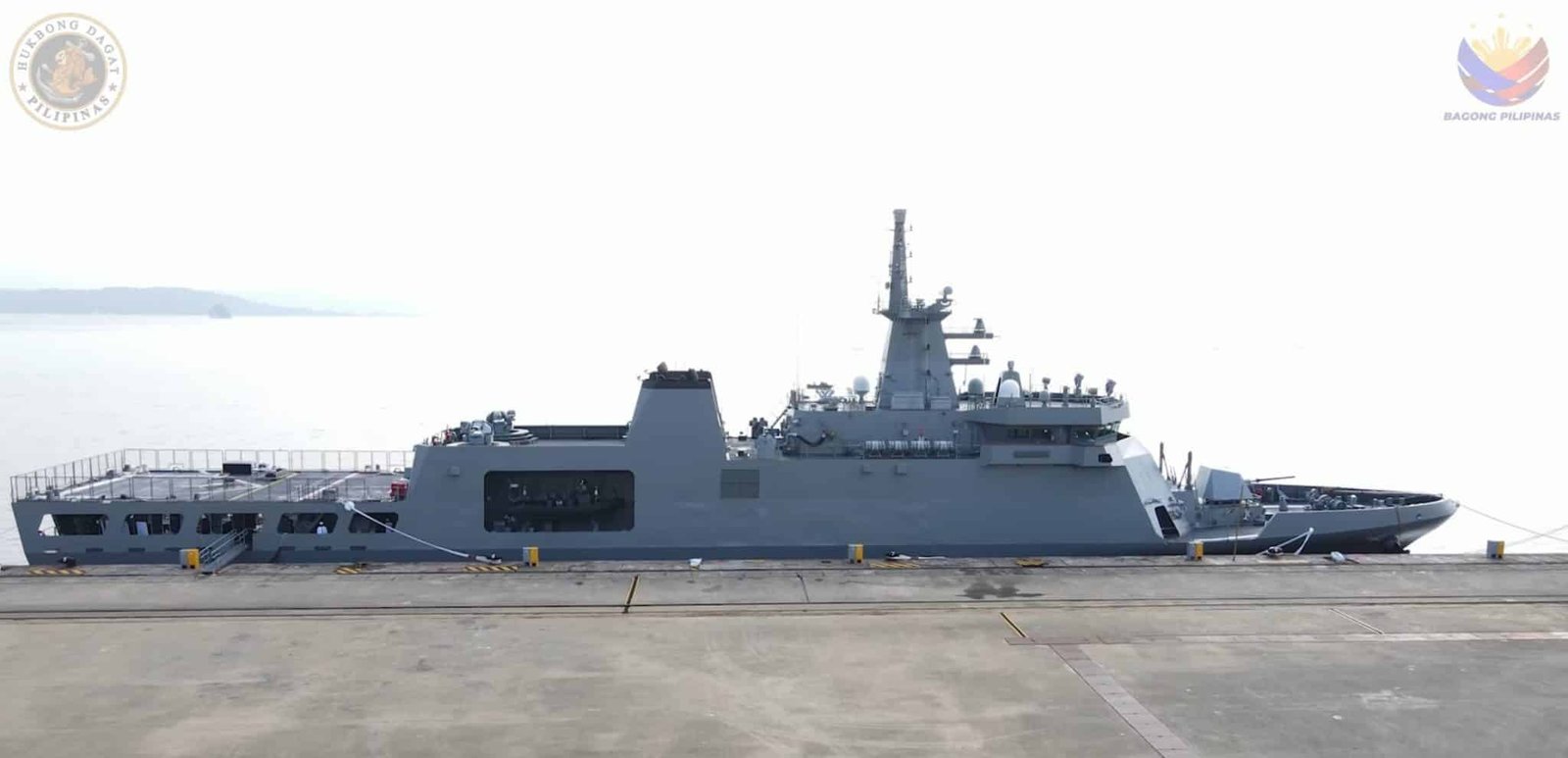
The Philippine Navy’s latest warship was spotted with vertical take-off and landing (VTOL) drones , which could enable enhanced maritime domain awareness operations from the service’s new offshore patrol vessels (OPV).
At least two VTOL drones were on BRP Rajah Sulayman’s (PS 20) flight deck during its arrival ceremony this week at Naval Operating Base Subic Bay. The 2,450-ton vessel is the first of a six ship class ordered from South Korean shipbuilder Hyundai Heavy Industries (HHI) to increase the service’s maritime presence across the Philippine exclusive economic zone. Manila’s naval modernization efforts have prioritized surface forces in order to counter increased Chinese activities in the South China Sea.
According to HHI, the OPV design that the Philippines procured could support unmanned aerial vehicle operations.

This is the first time that these rotorcraft-type drones have appeared on a Philippine Navy vessel. Previously, only ScanEagle unmanned aerial vehicles have been sported on the service’s surface combatants and amphibious vessels. While it is unclear what model of VTOL drone Rajah Sulayman was deploying, similar drones of this class such as the Schiebel Camcopter S-100 and High Eye Airboxer could operate at ranges of up to 180 kilometers.
These ranges could greatly enhance the service’s maritime domain awareness capabilities, as well as potentially relay information back to higher-command authorities during encounters with Chinese forces. Manila has long relied on unmanned aerial vehicles to provide live-feeds of encounters with Beijing’s military and paramilitary forces at several disputed maritime features, including Second Thomas Shoal. The deployment of these VTOL drones could expand and strengthen this existing surveillance network.
Compared to the six HHI guided-missile frigates currently in service or set to be constructed for the Philippine Navy, these OPVs will be used for lower-end patrol missions and anti-submarine duties. Their arrival will also supplement older Philippine blue water patrol assets, which have been overburdened with taskings over the last decade due to increased operational requirements in the South China Sea. The service has also eyed modular mission containers for potential installation aboard its vessels, which Naval News covered during the Asia Defense and Security exhibition 2024.
Integration of unmanned capabilities into the Philippine Navy has ramped up in recent years as the country shifts its defensive posture externally. Former Navy chief Toribio Adaci Jr told Naval News in a 2024 interview that the service needed unmanned surface vessels for surveillance purposes. “That’s how modern navies now evolve, using unmanned systems to complement manned systems,” Adaci said.
