

Explosive Weapons Killing Children at Scale Never Seen Before
LONDON, 20 November 2025— Explosive weapons are killing children on a scale never seen before as wars increasingly move into cities, responsible for a record 70% of nearly 12,000 children killed or injured in conflict zones last year, according to a Save the Children report.
For decades, children in war zones were more likely to die from malnutrition, disease, or collapsing health systems but as wars become more urban, bombs and drones are striking schools, homes, and hospitals – places that should be safe under international humanitarian law.
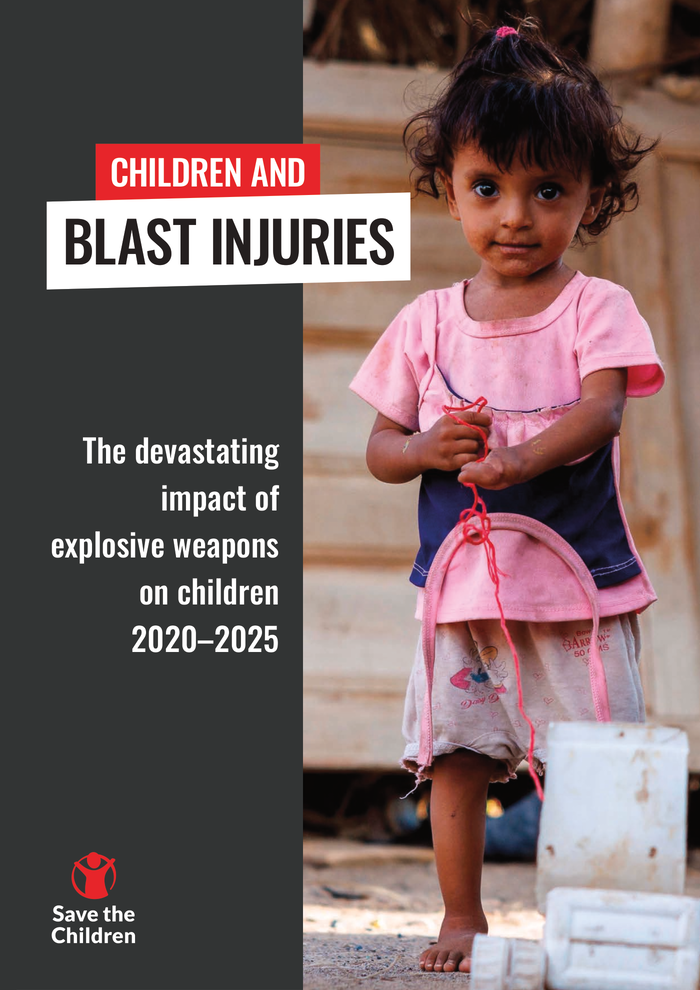
The new report, Children and Blast Injuries: The devastating impact of explosive weapons on children, shows that more than 70% of child casualties in war zones in 2024 resulted from explosive weapons. This compared to an average of about 59% from 2020-2024 and signals a shift in how children are being killed in modern conflicts.
For 2024, UN figures showed that 4,676 children were killed in conflict zones and 7,291 injured, bringing total casualties to 11,967. This was the highest number recorded and up by 42% from 8,422 child casualties in 2020 as wars became more urban, more destructive, and marked by growing impunity.
For three consecutive years government forces have been identified as the main perpetrators, largely due to their use of wide-area effect weapons in densely populated areas. State-made explosives now cause 54% of civilian deaths and injuries compared to 17% in 2020.
Save the Children said this was a consequence of the international community’s failure to hold governments to account.
Narmina Strishenets, Senior Conflict and Humanitarian Advocacy Advisor at Save the Children UK, and leading author of the report, said:
“The world is witnessing the deliberate destruction of childhood – and the evidence is undeniable.
“Children are paying the highest price in today’s wars – not only at the hands of armed groups, but through the actions of governments that should be protecting them.
“Missiles are falling where children sleep, play, and learn – turning the very places that should be the safest, like their homes and schools, into death traps. Actions once condemned by the international community and met with global outrage are now brushed aside as the ‘cost of war.’ That moral surrender is one of the most dangerous shifts of our time.
“We are watching the rules of war unravel. If we accept this as normal, we are accepting a world where childhood itself is under attack.”
Children’s smaller bodies and developing organs mean even a single blast can cause catastrophic injuries or death. Yet in too many conflicts, children are treated as “mini-adults,” their distinct medical needs overlooked -leaving those who survive to face lifelong pain, disability, and devastating mental health impacts.
A blast injury in a growing child is not a one-time wound, but a lifelong medical challenge, making recovery longer, more complex, and far more costly than for adults.
Dr Paul Reavley, Consultant Paediatric Emergency Physician, is a co-founder and chair of the Paediatric Blast Injury Partnership, a coalition between Save the Children UK and medical specialists. He said:
“Children are far more vulnerable to explosive weapons than adults. Their anatomy, physiology, behaviour, and psychosocial needs make them disproportionately affected.
“Many do not survive to reach hospital, and those who do face a higher risk of death than adult civilians in any health system. They often suffer multiple severe injuries that require complex treatment and lifelong care. Yet most health responses to conflict are designed for adults, overlooking children’s distinct needs. Survivors face chronic pain, disability, psychological trauma, and stigma that can last a lifetime.”
“Blast injuries are devastating for children and an enormous challenge for the healthcare workers who treat them. We must equip medics with the knowledge, skills, mental resilience, and facilities to care for the most severely injured children in the world.”
The report warns that modern wars ignore the long-term costs for children. Medical care, rehabilitation, and psychosocial support remain critically underfunded.
Protections for children in war are collapsing. Even with mounting evidence of indiscriminate attacks, accountability is almost non-existent. International courts lack power, and UN deadlock shields powerful states – fuelling a dangerous cycle of impunity. Major arms-exporting states, including the UK, continue to supply weapons to those responsible.
In response, Save the Children UK and Imperial College London, together with other international partners, established the Paediatric Blast Injury Partnership — bringing together medical specialists, humanitarians, and academics to improve outcomes for children injured by explosive weapons.
The Partnership’s Paediatric Blast Injury Field Manual arising from this collaboration — the first of its kind which helps medics in conflict zones treat children with blast injuries — has been translated into nine languages and is now used in 12 conflict zones including Ukraine, Syria, Yemen, and Afghanistan.
In 2023, it launched the Centre for Paediatric Blast Injury Studies at Imperial College London to strengthen global expertise, including improving research and care for affected children.
Professor Anthony Bull, Director of the Centre for Paediatric Blast Injury Studies at Imperial, said:
“Treating blast injuries is far from straightforward. It takes specialised knowledge and continued research to ensure children can not only recover but grow after amputation or surgery.
“The shocking findings of this report show how our partnership with Save the Children can help address this urgent humanitarian challenge by ensuring our research is reaching the people who need it most.”
A number of countries were identified among the deadliest conflicts for children in recent years , including the occupied Palestinian territory, where more than 20,000 children have been killed in Gaza since October 2023, and Ukraine, where over 3,000 children have been killed or injured since 2022.
The report also includes findings from Syria, Lebanon, Yemen, Somalia, the Democratic Republic of Congo, Mali, and Afghanistan, highlighting that children across multiple regions face severe risks from explosive weapons.
Save the Children is calling on world leaders to:
- Stop the use of explosive weapons in populated areas.
- Enforce stronger political and military policies to protect children in conflict.
- Invest in victim assistance, research, and rehabilitation for children affected by blast injuries.
ENDS
Notes to Editors
This report draws on United Nations Annual Reports on Children and Armed Conflict (CAAC) from 2021–2025, which track six grave violations against children:
- Killing and maiming
- Recruitment and use of children
- Sexual violence, Abduction
- Attacks on schools and hospitals
- Denial of humanitarian access
Data are supplemented by external sources including AOAV, Explosive Weapons Monitor, Airwars, ACLED, UNICEF, OHCHR, and ICRC to identify key conflict trends and blast-related harm affecting children. All figures are conservative due to access and verification limitations in active conflicts.
Clinical analysis is provided by the Centre for Paediatric Blast Injury Studies at Imperial College London, the Paediatric Blast Injury Partnership, and the University of Bath, highlighting:
- Medical realities of paediatric blast trauma
- Treatment challenges in conflict settings
- Innovations to improve rehabilitation and long-term recovery
All case studies and testimonies were collected with informed consent and anonymised. Names marked with an asterisk (*) have been changed to protect identities.
*******************************************************************************************************************
For further enquiries please contact:
For more information, please contact Shaima Al-Obaidi s.al-obaidi@savethechildren.org.uk
Our media out of hours contact is media@savethechildren.org.uk / +44(0)7831 650409
Please also check our X account @Save_GlobalNews for news alerts, quotes, statements and location Vlogs.
