

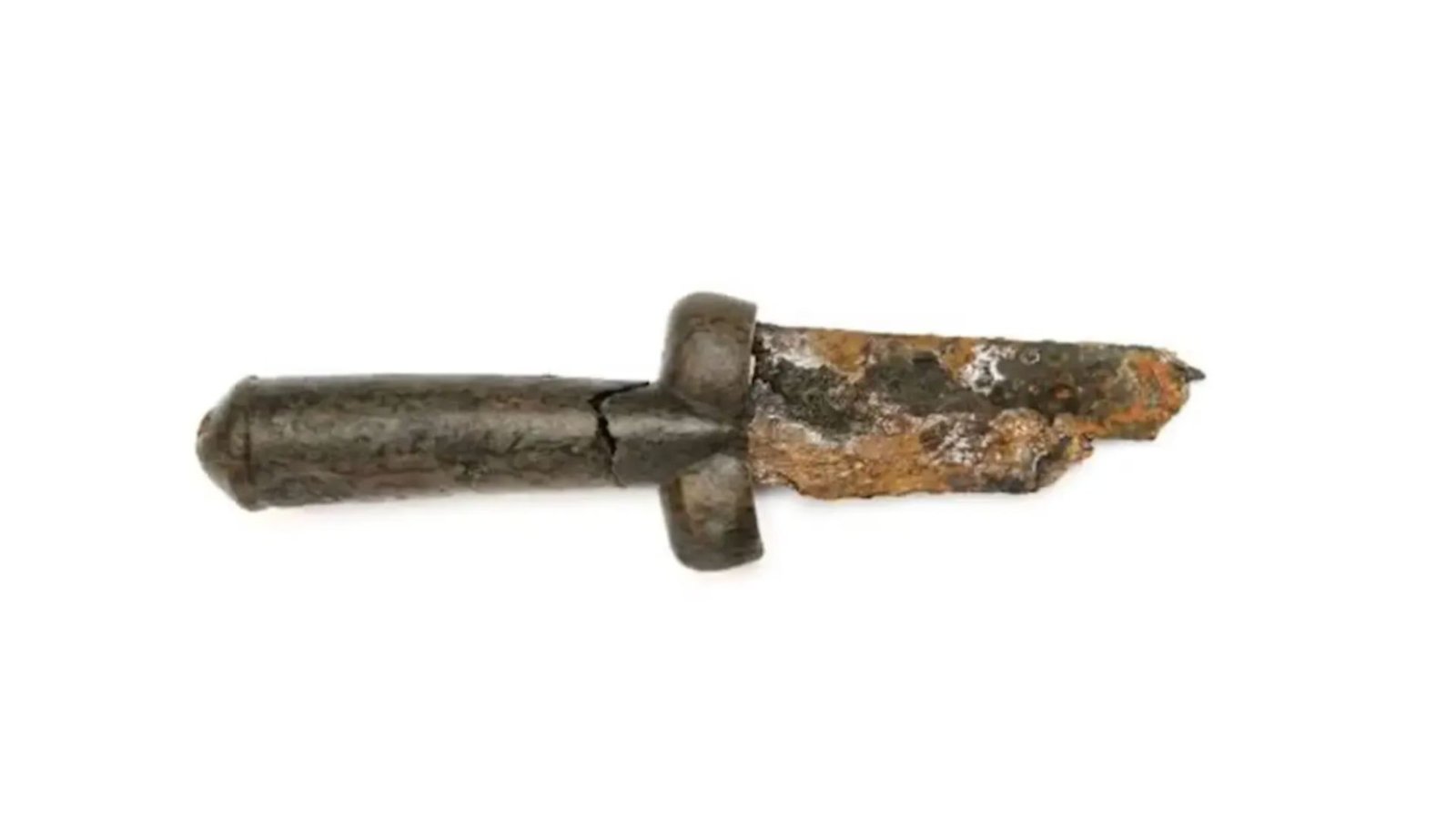
After a painstaking eight-year excavation in Sweden, archaeologists have unearthed a truly unique find: a medieval weapon with a wooden hilt shaped like testicles. This unusual design, researchers say, offered a superior grip and wielding abilities, so effective it could even pierce armor.
The distinctive artifact was discovered among other historical scraps at the renowned Gullberg Fortress in Gothenburg, providing compelling insights into daily life at a military outpost from the 14th to 17th centuries. While lying flat, the “testicle dagger” might seem curious, but when held upright, it was apparently capable of delivering a significant blow, marking it as a remarkable addition to military history.
Described as “flamboyant,” the original owner of this striking weapon remains a mystery, but its peculiar shape undoubtedly offered a tactical advantage. Beyond this intriguing, nature-inspired weapon, the nearly decade-long recovery mission has brought a vital piece of Swedish history vividly back to life.
A fortress complete with testicles
Photographs portray the Gullberg Fortress as a lone medieval sentinel amidst a modern urban landscape. Its rediscovery was prompted by the impending construction of a new train station, initiating the archaeological mission between 2014 and 2018.
Strategically overlooking the Göta River, this area once served as Sweden’s sole access point to the North Sea, at a time when much of the western coast was under Danish-Norwegian control. The fortress itself was sacked twice, necessitating multiple renovations and rebuilds – a tumultuous history that lends a humorous context to the discovery of the “testicle dagger.”
While the iron blade of the dagger showed some damage, its wooden hilt, crafted from curly birch, has remarkably withstood the test of time, clearly retaining its phallic form. Archaeologists interpret its existence as evidence that the fortress was frequently under attack, demanding smart weapons optimized for close-quarters combat.
Far from being a mere boast, its distinctive yet practical design would have given its wielder a critical edge in damaging enemy armor with a more secure grip.
In addition to this ingenious dagger, archaeologists uncovered architectural remains and artifacts, including houses, walls, 16th and 17th-century earthenware, and even the basement of a tower.
The home of the testicle dagger was frequently sacked
Originally a border fortress built in the 14th century, Gullberg served as a military stronghold for centuries, with additional defensive structures erected on the same site until the 19th century.
Working with on-site discoveries, historical sources, and maps, archaeologists pieced together a detailed picture of life within its walls, a scope that even surprised them. “We didn’t think there would be as much left as there was,” they stated in a press release.
Researchers observed diverse different construction techniques, primarily utilizing stone and brick, with other sections built from earthen ramparts and timber. The basement room proved “particularly exciting” due to its remarkably preserved staircase, floor, and intact sections of walls and ceiling. Among the other significant finds were crossbow arrows, cannonballs, a sundial, beer taps, a soup cup, and a sand spreader.
Several of the artifacts, alongside a 3D model of the 17th-century Gullberg fortress, are currently on display in the “Current Archaeology” mini-exhibition at the Historical Museum in Stockholm, Sweden, a press release concludes.
