

South Korean military cryptosystem still depends on hardware\n”Are you going to mount hardware cryptographic equipment on drones?”
“Our military communication network still relies on hardware cryptographic equipment, making it difficult to operate properly on advanced IT devices, drones, and 5G network-based battlefields,” Yoo Yong-won said on the 24th. “Now, it is urgent to switch to a software-based encryption system like the United States.”
Yoo Yong-won, a member of the National Assembly’s National Defense Committee, made the remarks at a parliamentary inspection of the Army headquarters at Gyeryongdae.
“The U.S. and major advanced countries have already gradually shifted their hardware-oriented encryption systems to software methods since the late 2000s,” Yoo said. “Thanks to these changes, commercial IT devices can be used militarily at a minimum cost and in the shortest time.”
“The U.S. Army has electrified Samsung Electronics’ Galaxy S9 Tactical Edition since 2019, and is currently operating S20 and S23 Tactical Edition in practice,” lawmaker Yoo said. “Software-based encryption systems are applied to these terminals.”
“Our military has yet to recognize only national hardware encryption equipment, so it has a long electrification cycle and is not able to respond quickly to changes in the operating environment,” he said. “For example, mounting hardware encryption equipment on drones and unmanned vehicles causes major restrictions in weight, power consumption, and linkage, which reduces operational efficiency.”
“The U.S. Department of Defense and the National Security Agency (NSA) have already operated the “CSfC (Commercial Solutions for Classified)” system to certify commercial security products developed in the private sector to be used in military communication networks,” Yoo said. “Thanks to this system, the U.S. military was able to quickly apply advanced smart devices, AI, and cloud technologies to military operations.”
The “CSfC (Commercial Solutions for Classified)” system is a commercial cryptographic product certification program operated by the U.S. National Security Agency (NSA), which verifies and approves security technologies made by private IT companies and allows them to be used for secret communications by military and government agencies. CSfC-certified devices or software can replace or operate existing military hardware encryption equipment, and can achieve three effects at the same time: rapid technology introduction, reduction of operating costs, and improved interoperability.
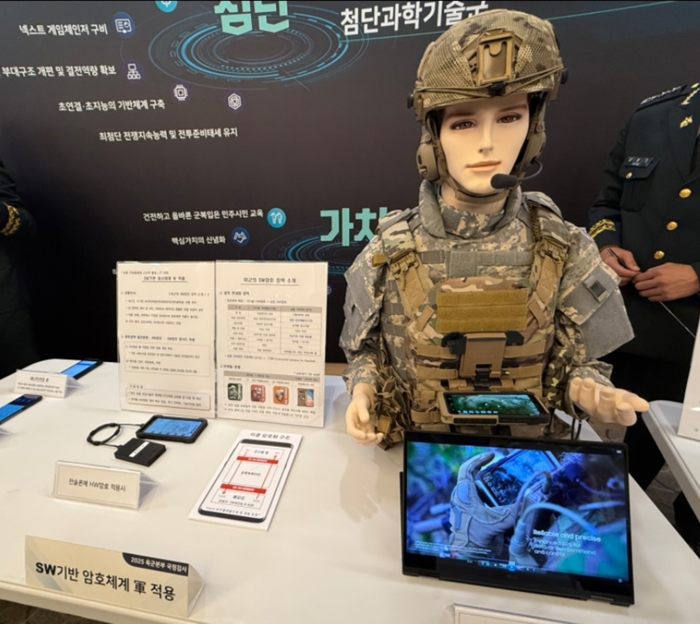
![A software-based encryption system military application model is being introduced at the Army Headquarters National Audit Office. [Photo source = Yoo Yong Won's office]](https://wimg.mk.co.kr/news/cms/202510/24/news-p.v1.20251024.f69922659e004290a4bc55f642910e45_P1.png)
“On the other hand, our military does not have such a system, so we treat private technologies only as ‘private,'” lawmaker Yoo said. “We need to design a flexible system that applies a software-based encryption system in parallel according to the security level.” “Cryptographic system innovation is not just a security problem, but a problem that determines operational efficiency and speed of electrification,” he said. “In the era of multi-day warfare, where drones, AI, satellites, and data links are intertwined at the same time, a fast and interoperable software encryption infrastructure is essential.”
In order to overcome these technological and policy limitations, we are pursuing the ‘Special Act on Rapid Acquisition of Software-Centered Weapons Systems’,” he said. “This law is aimed at flexing defense business procedures so that the military can keep up with the pace of private technology development and promoting full-scale software innovation from cryptography and communication systems to AI-based battlefield management.”
“As defense science and technology evolve rapidly, lowering the institutional threshold so that the military can absorb and use civilian technology safely and quickly is a real security innovation,” lawmaker Yoo said. “We will actively support the paradigm shift of the cryptographic and security system by cooperating with the Ministry of National Defense in the future.”
