

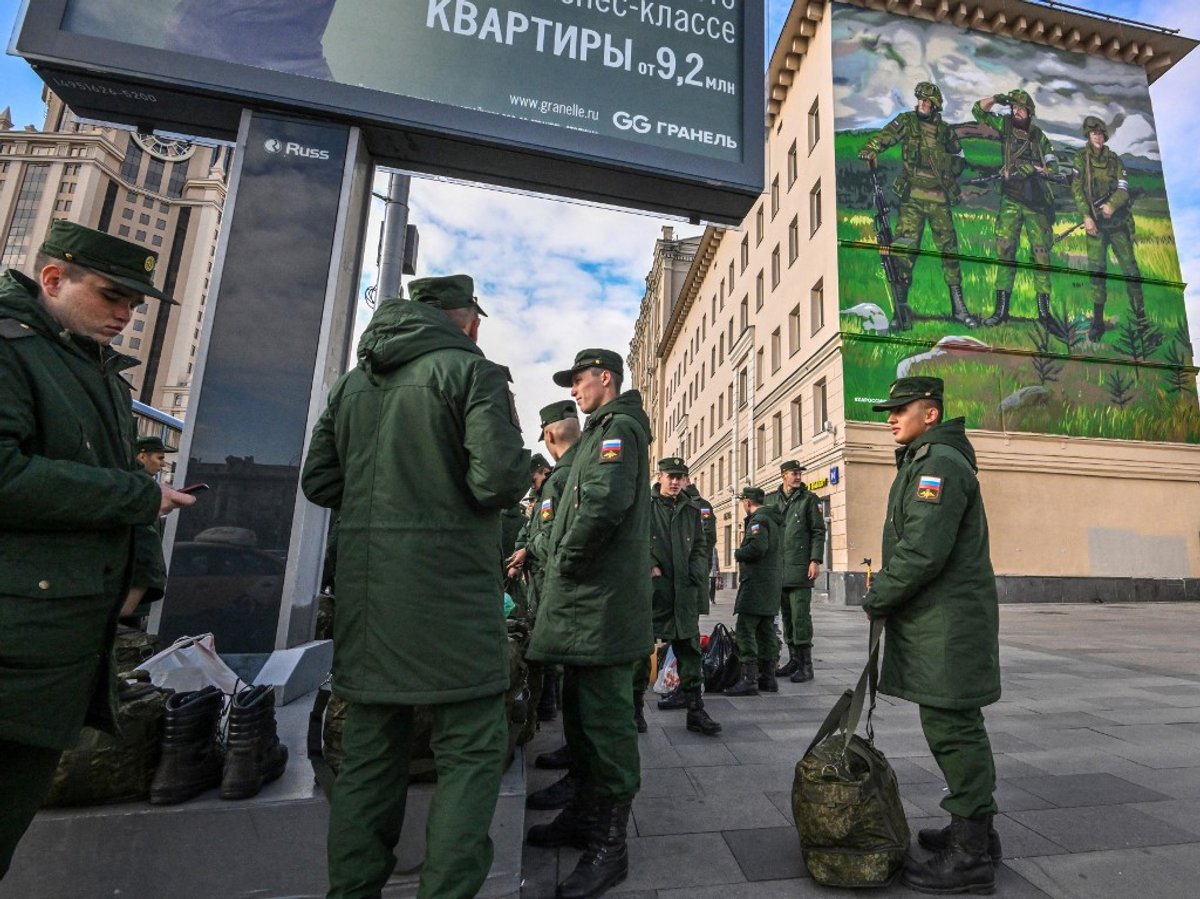
Russian officials are moving to order thousands of civilian reservists into active army service – but they promise the men about to be forced back into uniform aren’t supposed to be sent to Ukraine to fight.
Russian Navy Vice Admiral Vladimir Tsimlyanskiy, Deputy Chief of the Main Organizational and Mobilization Directorate of the General Staff, on Tuesday announced he had issued orders that men who had been drafted and served in the military, and who currently are civilians, will be subject to mandatory “mobilization” for the purpose of “safeguarding strategically important facilities.”
JOIN US ON TELEGRAM
Follow our coverage of the war on the @Kyivpost_official.
Tsimlyanskiy at a Moscow press conference reassured that the public authorities are not mobilizing men to be sent to Ukraine to take part in combat, but rather to serve as security troops in response to increased Ukrainian drone threats against Russian civilian areas. They would remain inside Russian Federation territory and their mission would be “rear area security,” he said.
Independent Russian media were quick to point out that, by Russian law, the former civilians might still be sent to battle in Russia’s Kursk region, where Ukrainian forces hold an enclave of Russian Federation territory, or in Russia’s Belgorod or Bryansk regions, where Ukrainian forces had raided across the international frontier for years.
Russian soldier accounts, some by prisoners of war to Kyiv Post, confirm that once in a unit a Russian service member often faces heavy pressure from his chain of command to sign up as a contract soldier, making him eligible for deployment to Ukraine. In some cases men are beaten or imprisoned to force them to sign up.
Other Topics of Interest
Russian Fighter Aircraft Violate Lithuanian Airspace
Lithuania’s foreign ministry summoned Russia’s chargé d’affaires over the 18-second incident.
Guarding Russian military bases and critical infrastructure is, in any case, far from an automatically safe job. According to open source reports and Ukraine military statements, Armed Forces of Ukraine (AFU) units launch hundreds of strikes against Russian military and military infrastructure targets daily, some up to 2,000 kilometers inside Ukraine. Since late July the priority Ukrainian targets have been Russian energy industry infrastructure, and arms and munitions manufacturing.
Defense Minister Andrey Belousov on Oct. 13 announced Russian military manpower policy would shift from twice-a-year call-ups of draft-liable 18- and 19-year-olds, to a strategy of “rolling mobilization,” allowing authorities to conscript men into military service, or mobilize selected reservists, on a continual basis.
The change made legal rolling and selected call-ups of new recruits and trained reservists without widening involuntary draft obligations on young men, or putting tens of thousands of civilian reservists on notice that they would be forced to return to military service.
Both measures would be politically risky and potentially dangerous for the authoritarian regime of Russian President Vladimir Putin, which has never officially acknowledged its invasion of Ukraine is a war, and whose state-controlled media push a narrative of general peace and prosperity in Russia.
Belousov said the mobilization law changes were needed to improve Russian national security and during the announcement made no direct reference to Russian combat losses in Ukraine.
Practically all other sources reporting on the reservists’ mobilization – independent Russian media, international security research groups and Ukrainian media – linked the moves directly with heavy losses suffered by Russian forces in Ukraine, particularly in the past nine months during repeated frontal attacks against prepared Ukrainian defenses, which have captured almost no ground.
Independent Russian watch groups point to tens of thousands of Russian soldiers confirmed killed, wounded or missile in battle, with casualty rates rising in 2025 following widespread use of “death zone” tactics by Ukrainian forces along an effectively static 1,000+ kilometer-long fighting line. In an Oct. 13 evaluation of the new Russian mobilization plan and an Oct. 14 report on Russian losses, the US-based Institute for the Study of War (ISW) said the Kremlin objective was to find replacements for soldiers killed and wounded.
“The changes will allow Russia to deploy reservists during peacetime, expanding the current legislation that only allows Russia to deploy reservists during mobilization or wartime. This enables the Kremlin to employ reservists in its war in Ukraine,” ISW wrote.
“Russian forces continue to suffer high losses and require constant reinforcements to sustain offensive operations… The Kremlin likely approved amendments to mobilization laws to enable more flexible use of reservists amid these ongoing manpower needs.”
The British Economist magazine on Oct. 18 published a report suggesting that from January to September 2025 Russian forces lost at least 100,000 men killed or missing in action to capture about one half of a single percent (0.4%) of Ukraine’s sovereign territory.
According to data compiled by the Iceland-based political scientist Ragnar Gudmundsson, a leading Russo-Ukrainian War statistician, since invading Ukraine in February 2022 the Russian military has potentially lost 1,134,170 casualties of all types, among then 299,971 killed in action. In the first nine months of 2025 Russian forces averaged more than 1,000 men killed or wounded every 24 hours, and in days of peak fighting the figure was around 2,000 a day, current data published by Gudmundsson showed.
Russian casualty rates have rocketed because of improving Ukrainian defensive tactics. First implemented by individual Armed Forces of Ukraine (AFU) units in early 2023 the tactic – now common across the AFU – deploys swarms of observation and FPV drones, backed by mortars, artillery and rocket artillery to blanket a wide no-man’s-land space between Russian and Ukrainian forces.
Russian troops ordered to attack a Ukrainian position are forced to run a gauntlet 10-30 kilometers wide before reaching an objective. Russian assault unit participants and Ukrainian defending units typically report 70-90 percent of attackers are hit en route. Kamikaze and bomber drones hunt down survivors.
In a series of assaults against positions held by Ukraine’s 1st National Guard Corps “Azov” defending the battlefield city Pokrovsk near a village called Shakhove, from Oct. 10 to Oct. 16, Russian tank and infantry fighting vehicle columns advanced on Ukrainian positions four times and were repeatedly repelled, losing dozens of armored vehicles and close to 300 men.
Ukrainian strike drone and ground force units participating in the battles published drone video documenting about half of the claimed Russian casualties in men and equipment. According to 1st Corps press statements, Kremlin forces lost 8 tanks, 40-45 infantry fighting vehicles, 4-8 armored personnel carriers, 1 armored recovery vehicle, more than 41 motorcycles, at least 300 Russian soldiers and officers killed and wounded, and two automobiles.
The Ukrainian 82nd Air Assault and 93rd Mechanized Infantry Brigades, along with the drone strike units SSO special operations, Phoenix and Kryla Omega, published geolocated content confirming about half of the claimed Russian losses.
Russian and Ukrainian sources identified Russia’s 40th and 155th Naval Infantry “Marine” Brigades as the formations leading the attacks and suffering the losses. Kyiv Post review of Russian Telegram channels associated with those units confirmed heavy recent losses, and line soldier complaints against alleged “cannon fodder” tactics used by their commanders.
