

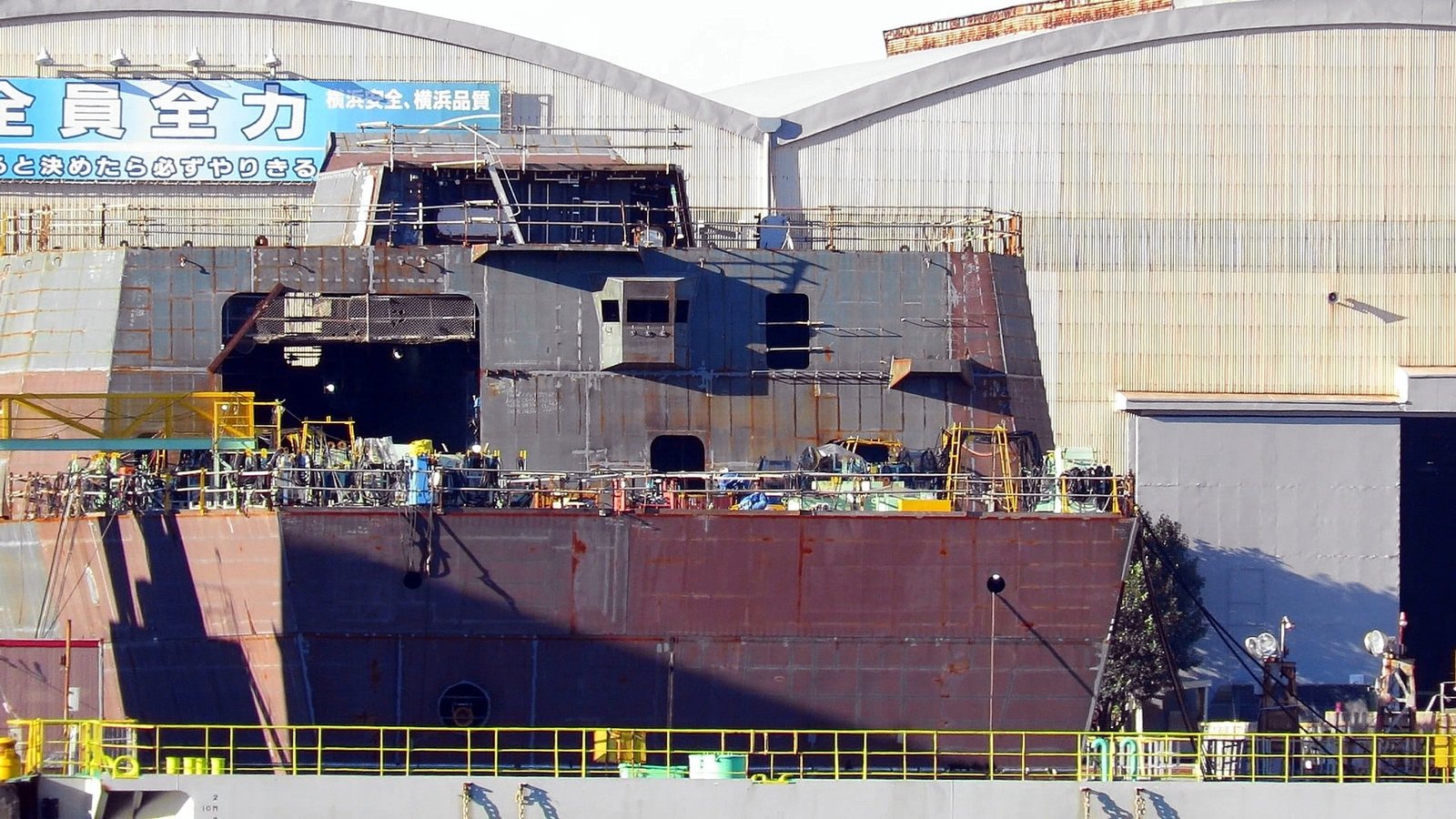
New images from Japan Marine United’s Isogo shipyard in Yokohama show a large hull section believed to be part of the second of two ASEV ships that Japan is building for ballistic missile defense.
A massive hull block thought to be the stern section of Japan’s second Aegis System Equipped Vessel (ASEV) has come into view at Japan Marine United’s (JMU) Isogo shipyard in Yokohama. The vessel is scheduled to launch in fiscal year 2027, with Japan’s Ministry of Defense aiming to commission it by the end of March 2029.
Ship spotter AGC Hatch (@agcdetk) posted a video of the vessel under construction on YouTube on November 21. The footage shows a gray superstructure rising above a reddish-brown hull section, surrounded by scaffolding and featuring a large aft opening consistent with a hangar or stern bay. A wider view shows the block positioned in front of shipyard buildings with a red crane to the right.
Assessing Hull Assembly at Isogo
Ship spotter AGC Hatch told Naval News that overhead imagery on Google Earth appears to show the stern block already joined to adjacent hull sections.
However, based on the ground-level photos, he assessed that the stern block may be resting on raised supports in the dock while the bow and midship sections remain under construction nearby. Because of the viewing angle, it is difficult to determine from the new photographs how far the visible block extends or whether other sections have already been mated to it. At roughly 12,000 metric tons standard displacement, the ASEV will be about 50 percent heavier than the 8,200-ton Maya-class destroyers.

Two Ships Under Construction at Separate Yards
As Naval News previously reported, Japan’s Acquisition, Technology and Logistics Agency confirmed in March that the second ship was laid down at Isogo on February 5, 2026. The lead ship was laid down on July 18, 2025, at Mitsubishi Heavy Industries’ Nagasaki Shipyard. It is scheduled to launch in fiscal year 2026, which ends in March 2027, with commissioning targeted for the end of March 2028.

Built for Sustained Missile Defense Patrols
Japan decided in 2020 to build two ASEVs after abandoning plans to deploy the land-based Aegis Ashore system. The ships are intended to sustain ballistic missile surveillance at sea and ease the patrol burden on the JMSDF’s eight existing Aegis destroyers.
Each ship will measure about 190 meters in length and 25 meters in beam. The large hull is designed to improve stability in rough seas and support extended patrols. The ships will use the AN/SPY-7(V)1 radar, with four fixed antenna arrays, to detect and track ballistic missiles and other targets. Estimated procurement costs are about 392 billion yen (about $2.5 billion) per ship.
Each ASEV will have 128 vertical launch system (VLS) cells, compared with 96 on the Maya class. Planned weapons include the SM-3 Block IIA ballistic missile interceptor, jointly developed by Japan and the United States, and the SM-6, which can engage threats including hypersonic glide vehicles in the terminal phase of flight.
The two ships are expected to carry the hull classification symbol CG, for guided-missile cruiser. The JMSDF’s existing Aegis destroyers carry the DDG designation. Once commissioned, the ASEVs will be Japan’s largest Aegis-equipped ships.
Source: navalnews.com. Summarised by TBH Center; all rights to the original reporting remain with the publisher.
