

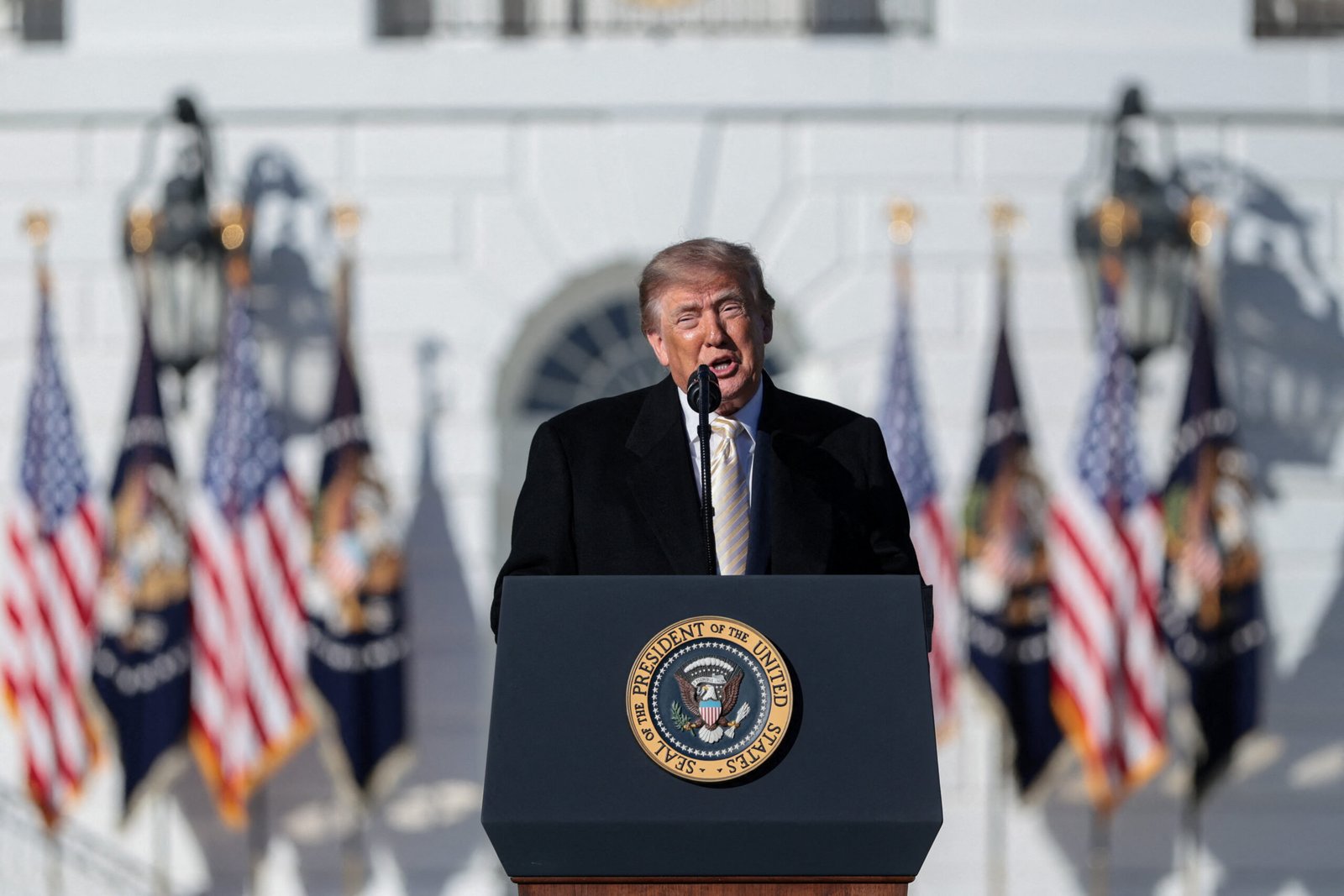
As per tradition, the US president pardoned two turkeys this week ahead of today’s Thanksgiving celebrations. But at the same time, he took two actions to demonstrate that he would do everything possible to keep lame duck off the menu.
President Donald Trump’s central role in the extraordinary resurrection this week of Nvidia CEO Jensen Huang is just one of several recent signs that Trump’s loss of congressional majorities might even increase his appetite for executive authority.
Further evidence of that emerged yesterday, when the Trump administration announced that it will impose new tariffs on fourteen partners, including China, the European Union, Japan, and India, charging them with creating and sustaining structural excess capacity in a manner that undermines US producers. In contrast to last year’s “Liberation Day” tariffs, many of which were struck down in February by the Supreme Court, the Atlantic Council’s Josh Lipsky reports that these new measures seem designed to last.
Even before Democrats take control of Congress in January, Trump has demonstrated his willingness to intervene in the affairs of one of the world’s most consequential companies and in the United States’ top trading relationships. And he did this even though Democratic lawmakers are gearing up to try to repeal the tariffs he already has in place.
If these moves are any indication of what’s to come, the next two years could bring more of a contested presidency than a diminished one—characterized by a collision of powers in Washington. As with previous presidents, Trump will retain considerable executive room for maneuver, particularly in foreign affairs, even as the incoming Congress will gain powerful instruments to contain him through investigations, oversight, and appropriations.
For history buffs, the term “lame duck” has its origins in eighteenth-century England, first appearing in a 1761 letter by English writer Horace Walpole and subsequently becoming financial slang for bankrupt or defaulting speculators, likening them to an injured fowl struggling to keep up with the flock. From there, it spread to the American colonies, where a century later it referred to a defeated official serving out the rest of his term of office.
Perhaps another metaphor is needed for Trump. One Middle Eastern leader, whom I spoke to shortly after the midterms, instead turned to soccer to describe what his country expects from Trump through the rest of his second term. “He’s going to go from being a striker to a goalkeeper,” the official said, given how many incoming shots from new Democratic majorities Trump will have to defend against. I challenged this official, arguing Trump’s fundamental character as a striker might only increase, leaving his net open, if necessary, to score goals of his own.
Yet this is no game, and Americans will be wrestling with this messy redistribution of power at home at precisely the moment when the world is wrestling with the redistribution of power internationally. With wars in Europe and the Middle East that are bleeding across borders, and with tensions between the US and China threatening to escalate, the next two years could be among the most dangerous of our lifetimes.
That’s particularly the case because we are in the midst of a generational technological revolution driven by artificial intelligence (AI), the economic, military, and societal consequences of which we’re only beginning to comprehend. News last Friday that AI had cracked “math’s holy grail,” the long-unproven Riemann hypothesis, is just a glimpse of this technology’s transformative capability. AI industry leaders themselves have pointed to the rising perils of catastrophic risk, including greater access of nonstate actors to cyber or biological weapons.
On the positive side, the midterms demonstrated US democracy’s continued resilience at a time when many in the world had begun to question Washington’s ability to self-correct. The danger is that Americans will spend the next two years so consumed by their struggle over power at home that they fumble their ability to shape world affairs. The rest of the world won’t wait for our next presidential election in 2028.
Here’s some of what to watch over the next two years:
The impact of divided government
President Harry S. Truman suffered a massive midterm election setback in 1946, with his party losing control of both the House and the Senate for the first time in more than a decade. Despite that, Truman achieved historic foreign policy milestones, including the Marshall Plan, the Berlin Airlift, and NATO, by forging a bipartisan Cold War consensus. He did this by building key alliances with internationalist Republicans, most importantly Senator Arthur Vandenberg of Michigan, the chairman of the Senate Foreign Relations Committee.
Don’t expect any such common cause between Trump and Democratic Senator Chris Coons of Delaware, who is widely expected to chair the Senate Foreign Relations Committee. What’s likely to poison the well are deep differences over key issues regarding Ukraine and Iran and widening Democratic investigations into the Trump administration’s alleged conflicts of interest. Rep. Jamie Raskin of Maryland, who is expected to lead the House Judiciary Committee, has already sought records from companies backed by 1789 Capital, which the president’s son Donald Jr. joined as a partner soon after his father was elected in 2024.
The dangers of escalation in Ukraine
The Financial Times reported on Tuesday, quoting two Ukrainian officials and a third person familiar with the situation, that Secretary of War Pete Hegseth has held up delivery of some sixty US-designed and US-produced PAC-3 and PAC-2 interceptors, which are being paid for by Western allies. They are the only effective defense against Russian ballistic missile attacks on Ukrainian civilian targets.
The danger lies in Russian President Vladimir Putin’s potential misreading of the situation, seeing it as a window in which he can escalate in Ukraine with impunity. He knows that any future US president is likely to be less critical of Ukrainian President Volodymyr Zelenskyy than Trump, who recently referred to the Russian president as a “friend.” Conversely, a more pro-Ukraine Congress could ratchet up pressure on Trump to support Ukraine, complicating any Russian calculation that US support will decline.
The problem for Putin is that his troops in Ukraine have been stuck for months. And he has already substantially increased the one thing that he can do there—bombing Ukrainian civilians and civilian infrastructure. But “strategic bombing” by itself does not win wars. The more likely next move for Putin is to intensify his hybrid attacks on Ukraine’s European supporters, while ramping up his charm offensive with Trump to get him to further pressure Zelenskyy to accept dubious Kremlin peace conditions.
The perils of an unresolved Iran war
While both Democratic and Republican senators have criticized Trump’s handling of Russia’s war on Ukraine, the line has been more firmly drawn on Iran. Democrats are almost universally critical, and momentum against the Iran war has grown in the GOP—with even Vice President JD Vance singling out the war as harming his party’s political fortunes.
Seizing on Republican divisions, Democratic members of Congress, buoyed by an election outcome driven in no small part by public opposition to the war and its consequences, will look for budgetary and other ways to constrain Trump. For the moment, Trump has been focused on keeping up the economic pressure on Iran, which since the midterms has become an even more intransigent negotiator.
The danger is that Iran’s Islamic Revolutionary Guard Corps, pumped up on the conviction that Iran has brought about shifts in power in the United States and perhaps even in Israel, may undertake actions to escalate the war against regional neighbors or against US troops in the region, which may then prompt Trump to escalate.
The illusion of great-power stability
Last week’s unprecedented trilateral meeting in Shenzhen between Trump, Putin, and Chinese President Xi Jinping provided the spectacle of great-power stability. The truth is otherwise. With Putin’s designs on Ukraine and Xi’s designs on Taiwan—and with Trump failing to take a strong stand on either—the danger of miscalculation is growing.
Meanwhile, as the Economist reports in its must-read special issue The World Ahead 2027, “The real story in geopolitics is the deepening collaboration between four autocratic, anti-Western regimes: China, Russia, Iran and North Korea. … And as Mr. Trump weakens America’s wider and deeper network of alliances, America’s foes are quietly helping each other.” The Economist dubs this alignment “the axis of malice.”
The intersection of economic and technological volatility
The Nvidia episode this week, which sent markets on a roller-coaster ride, underscored how interconnected corporate fortunes, national security, technological leadership, and financial markets have become. Any upset in one sphere can reverberate across the others. How will AI-driven productivity growth interact with the accumulating pressures of debt, economic disruption, and geopolitical competition?
Source: atlanticcouncil.org. Summarised by TBH Center; all rights to the original reporting remain with the publisher.
