

This article is part of a wider series in partnership with Football Manager 26, which looks at the strengths and weaknesses of famous historical and contemporary tactics.
Pep Guardiola famously referred to them as “nothing more than phone numbers”, but there is little doubt that formations can be a digital code used to unlock the broad principles of a manager’s tactical strategy.
There is no single way to set up a team. Each formation has its own strengths and weaknesses, and can vary significantly depending on the roles a manager is asking their players to fulfil. Given the fluidity of the game, teams will often shape shift depending on the sequence being played — although perhaps not quite as frequently as Arsenal boss Mikel Arteta has previously suggested.
“The other day (against Fulham), there were 36 different formations in the match. Against Manchester City — 43,” Arteta told reporters in 2023. “I don’t know what formation we’re talking about. It’s something very different from the way that you look.”
There is a facetiousness to Guardiola and Arteta’s statements, but it is important to distinguish between different phases of play when analysing certain formations — at its simplest, in-possession and out-of-possession setups.
The 4-2-3-1 formation has been one of the most prominent systems used across Europe since the turn of the century, adopted by some of the best tacticians in modern football. With that in mind, allow The Athletic to walk through a potted history of its use — including its biggest proponents, the key roles that define it, and how its popularity has evolved.
After years of a 4-4-2 being the prevailing setup across Europe in the 1990s, former Manchester City assistant manager Juanma Lillo was an early exponent of the 4-2-3-1 system in the early 2000s during his time in Spain.
The focus was to provide more attacking numbers in advanced areas to maintain territorial dominance, with a midfield pair — or ‘double pivot’ — providing the defensive foundation behind a nominal front four. While City boss Guardiola has used a 4-3-3 more often in his managerial career, his methods follow Lillo’s approach in using positional play to create more passing angles and greater numerical advantages at the sharp end of the pitch.
Juanma Lillo, pictured working for Manchester City in 2023 (Michael Regan/Getty Images)
In truth, the emerging 4-2-3-1 was not overly dissimilar from the dominant 4-4-2 of the era, where certain players engaged more as a withdrawn striker. In the Premier League, think Dennis Bergkamp, Eric Cantona, Teddy Sheringham — all of whom would be comfortable dropping off from the front line to link midfield and attack.
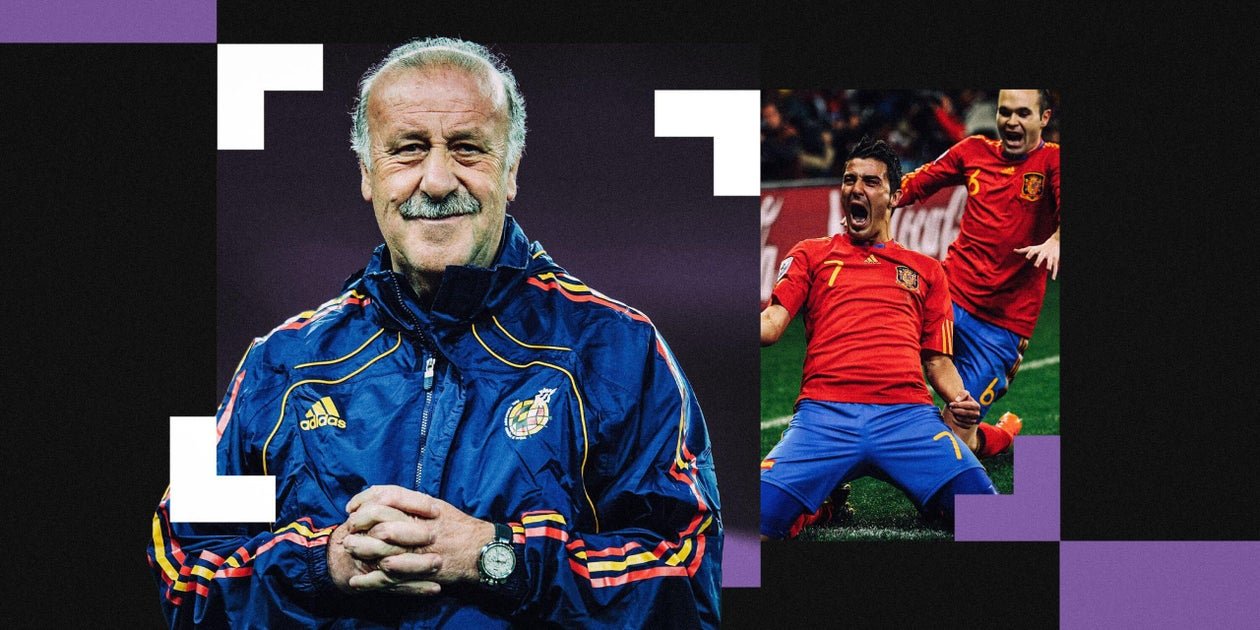
Jose Mourinho, Rafael Benitez and Mauricio Pochettino were notable managers who used a 4-2-3-1 going into the 2010s, but it was arguably on the international stage that the system garnered its greatest success. Spain’s era of dominance between 2008 and 2012 under Luis Aragones and Vicente del Bosque saw them win two European Championships and a World Cup with a midfield that was laden with technical talent.

During Euro 2008, Aragones favoured Marcos Senna as a single pivot, but Spain moved to two holders under Del Bosque. Sergio Busquets and Xabi Alonso became their midfield pairing, as Xavi pushed ahead.
By Euro 2012, midfielder Cesc Fabregas often played as a ‘false nine’ while Andres Iniesta (left) and David Silva (right) would drift inside from their wide roles onto their stronger foot. The result was comprehensive, with Spain only conceding one goal en route to the 4-0 victory over Italy in the final.
Fast forward to today, and Hansi Flick’s Barcelona, Arne Slot’s Liverpool, and Vincent Kompany’s Bayern Munich are notable examples of the system being operated at the highest level — albeit with qualitatively different wide roles to the previous era.
Where previously Samir Nasri (Arsenal and Manchester City), Juan Mata (Chelsea and Manchester United), and Silva (Manchester City) were ball-to-feet technicians being played in wide roles, modern-day inverted wingers are more likely to use their pace and trickery when hugging the touchline — underpinned by Mohamed Salah (Liverpool), Lamine Yamal (Barcelona) or Michael Olise (Bayern Munich).

The dominant attacking position within this formation is the role of the ‘No 10’ — or attacking midfielder.
This role has traditionally been reserved for players with the greatest flair, possessing an ability to open up defences with their deftness of touch and eye for a pass. These profiles are often the team’s luxury player — historically, think Roberto Baggio, Ronaldinho, or Mesut Ozil — who had the freedom to service the lone striker ahead of them.

Roberto Baggio at the 1994 World Cup (Omar Torres/AFP via Getty Images)
Coupled with inverted wingers coming inside onto their stronger foot, the idea behind this system is to create those numerical advantages going forward. Full-backs are encouraged to get up the pitch to support the attack and provide greater width, often creating a front five across the pitch as the No 10 drifts between the lines.

The role of the double pivot is to protect the centre-backs and provide the defensive foundation when the team is attacking. Often, one of the pair is more offensive or box-to-box in their profile, with the other being more of a traditional, defensive-minded midfielder whose strengths are to break up opposition attacks.
As is well-established in modern football, having an “attacking five” and “defensive five” is clear within this structure when a supporting player goes forward from full-back or midfield.
Crucially, this midfield double pivot requires discipline out of possession, particularly against an opponent with a midfield three (or midfield diamond), where there is greater vulnerability to a numerical overload.
To combat this, a 4-2-3-1 can be morphed into multiple defensive shapes depending on the head coach’s preference. As highlighted below, teams can be aggressive in going player-for-player (often led by the lone striker) or fall back into a 4-5-1 or 4-4-2 defensive block.
The defensive role of the No 10 is particularly notable. Where previously, these creative players often played without much defensive responsibility, modern head coaches are likely to ask their attacking midfielder to join an aggressive press or retreat into a structured block alongside the striker or fellow midfielders.

The 4-2-3-1 was arguably at its most prominent in the early 2010s.
As the decade progressed, the influence that Guardiola had on European football at Barcelona, Bayern Munich and Manchester City meant there was greater focus on a single pivot and two ‘free eights’ (midfielders who contribute to attack and defence), or a situational ‘box midfield’ employed by stepping a full-back inside along the anchoring midfielder when his team were in possession. Perhaps it is of little surprise to see that the Premier League experienced a downturn in this system upon his arrival in England in 2016-17.
With greater importance placed on controlling the midfield, more teams sought to emulate the 4-3-3 formation and provide greater strength in the middle third of the pitch.
However, there is evidence to suggest a 4-2-3-1 structure is experiencing a renaissance in the Premier League. Chelsea, Liverpool, and Aston Villa have been notable proponents of this setup, with last season’s total share of teams employing this system reaching its highest level for a decade.

This trend has followed a similar pattern across Europe, with Spain and Germany also seeing a boost in this system’s use after a quieter period.
Curiously, the pattern looks different in Italy, where a 3-5-2 or 3-4-2-1 has been the prevailing system for some time. This can likely be traced back to Gian Piero Gasperini’s arrival in Serie A with Genoa in 2007, using a back-three system to counteract the prevailing, narrow 4-3-1-2 shape that was commonly employed in Italy.

Gasperini has left a lasting influence on many of his former players who have since become coaches in Serie A, including Thiago Motta (Bologna and Juventus), Raffaele Palladino (Fiorentina) and Ivan Juric — not to mention Antonio Conte, who has won multiple league titles with a back-three system.
Perhaps the notable uptick of a 4-2-3-1 in the Premier League can be attributed to the ever-increasing physicality we are seeing in England, where greater protection is required from a double pivot to combat any vulnerabilities out of possession.
The growing trend of player-for-player marking can also mean that teams can bypass an opponent’s midfield with direct passes when building up, allowing an attacking midfielder, two wingers, and a lone striker to stay high and push the opposition back towards their own goal.
As this season is already showing, the evolution of tactical systems will continue. While Guardiola might still refer to formations as phone numbers, the use of a 4-2-3-1 appears to be dialling back up.
This series is part of a partnership with Football Manager 26.
The Athletic maintains full editorial independence. Partners have no control over or input into the reporting or editing process and do not review stories before publication.
