

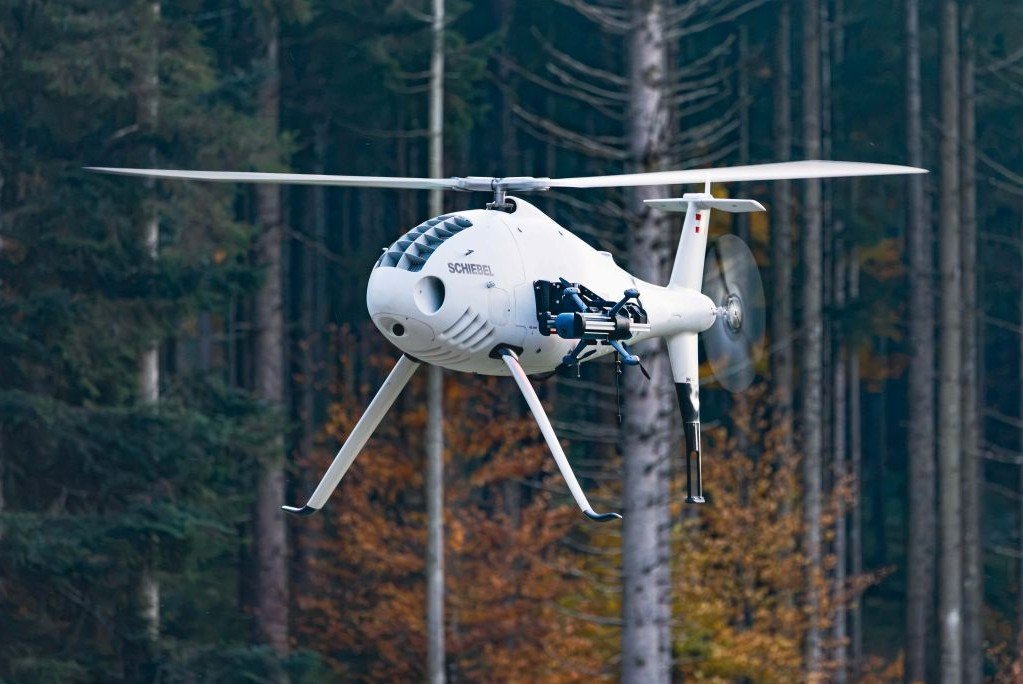
Vienna, 18 November 2026: Schiebel, together with OSIRIS Poland, has successfully demonstrated the CAMCOPTER® S-100 Unmanned Air System (UAS) as an airborne carrier, deployer and communications relay for a small Unmanned Air System (sUAS) during a proof-of-concept demonstration in Austria.
During the demonstration, the CAMCOPTER® S-100 carried and deployed an OSIRIS HSCD-1 (High-Speed Camera Drone) whilst in forward flight. Following release, the small drone was operated through a communications link relayed via the S-100, successfully demonstrating the concept of using the larger UAS as a drone mothership as well as an airborne control and video relay.
The concept combines the range and endurance of the CAMCOPTER® UAS series with the speed and agility of smaller unmanned systems. By transporting an sUAS closer to its intended area of operation / target and maintaining the communications link after deployment, the Schiebel UAS can significantly extend the operational reach and endurance of smaller drones beyond the limitations of conventional ground-based launch and operation.
The successful proof-of-concept opens up a range of potential applications, particularly in the Counter-Unmanned Air System (C-UAS) domain. While the demonstration was conducted with an inert variant, the concept can also support high-speed interceptor drones equipped with effectors or any other sUAS for a wide range of applications. Acting as a force and capability multiplier, the CAMCOPTER® S-100, S-300, S-101 and S-301 systems can serve as carrier, launch platform and airborne communications relay for smaller unmanned systems and loitering munitions, extending their operational reach and flexibility.
“This proof-of-concept demonstrates the incredible potential of combining the mature and proven CAMCOPTER® with smaller, specialised unmanned systems,” said Hans Georg Schiebel, Chairman of the Schiebel Group. “The successful integration of the OSIRIS HSCD-1 demonstrates a concept that can also be applied to high-speed interceptor drones, opening up new possibilities for diverse operational scenarios.”
photo courtesy Schiebel
