

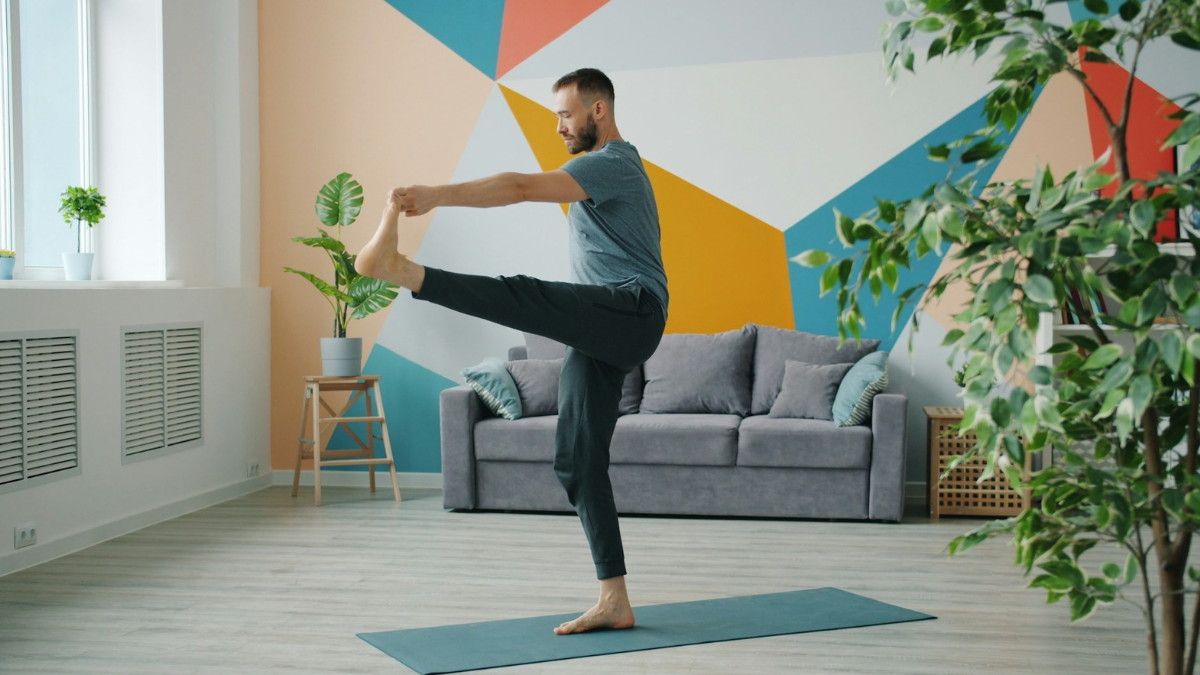
Balance is easy to overlook until you need it. You might notice it when stepping off a curb, putting on a shoe while standing, or trying to hold a yoga pose. A simple one leg test can give you a quick snapshot of your balance, but your time can change depending on how you test it.
So what counts as a good time? There is no single cutoff that works for everyone. Research does offer age group reference values, though, and they give you a useful way to compare your result with other adults. Here is what the research says, how to test yourself safely, and what your time can and cannot tell you.
One leg balance times by age
The table below shows average times from a study of 549 healthy adults aged 18 to 99. Participants stood on one leg with their eyes open and completed three attempts. The figures show the average of each age group’s best attempt. The test had a 45 second cap, so the results for younger adults sit close to the maximum.
| Age | Average best time with eyes open |
|---|---|
| 18 to 39 | 44.7 seconds |
| 40 to 49 | 41.9 seconds |
| 50 to 59 | 41.2 seconds |
| 60 to 69 | 32.1 seconds |
| 70 to 79 | 21.5 seconds |
| 80 to 99 | 9.4 seconds |
These are group averages, not pass or fail standards. A result below your age group’s average does not mean you are unhealthy, and a result above it does not guarantee that your balance is excellent in every situation. The study used a particular testing method, and your result may differ if you use another method, such as keeping your hands on your hips or standing barefoot.

The pattern is still clear: people in the older age groups tended to hold the position for less time. Other research has also found that balance performance changes with age, although the result varies with the test, the group being studied, and whether participants keep their eyes open or closed.
How to test your balance at home
Choose a clear, level floor and stand close to a wall, sturdy chair, or countertop. You want something within reach if you need support. Wear shoes or go barefoot, then use the same choice if you repeat the test later.
Stand upright with your feet together and your arms relaxed at your sides. Lift one foot a few inches off the floor and start a timer. Stop when your raised foot touches down, your standing foot moves, or you grab the support. Try the other side, then repeat each side so you have three attempts. Record your best time for each leg.
For a fair comparison with the table, keep your eyes open. Do not close your eyes to make the test harder unless you are following guidance from a health professional. The test is not worth a fall. Keep your support close, and stop if you feel dizzy, unsteady, or in pain.
A few details can change your result. Your shoes, the floor, the position of your arms, the leg you stand on, and whether you have practiced the test can all affect your time. If you want to track progress, repeat the test under similar conditions and compare your result with your own previous attempts.
Why does balance change with age?
Standing on one leg looks simple, but your body is constantly making small adjustments to keep you upright. Your eyes, inner ear, muscles, joints, and nervous system all contribute information. Your brain uses that information to make corrections as your body shifts.
Age can affect several parts of this system. Changes in muscle strength, reaction time, joint sensation, vision, and the inner ear may make balance tasks more challenging. These changes do not happen at the same rate for everyone. Regular activity and health conditions can also influence how steady you feel.
That is one reason a single score should not be treated as a complete measure of fitness. The one leg test looks at one aspect of balance in a quiet, controlled setting. It does not measure how well you can react to a trip, walk on an uneven path, or change direction during sport.
What does a 10 second result mean?
A 2022 study examined a different version of the test in 1,702 adults aged 51 to 75. Participants were asked whether they could stand unsupported on one leg for 10 seconds. Around one in five could not complete the test. During follow up, inability to complete it was associated with a higher risk of death from any cause, even after researchers adjusted for age, sex, body mass index, and some health conditions.

That finding attracted attention, but it needs careful interpretation. The study found an association in a specific group of middle aged and older adults. It did not show that failing the test causes poor health or predicts what will happen to any one person. The researchers also noted limits, including factors they could not fully account for.
The 10 second test is therefore best seen as a simple prompt to pay attention to balance, not as a medical diagnosis or a personal forecast. If you have concerns about falls, sudden changes in balance, or difficulty with everyday movement, speak with a health professional.
Can you improve your one leg balance?
Balance is a skill you can practice, provided you do it safely. Start by standing near a stable support and shifting your weight gently from one foot to the other. When that feels comfortable, try lifting one foot slightly while keeping a hand close to the support.
You can also build balance into everyday training. Exercises such as step ups, split squats, lunges, and controlled single leg deadlifts challenge your ability to stay steady while moving. Begin with a version you can perform with good control. Use support when needed, and increase the challenge gradually.
If you have a health condition, a history of falls, or pain that affects how you stand, ask a clinician or physical therapist what is appropriate for you. There is no need to chase a longer time if doing so makes the test unsafe.
What your result can tell you
The one leg test gives you an easy way to check a basic part of balance and track it over time. Compare your result with the age group figures as context, then consider how steady you feel in daily life and during exercise. A single attempt is only a snapshot, and differences in testing methods make precise comparisons difficult.
If you repeat the test every few weeks under similar conditions, you may get a clearer picture of your own progress than by focusing on a single age based average. If your balance has changed suddenly or is affecting everyday activities, get advice from a health professional.
References
- Araujo, C.G., de Souza e Silva, C.G., Laukkanen, J.A., Singh, M.F., Kunutsor, S.K., Myers, J., Franca, J.F. and Castro, C.L. (2022) ‘Successful 10-second one-legged stance performance predicts survival in middle-aged and older individuals’, British Journal of Sports Medicine, 56(17), pp. 975–980.
- Riis, J. et al. (2020) ‘Lifespan data on postural balance in multiple standing positions’, Gait & Posture, 76, pp. 90–96.
- Springer, B.A., Marin, R., Cyhan, T., Roberts, H. and Gill, N.W. (2007) ‘Normative values for the unipedal stance test with eyes open and closed’, Journal of Geriatric Physical Therapy, 30(1), pp. 8–15.
| Key Takeaways | |
|---|---|
| Age group averages | The average best eyes open time ranged from 44.7 seconds for adults aged 18 to 39 to 9.4 seconds for adults aged 80 to 99 in one study. |
| How to use the test | Treat it as a rough balance check, not a diagnosis or a universal pass or fail standard. |
| How to test safely | Stand near a sturdy support, keep your eyes open, and stop if you feel unsteady, dizzy, or in pain. |
| What to track | Repeat the test under similar conditions and compare your result with your own earlier attempts. |
