

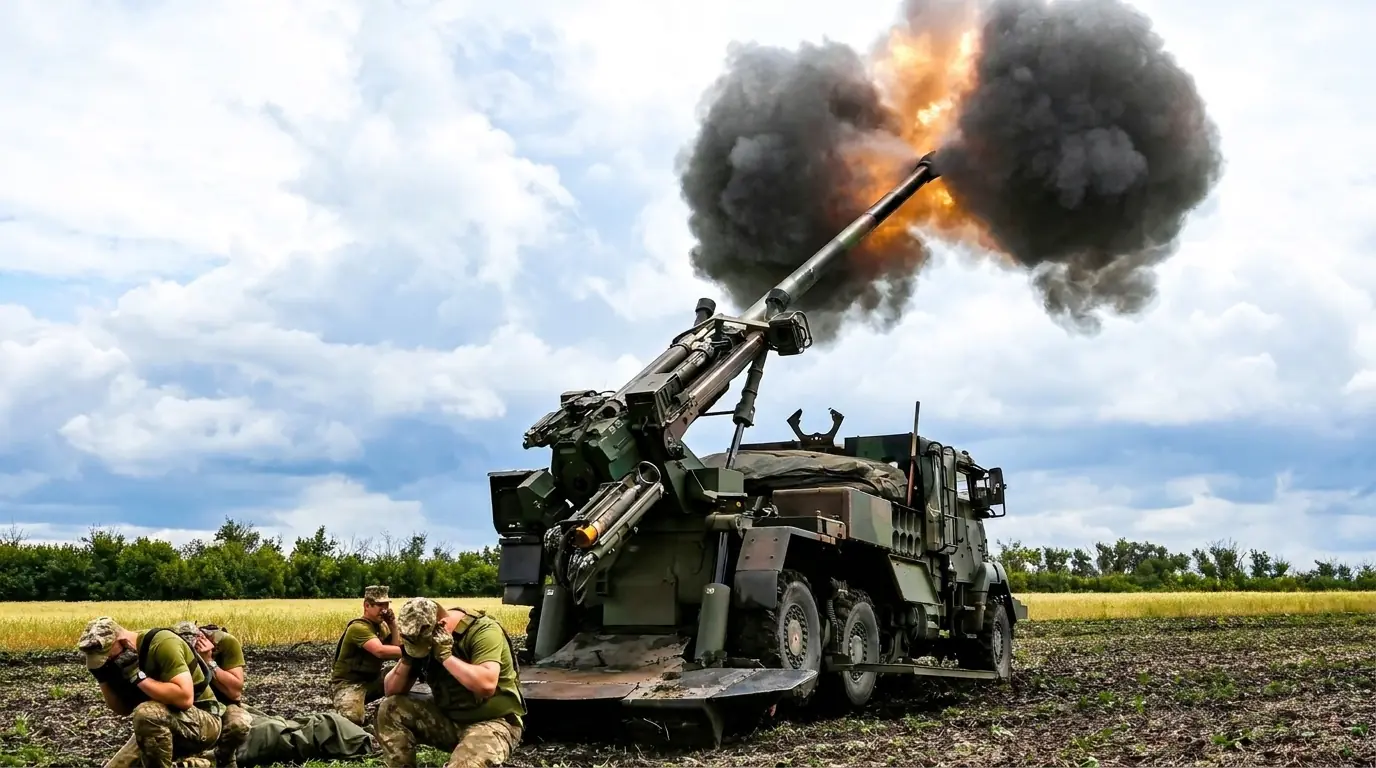
A battlefield filled with drones, precision-guided missiles, and stealth aircraft might seem like the last place for conventional artillery. Yet, when modern armies enter a prolonged conflict, one weapon system continues to shape the fighting: artillery.
It is an interesting contradiction. Military technology has advanced dramatically, but the ability to deliver sustained firepower over long distances remains essential. Sophisticated weapons can destroy individual targets, but armies also need something capable of supporting troops throughout hours or even days of fighting.
That’s where artillery comes in.
From self-propelled howitzers to multiple-launch rocket systems, modern artillery provides ground forces with firepower that aircraft and missiles cannot always deliver economically or consistently. It can suppress enemy positions, disrupt defensive formations, and support advancing troops when air support is unavailable.
The Russia-Ukraine war has made this reality particularly difficult to ignore. Both sides have relied heavily on artillery, demonstrating how ammunition supplies, firing range, and sustained firepower can influence the outcome of large-scale military operations.
But there is more to the story than simply firing shells across the battlefield.
Modern artillery is increasingly connected to drones, digital targeting networks, and precision-guided ammunition. These developments are changing how armies use traditional guns and rocket systems.
So, why modern militaries still need artillery when they possess some of the world’s most advanced weapons? The answer lies in a combination of battlefield effectiveness, economic practicality, operational flexibility, and the changing nature of warfare.
Artillery Remains the Backbone of Ground Combat
Artillery remains one of the most important sources of firepower for modern ground forces. Despite advances in military aviation and missile technology, armies still depend on it to influence battles and support troops operating on the front lines.
Its biggest advantage is straightforward: artillery can deliver powerful, sustained fire support without requiring aircraft to remain overhead.
Consider an army attempting to capture a heavily defended position. Infantry and armored vehicles might have the equipment and manpower to advance, but enemy machine-gun positions, trenches, and fortified buildings can make movement extremely difficult.
Artillery helps change that situation.
Field guns and howitzers can strike enemy positions from considerable distances, disrupting defensive formations and reducing their ability to resist advancing forces. This gives infantry and armored units more opportunities to maneuver.
Artillery also performs several important battlefield roles:
- Fire support: Helps ground troops overcome enemy defensive positions.
- Counter-battery fire: Targets hostile artillery threatening friendly formations.
- Area suppression: Disrupts enemy movements and reduces their ability to operate effectively.
- Defensive operations: Helps prevent enemy forces from concentrating for an attack.
- Battlefield interdiction: Strikes military targets and infrastructure supporting enemy operations.
However, artillery is not limited to traditional towed guns. Modern armies operate self-propelled howitzers, rocket artillery, and highly mobile gun systems designed for different battlefield requirements.
For example, the American M109A7 Paladin provides armored, self-propelled fire support, allowing artillery units to move alongside mechanized formations. Meanwhile, Germany’s PzH 2000 combines mobility, automation, and a powerful 155mm gun.
The important distinction is that artillery supports the entire ground operation, not just individual engagements.
Tanks provide direct firepower, infantry secure terrain, and aircraft attack targets from above. Artillery connects these capabilities by delivering supporting fire when and where ground commanders need it.
That is why artillery remains fundamental to combined-arms warfare. Modern armies may have more sophisticated weapons, but they still need reliable firepower to help soldiers advance, defend positions, and control the battlefield.
Artillery Delivers Massive Firepower at a Lower Cost
Modern warfare is expensive. A single precision-guided missile can cost hundreds of thousands of dollars, while advanced aircraft require enormous investments in maintenance, fuel, and operational support.
Artillery offers a different economic equation.
Conventional artillery ammunition is generally less expensive than sophisticated missiles, making it attractive for militaries that need to maintain sustained firepower throughout prolonged conflicts. When an army must engage numerous targets across an extensive frontline, ammunition costs become a serious consideration.

Think about the difference between destroying one target and supporting an entire battlefield. A cruise missile might be ideal for striking a high-value command facility, but using expensive missiles against every defensive position would quickly exhaust military budgets and available stockpiles.
Artillery provides another option.
A conventional 155mm high-explosive shell can deliver substantial destructive force without the sophisticated guidance technology found in expensive missiles. Modern artillery systems can also fire different ammunition types depending on operational requirements.
The economic advantages become particularly important during high-intensity conflicts, where ammunition consumption can reach extraordinary levels.
The Russia-Ukraine war illustrates this problem. Both countries have experienced enormous demands for artillery ammunition, forcing governments and defense manufacturers to expand production capacity and secure additional supplies.
For perspective, NATO’s July 2024 announcement highlighted that European ammunition production capacity had increased significantly, with a target of producing two million artillery rounds annually by the end of 2025.
This reflects an important military reality: having advanced weapons means little without enough ammunition to operate them.
| Weapon category | Economic consideration |
| Conventional artillery | Relatively inexpensive ammunition |
| Precision-guided artillery | Higher ammunition costs but improved accuracy |
| Guided missiles | Generally expensive per engagement |
| Combat aircraft | Significant operating and maintenance expenses |
| Armed drones | Costs vary considerably by size and capability |
Of course, artillery is not automatically the cheapest solution. Its effectiveness depends on ammunition availability, transportation, maintenance, and operational requirements.
Nevertheless, artillery gives military commanders something extremely valuable: the ability to sustain battlefield firepower without depending entirely on expensive precision weapons.
In a prolonged conflict, that financial advantage can become just as important as the weapon’s destructive power.
Artillery Provides Critical Fire Support for Ground Forces
Even the most advanced tanks and infantry fighting vehicles cannot guarantee success against a well-prepared enemy. Modern battlefields are filled with trenches, fortified positions, anti-tank weapons, and defensive obstacles that can slow an offensive to a crawl.
Ground forces need more than armored protection and direct-fire weapons. They need supporting firepower capable of reaching enemy positions beyond the immediate engagement area.
This is where artillery becomes indispensable.
Unlike tank cannons, which primarily engage targets within direct line of sight, howitzers can fire at distant targets using indirect fire. This allows artillery units to support troops without exposing themselves directly to enemy positions.

Artillery essentially gives ground commanders an additional layer of firepower.
During offensive operations, artillery can help suppress defensive positions, making it harder for opposing forces to organize an effective response. This support gives infantry and armored formations greater freedom to maneuver.
Its importance is equally apparent during defensive operations.
When enemy forces attempt to advance, artillery can engage concentrations of troops, disrupt supporting vehicles, and complicate their movements. Defensive formations can therefore use artillery to strengthen positions and respond to developing threats.
Another important responsibility is counter-battery warfare. Enemy artillery presents a serious threat to friendly troops, particularly during prolonged engagements. Modern counter-battery radar systems can detect incoming projectiles and help estimate their firing locations, supporting a response from friendly artillery units.
Artillery also works closely with other military platforms:
- Main battle tanks: Provide direct firepower against enemy armor and fortified positions.
- Infantry fighting vehicles: Transport troops and deliver supporting weapons.
- Reconnaissance drones: Help identify potential targets and monitor battlefield activity.
- Combat aircraft: Engage targets requiring specialized air-delivered weapons.
- Electronic warfare systems: Disrupt communications and complicate enemy targeting.
This cooperation is central to combined-arms warfare. No single weapon system needs to accomplish everything.
Consider a mechanized brigade advancing across contested terrain. Tanks provide protection, infantry secure important positions, and reconnaissance units identify threats. Meanwhile, artillery supplies supporting fire from behind the frontline.
That combination makes military operations more effective.
Artillery does not replace ground troops. It helps them fight under better conditions, which explains why modern armies continue investing heavily in artillery capabilities.
Lessons From the Russia-Ukraine War Prove Artillery’s Importance
If anyone still questioned whether artillery had a future in modern warfare, the Russia-Ukraine war provided a powerful answer. Despite the widespread use of drones, precision-guided missiles, and advanced surveillance systems, conventional artillery has remained central to battlefield operations.
Since Russia launched its full-scale invasion in February 2022, both countries have relied heavily on artillery to support offensive and defensive operations. The conflict has demonstrated how quickly ammunition consumption can become a strategic problem.
The scale of artillery warfare is particularly striking.
Russian forces have employed large numbers of 152mm artillery systems, including the 2S19 Msta-S and 2S3 Akatsiya self-propelled howitzers. Ukraine, meanwhile, has operated Soviet-era artillery alongside Western-supplied systems such as the American M777 and German PzH 2000.
These weapons serve different operational requirements, but they share one important purpose: delivering sustained firepower against enemy positions.

The Return of Large-Scale Artillery Warfare
One important lesson from Ukraine is that modern conflicts can still involve enormous quantities of conventional ammunition.
Artillery has been used to attack fortified positions, support infantry advances, disrupt defensive formations, and engage opposing artillery units. In heavily contested areas, its contribution can influence whether ground forces successfully advance or remain pinned down.
However, the conflict has also exposed a major weakness: ammunition shortages.
Ukraine has repeatedly required international assistance to maintain its artillery operations. Western governments have consequently increased ammunition procurement and production efforts to replenish supplies and support Ukrainian forces.
Drones Are Changing How Artillery Operates
Another significant development is the growing relationship between artillery and unmanned aerial vehicles.
Reconnaissance drones can locate enemy positions, observe impacts, and provide information that helps artillery crews improve accuracy. This creates a faster connection between battlefield observation and fire support.
But drones have also made artillery more vulnerable. A firing position that remains exposed for too long can attract surveillance and counterattacks.
Consequently, mobility and rapid repositioning have become increasingly important.
| Battlefield lesson | Military implication |
| High ammunition consumption | Larger stockpiles and production capacity |
| Extensive use of drones | Better reconnaissance and targeting integration |
| Counter-battery threats | Greater emphasis on mobility |
| Prolonged defensive fighting | Continued demand for sustained fire support |
| Diverse artillery systems | Importance of ammunition compatibility and logistics |
The Ukraine conflict demonstrates something important: advanced technology has changed artillery warfare, but it has not eliminated the need for artillery itself.
For modern militaries preparing for high-intensity conflicts, that lesson is difficult to overlook.
Why Drones and Missiles Cannot Completely Replace Artillery
Drones and precision-guided missiles have transformed modern warfare. They can identify targets, strike important military infrastructure, and attack enemy forces with impressive accuracy. So, why do modern militaries continue investing in conventional artillery?
The answer comes down to capability, cost, and battlefield endurance.
Although these weapons sometimes perform similar missions, they are not interchangeable. Each offers different advantages, and replacing artillery entirely would leave significant gaps in a military’s firepower.
Artillery Offers More Sustained Firepower
One major advantage of conventional artillery is its ability to deliver repeated fire missions using comparatively affordable ammunition.
A self-propelled howitzer can carry multiple rounds and receive additional ammunition from supporting supply vehicles. This allows artillery formations to maintain fire support during extended operations, provided ammunition and logistical support remain available.
Drones operate differently.
Small reconnaissance drones are excellent for surveillance, while larger armed drones can attack specific targets. However, their payload capacity, endurance, and vulnerability vary considerably between platforms.
A small quadcopter carrying one explosive charge cannot replace the sustained firepower of a 155mm artillery battery.
Missiles Serve a Different Purpose
Precision-guided missiles are particularly valuable against high-priority targets. They can engage command facilities, air defense installations, bridges, and other important military infrastructure.
However, their sophisticated guidance systems and propulsion technologies generally make them more expensive than conventional artillery ammunition.
Using expensive missiles for every battlefield engagement would be financially and logistically difficult.
Artillery therefore remains useful for delivering repeated fire support, while missiles can be reserved for targets requiring specialized capabilities.
Comparing Artillery, Drones, and Missiles
| Capability | Artillery | Drones | Missiles |
| Sustained firepower | High | Platform-dependent | Limited by available stock |
| Ammunition cost | Generally lower | Varies widely | Generally higher |
| Precision | Varies by ammunition | Platform-dependent | Often very high |
| Payload | Substantial | Usually limited on small platforms | Varies by missile |
| Battlefield role | Fire support | Reconnaissance and strikes | Specialized target engagement |
The Real Advantage Is Integration
Modern militaries increasingly combine these technologies rather than treating them as competing solutions.
Drones can provide battlefield awareness, artillery can deliver sustained supporting fire, and missiles can engage selected high-value targets. Aircraft add another layer of capability.
This combination creates a more flexible military force.
Ultimately, drones and missiles are changing how armies fight, but they cannot perform every artillery mission economically or consistently. Artillery remains relevant because modern warfare demands more than precision strikes. It also demands sustained firepower.
How Modern Artillery Is Becoming More Advanced
Artillery might have centuries of battlefield history, but today’s systems look very different from the guns used during earlier wars. Modern militaries are transforming conventional artillery through automation, digital targeting, precision-guided ammunition, and improved mobility.
The biggest change is not necessarily the gun itself. It is the technology connecting artillery crews to the wider battlefield.
In the past, artillery units depended heavily on observers, communication networks, and manual calculations to determine firing solutions. Modern systems can integrate digital fire-control equipment, satellite navigation, and battlefield information to accelerate these processes.
This makes artillery more responsive and adaptable.

Precision-Guided Ammunition Improves Accuracy
One important development is the introduction of precision-guided artillery ammunition.
Traditional artillery shells generally rely on ballistic trajectories, meaning their accuracy depends on several factors, including weather, firing conditions, and target information.
Guided ammunition introduces additional capabilities.
For example, the American M982 Excalibur is a 155mm GPS-guided artillery projectile designed to engage targets with significantly improved accuracy compared with conventional ammunition.
This allows commanders to engage selected targets while potentially reducing the number of rounds required for certain missions.
Automation Makes Artillery More Responsive
Modern self-propelled howitzers increasingly feature automated loading systems, digital fire-control equipment, and advanced navigation technologies.
Germany’s PzH 2000 and South Korea’s K9 Thunder demonstrate this development. Both combine substantial firepower with mobility and sophisticated onboard systems.
These improvements help artillery units operate more efficiently, particularly during demanding battlefield conditions.
Mobility and Survivability Are Becoming Priorities
Modern artillery faces a growing threat from reconnaissance drones, counter-battery radar, and precision-guided weapons.
Remaining stationary for extended periods can make artillery units easier to detect and target.
Consequently, manufacturers are developing more mobile platforms capable of relocating after firing. Systems such as France’s CAESAR and Sweden’s Archer demonstrate the growing importance of wheeled artillery platforms.
Examples of Modern Artillery Systems
| Artillery system | Country | Main characteristic |
| M109A7 Paladin | United States | Armored self-propelled howitzer |
| PzH 2000 | Germany | Advanced 155mm tracked howitzer |
| CAESAR | France | Highly mobile wheeled artillery |
| K9 Thunder | South Korea | Modern tracked self-propelled howitzer |
| Archer | Sweden | Automated wheeled artillery system |
Another important development is the integration of artillery with unmanned aerial vehicles. Drones provide battlefield reconnaissance, while digital networks help distribute information between different military units.
Artificial intelligence may further improve battlefield information processing and decision support.
However, technology also introduces new vulnerabilities. Electronic warfare can disrupt communications and navigation, while sophisticated surveillance makes concealment increasingly difficult.
Modern artillery is therefore evolving beyond conventional firepower. Its future depends on combining accuracy, mobility, automation, and battlefield connectivity into a more effective military capability.
