

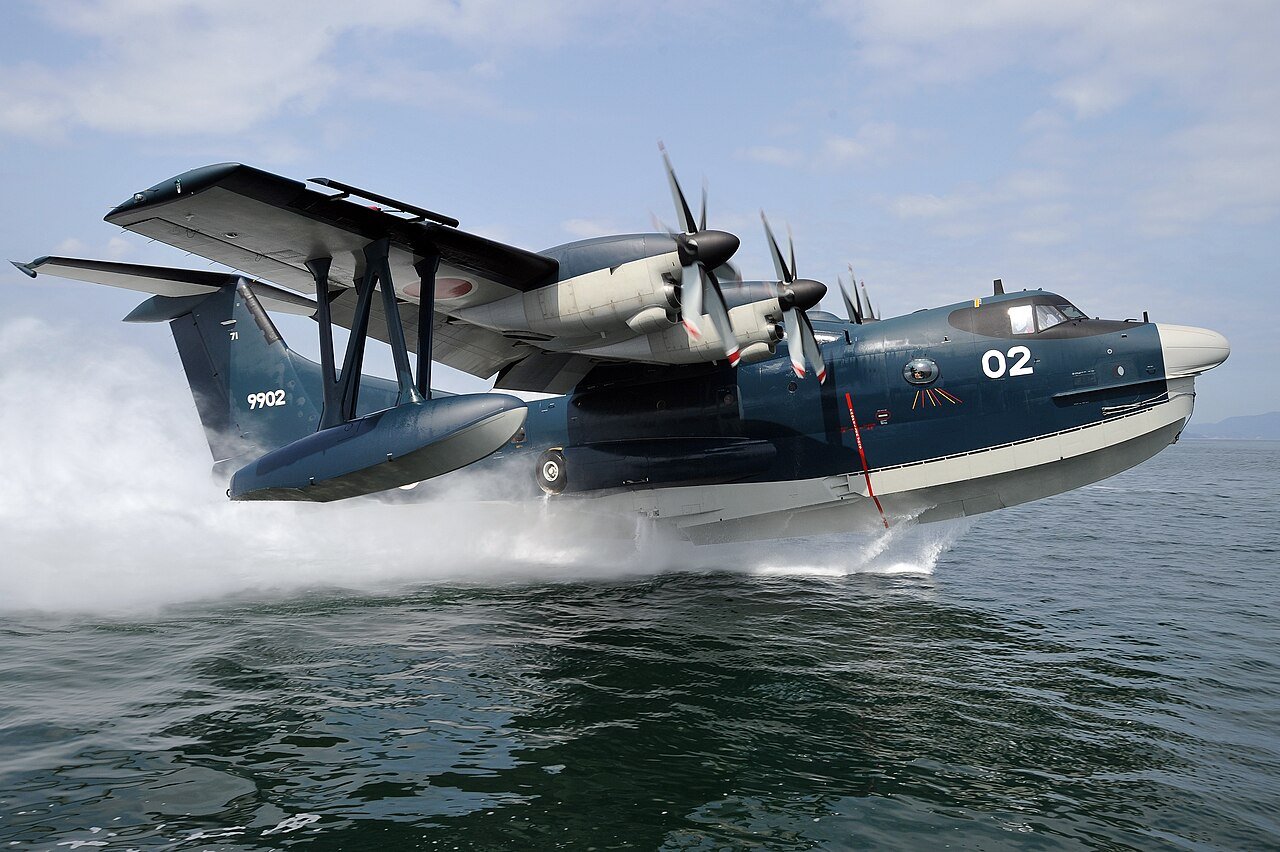

The Japanese ShinMaywa US-2 amphibian evolved from its four-engine SS-2 flying boat, which first flew in October 1967. Fourteen served with the Japan Maritime Self-Defence Force (JMSDF) in the ASW role as the PS-1.
An amphibious prototype, the US-1 flew in 1974, and the JMSDF ordered 24 in the SAR role. In 2006, the upgraded short take-off and landing (STOL) US-2, powered by four 4,591 shp Rolls-Royce AE 2100 turboprops, entered service with the JMSDF’s 71st Squadron, and nine remain in service.
Although only one more is on order for the JMSDF, ShinMaywa Industries plans to invest tens of millions of dollars in a new facility near Kobe Airport to assemble US-2s in view of Japan’s increasing defence spending, which has seen its Ministry of Defence requesting a record US$60.1 billion as part of its defence planning programme.
The Bombardier CL-415 amphibian, powered by two 2,380 shp Pratt & Whitney Canada PW123PF turboprops, was developed from the piston-engined Canadair CL-215, which also first flew in 1967. By 2017, 95 had been produced when De Havilland Canada purchased the CL-415 type certificate.
With countries worldwide facing increasingly severe wildfire seasons and an ageing fleet of existing Canadair firefighting amphibians, De Havilland Canada launched the DHC-515 in 2022. Design changes incorporate new materials and corrosion protection to reduce maintenance costs and meet future navigational standards; it also offers a complete flight-deck upgrade with an advanced avionics suite. It has a 6,137-litre water tank capacity, and the DHC-515 has a MTOW of 21,364 kg after scooping and can take off in 2,670 ft.

With 22 DHC-515s ordered by six European countries, De Havilland Canada has secured financing to double production capacity for its DHC-515 amphibious firefighting aircraft.
by David Oliver
