

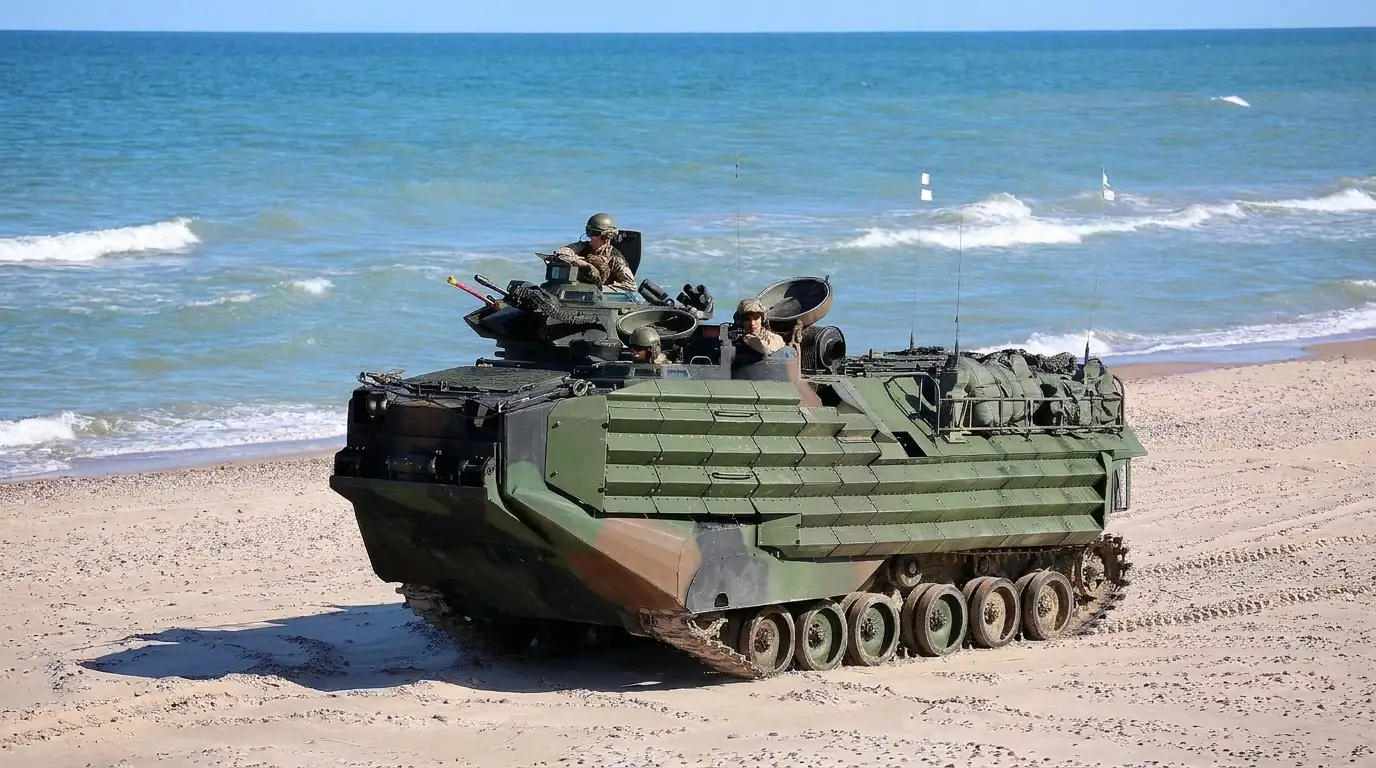
Imagine a vehicle that can leave a warship, cross several miles of open water, storm a beach, and carry Marines straight into combat. That’s the job of the AAV7 Amphibious Assault Vehicle.
Unlike conventional armored personnel carriers, the AAV7 was designed to operate in two very different environments. It must handle the challenges of ocean movement before tackling mud, sand, roads, and rough terrain inland. Few military vehicles face such a demanding combination.
Developed for the U.S. Marine Corps, the AAV7 became a central part of American amphibious warfare. Its tracked chassis, diesel engine, and water-jet propulsion system allowed Marines to move from ship to shore without immediately depending on landing craft.
But there’s more to this vehicle than its unusual swimming ability. The AAV7 also carries infantry, provides supporting fire, and supports command and recovery missions through specialized variants.
Its capabilities have evolved through decades of modernization, particularly with the AAV7A1 and Reliability, Availability, Maintainability/Rebuild to Standard (RAM/RS) programs. These upgrades improved important mechanical systems, although they could not eliminate every limitation of the original design.
So, how capable is the AAV7? What engine powers it, how fast can it travel, and what weapons protect its passengers?
This guide examines the AAV7’s technical specifications, mobility, armor, firepower, and battlefield role to explain what makes this amphibious vehicle distinctive.
AAV7 Amphibious Assault Vehicle Specifications
The AAV7 is a tracked, armored amphibious vehicle built primarily to transport Marines from naval ships to shore and then continue moving across land. Its design combines the functions of an amphibious transport and an armored personnel carrier.
The vehicle originated as the LVTP-7, which entered U.S. Marine Corps service in 1972. It later received improvements and was redesignated the AAV7, followed by the modernized AAV7A1 configuration.
Despite its age, the basic design remains recognizable. A large enclosed hull protects the occupants, while tracks provide traction on difficult terrain. At the rear, water-jet propulsion enables movement through the water.
Here are the principal specifications commonly associated with the AAV7A1 family.
| Specification | Typical figure |
| Vehicle type | Amphibious armored personnel carrier |
| Crew | 3 |
| Troop capacity | Up to 21 Marines |
| Engine | Cummins VTA-903T diesel |
| Engine power | Approximately 400 hp |
| Transmission | FMC HS-400-3A |
| Combat weight | Approximately 23–29 tonnes, depending on configuration |
| Length | Approximately 8.2 meters |
| Width | Approximately 3.3 meters |
| Height | Approximately 3.3 meters |
| Maximum land speed | Approximately 72 km/h |
| Maximum water speed | Approximately 13 km/h |
| Land range | Approximately 480 km |
| Primary armament | M2 .50-caliber machine gun and Mk 19 grenade launcher |
One interesting feature is its passenger capacity. The AAV7 can carry a crew of three alongside up to 21 fully equipped Marines. That’s a substantial infantry load inside an armored vehicle designed for amphibious operations.
However, passenger capacity comes with trade-offs. Additional armor and equipment increase weight, potentially affecting mobility and water performance.
The AAV7’s specifications therefore tell only part of the story. Its real strength lies in combining transportation, protection, and amphibious mobility within one platform.
Engine, Mobility, and Amphibious Capabilities
The AAV7’s greatest advantage isn’t simply its armor or firepower. It’s the ability to move between water and land without changing vehicles.
That flexibility starts with its diesel engine. The AAV7A1 uses a Cummins VTA-903T turbocharged diesel engine, producing approximately 400 horsepower. Power travels through an automatic transmission to the vehicle’s tracked drivetrain.

On land, the AAV7 behaves much like a conventional tracked armored carrier. Its tracks provide traction across sand, mud, loose soil, and uneven terrain. This is particularly valuable during beach assaults, where wheeled vehicles can struggle with soft surfaces.
But the engineering becomes more interesting in the water.
Unlike a boat with a conventional propeller, the AAV7 uses two rear-mounted water-jet propulsion units. These systems draw in water and discharge it under pressure, pushing the vehicle forward. Steering is achieved through adjustable water-flow controls.
The arrangement allows the vehicle to approach shore without requiring a separate landing craft for every movement. Once it reaches shallow water, the tracks take over as it transitions onto the beach.
Here is how its mobility compares across the two environments:
| Mobility characteristic | Approximate performance |
| Maximum land speed | 72 km/h |
| Maximum water speed | 13 km/h |
| Land operational range | 480 km |
| Propulsion on land | Tracked drivetrain |
| Propulsion in water | Twin water jets |
The difference in speed is considerable. On roads, the AAV7 can keep pace with many conventional military vehicles. In water, however, its speed drops dramatically.
That distinction matters during amphibious assaults. A vehicle crossing several miles of ocean needs time to reach the beach, especially when operating in formation.
Sea conditions also impose restrictions. Heavy surf, rough waves, and unfavorable weather can complicate operations or prevent launches altogether.
The AAV7 offers something valuable: a continuous route from ship to shore. Yet its amphibious performance depends heavily on environmental conditions, vehicle loading, and operational planning.
AAV7 Armor Protection and Survivability
An amphibious assault vehicle faces a difficult protection challenge. It must remain light enough to float while providing enough armor to protect Marines from battlefield threats.
The AAV7 addresses this challenge through an aluminum hull and additional armor packages. Its original construction balances structural strength with the weight restrictions of amphibious operations.

One important improvement is the Enhanced Appliqué Armor Kit (EAAK). This package adds protective plates to vulnerable areas of the vehicle, particularly along its sides. It improves resistance against small-arms fire and fragmentation.
Marine Corps training documentation describes the EAAK-equipped vehicle as providing protection against 7.62mm ammunition under specified test conditions. However, this should not be interpreted as complete protection against every ammunition type or impact angle.
The additional armor comes with a trade-off. Every extra kilogram affects the vehicle’s overall weight, and that matters considerably when the AAV7 enters the water.
A heavier vehicle has less room for additional equipment or cargo before reaching its operational weight limits. Amphibious performance can also suffer when the vehicle carries more protection.
What about modern battlefield threats?
The AAV7 was designed around an earlier generation of battlefield requirements. Modern anti-tank guided missiles, rocket-propelled grenades, mines, and improvised explosive devices present serious challenges.
Its armor should therefore be understood as protection for an amphibious transport platform, not equivalent to the heavy frontal protection of a modern main battle tank.
Survivability also depends on operational tactics. Smoke generation, coordinated infantry support, vehicle spacing, and careful route selection can reduce exposure to enemy fire.
Ultimately, the AAV7’s protection reflects a compromise between mobility and survivability. It offers Marines an armored route from ship to shore, but its design has limitations against modern weapons.
AAV7 Armament and Firepower
The AAV7 isn’t designed to fight like an infantry fighting vehicle. Its primary mission is transporting Marines, but it also carries weapons to provide supporting fire during amphibious assaults.
Its main armament consists of two familiar weapons: the M2 .50-caliber heavy machine gun and the Mk 19 40mm automatic grenade launcher. Both provide different types of firepower against battlefield targets.

The weapons are mounted on the vehicle’s forward weapon station, allowing the crew to engage targets while remaining inside the armored hull.
M2 .50-Caliber Heavy Machine Gun
The M2 Browning is one of the most recognizable heavy machine guns in military service. It fires 12.7×99mm NATO ammunition and provides substantial firepower against exposed personnel, lightly armored vehicles, and selected equipment targets.
Its effective range depends on the ammunition, target, and engagement conditions. Nevertheless, the weapon gives the AAV7 considerable reach compared with ordinary infantry small arms.
Mk 19 40mm Automatic Grenade Launcher
The Mk 19 provides a different capability. Instead of relying on individual bullets, it fires 40mm high-explosive grenades that detonate near or against targets.
This makes it useful for engaging exposed infantry positions, providing suppressive fire, and attacking lightly protected targets.
The two weapons complement each other. The M2 delivers heavy machine-gun fire, while the Mk 19 offers explosive effects over an area.
| Weapon | Caliber | Primary purpose |
| M2 Browning | 12.7mm | Heavy machine-gun fire |
| Mk 19 | 40mm | Explosive suppressive fire |
The AAV7 also carries smoke grenade launchers. These help create obscuration during movement, potentially reducing visibility for opposing forces.
However, its firepower has clear limitations. It lacks the dedicated anti-tank armament and sophisticated weapon systems found on modern infantry fighting vehicles.
Think of the AAV7 as an armored troop transporter with supporting weapons, rather than a vehicle intended to dominate enemy armor. Its greatest contribution remains delivering Marines safely and providing supporting fire when needed.
AAV7 Variants: AAVP7A1, AAVC7A1, and AAVR7A1
Not every AAV7 performs the same battlefield job. Although the family shares a common amphibious platform, different configurations support personnel transport, command operations, and vehicle recovery.
This approach allows military units to build an amphibious force around a common vehicle design without requiring an entirely different platform for every mission.

Three principal configurations stand out.
AAVP7A1: Personnel Carrier
The AAVP7A1 is the standard personnel-carrying configuration and the most recognizable member of the family.
Its primary purpose is transporting Marines from amphibious ships to landing beaches and onward into inland operating areas. It accommodates a crew of three and can carry up to 21 combat-equipped Marines.
The vehicle also provides protection and supporting fire during the landing phase. For Marine infantry units, this configuration serves as the primary transportation platform.
AAVC7A1: Command Vehicle
The AAVC7A1 is designed for command and control operations.
Instead of prioritizing passenger capacity, this configuration accommodates additional communications equipment and working space for command personnel. It allows commanders to coordinate activities during amphibious operations.
Reliable communications are particularly important during beach landings, where multiple vehicles and infantry units must operate together.
AAVR7A1: Recovery Vehicle
The AAVR7A1 handles recovery and maintenance support.
It carries specialized recovery equipment, including a winch and lifting equipment, allowing crews to assist disabled vehicles. This capability becomes especially valuable when an amphibious operation involves difficult terrain or damaged vehicles.
Here is a quick comparison:
| Variant | Primary mission |
| AAVP7A1 | Personnel transportation |
| AAVC7A1 | Command and control |
| AAVR7A1 | Recovery and maintenance |
The AAV7 family also received significant modernization through the Reliability, Availability, Maintainability/Rebuild to Standard (RAM/RS) program.
These upgrades included improvements to the powertrain, suspension, and automotive systems. The objective was to improve reliability and extend the vehicle’s useful service life.
Together, these configurations demonstrate that the AAV7 is more than an amphibious personnel carrier. It provides transportation, command support, and recovery capabilities within one vehicle family.
AAV7 Operational History and Combat Experience
The AAV7 has spent decades supporting amphibious operations around the world. Its history reflects the changing demands of Marine Corps warfare, from traditional beach assaults to expeditionary operations involving complex inland missions.
Its story began with the LVTP-7, which entered U.S. Marine Corps service in 1972. Developed by FMC Corporation, the vehicle replaced the older LVTP-5 and introduced improved mobility, protection, and amphibious transportation capabilities.

In 1985, the Marine Corps introduced the AAV7A1 designation following a major modernization program. Improvements included a more powerful engine, updated transmission, and changes to the vehicle’s automotive systems.
The AAV7 subsequently became a familiar sight during several American military operations.
Grenada and the Persian Gulf
During Operation Urgent Fury in Grenada in 1983, amphibious assault vehicles supported Marine movements ashore. The operation demonstrated the continuing importance of vehicles capable of moving between naval vessels and coastal environments.
The AAV7 family also supported operations during the 1991 Gulf War. Its ability to transport infantry across difficult terrain made it useful beyond traditional amphibious landings.
Somalia and Iraq
During operations in Somalia in the early 1990s, Marine amphibious vehicles supported deployments and movements through challenging urban and coastal environments.
The Iraq War beginning in 2003 provided another important operational chapter. AAV7s participated in the invasion, transporting Marines during ground operations and supporting movements through urban and desert terrain.
However, combat experience also exposed the vehicle’s limitations. The growing threat from improvised explosive devices and increasingly powerful anti-armor weapons raised questions about the protection offered by its aging design.
Modernization and Continued Service
The RAM/RS program extended the AAV7’s operational usefulness through improvements to reliability and mechanical performance.
Nevertheless, modernization could not completely overcome the limitations of a vehicle originally designed during the Cold War.
The Marine Corps eventually began transitioning toward the Amphibious Combat Vehicle (ACV), reflecting changing requirements for protection, mobility, and expeditionary operations.
The AAV7’s legacy remains significant. It served as a central component of American amphibious warfare for more than five decades, helping generations of Marines move from ships to shore and into combat.
AAV7 vs. Amphibious Combat Vehicle: Why Is It Being Replaced?
For decades, the AAV7 provided the U.S. Marine Corps with a practical way to move infantry directly from naval vessels to coastal landing areas. But battlefield requirements have changed considerably since its introduction in 1972.
Modern amphibious warfare demands more than the ability to swim. Vehicles must also provide stronger protection, improved mobility, and greater flexibility against increasingly sophisticated threats.
That’s where the Amphibious Combat Vehicle (ACV) enters the picture.

The ACV is designed to replace the aging AAV7 fleet. Unlike its predecessor, it uses an eight-wheeled configuration rather than continuous tracks.
This represents a major change in vehicle design. The ACV combines amphibious mobility with improved land performance, enhanced protection, and modern vehicle systems.
AAV7 vs. ACV: Technical Comparison
| Specification | AAV7A1 RAM/RS | ACV |
| Manufacturer | BAE Systems (original FMC design) | BAE Systems |
| Configuration | Tracked | 8×8 wheeled |
| Engine | Cummins diesel | Iveco Cursor 16 |
| Engine power | Approximately 400 hp | Approximately 690 hp |
| Crew | 3 | 3 |
| Troop capacity | Up to 21 | 13 Marines |
| Maximum land speed | Approximately 72 km/h | Approximately 105 km/h |
| Water propulsion | Twin water jets | Twin water jets |
| Primary mission | Amphibious personnel transport | Amphibious infantry transport |
One of the biggest differences involves protection. The ACV incorporates a newer hull design intended to improve survivability against modern battlefield threats, including mines and improvised explosive devices.
Its wheeled configuration also offers advantages during road movement and inland deployment.
However, the AAV7 still has an important historical advantage: its ability to carry larger infantry groups. Its capacity of up to 21 Marines exceeds the standard ACV configuration.
Why the Marine Corps Needed a Replacement
The AAV7’s age was becoming increasingly difficult to ignore. Its original design faced growing challenges from modern weapons, changing amphibious tactics, and maintenance demands.
The ACV addresses these concerns with a more modern platform.
Rather than simply upgrading the AAV7 again, the Marine Corps chose a different vehicle architecture. The transition reflects a broader shift toward survivability and flexible expeditionary operations.
The AAV7 helped define American amphibious warfare for generations. The ACV represents the next chapter.
