

Topline
RAND researchers examine how Xi Jinping’s consolidation of power has reshaped China’s political calendar and the opportunities for effective U.S.-China engagement.
The state of the U.S.-China relationship is likely to define the future of peace and stability in the Indo-Pacific region and the broader international order. At the heart of that relationship is a fundamental question: How do the Chinese Communist Party’s (CCP’s) political calendar and internal bureaucratic rhythms shape the opportunities for—and quality of—U.S. engagement with the People’s Republic of China (PRC)?
Xi Jinping’s consolidation of power since 2012, including the 2018 abolition of presidential term limits, has substantially altered how China’s Party-state operates. RAND researchers examine these changes and their implications for U.S. diplomacy in this report.
Key Takeaways
China’s political calendar matters less under Xi.
Xi’s consolidation of power has reduced the calendar’s overall significance, making it harder for U.S. officials to time diplomatic initiatives for strategic advantage.
Foreign policy has shifted from state ministries to Party channels.
The Ministry of Foreign Affairs now primarily transmits decisions made at higher levels, reducing the value of engaging ministry-level counterparts and elevating the importance of summitry.
China’s diplomatic calendar is more crowded than ever.
China’s growing international engagement has filled the PRC annual calendar, shrinking the windows available for high-level U.S.-China interlocution.
Leadership succession is deeply uncertain.
Xi’s decision to remain in power beyond two terms has deferred the emergence of a next-generation leadership cohort, complicating U.S. efforts to build early relationships with future Chinese leaders.
Recommendations
U.S. and allied policymakers should:
- Prioritize engagement with top-level CCP officials—especially through summitry and the Central Foreign Affairs Commission—over the state bureaucracy, which has ceded influence to Party-led commissions.
- Develop strategies to engage rising CCP cadres earlier in their careers because the generation immediately behind Xi may be skipped over entirely as Xi continues to hold power.
- Establish a routinized slate of senior U.S.-PRC meetings to preserve calendar space, lower the political risk for Chinese officials who engage with U.S. counterparts, and complicate any PRC narrative claiming that the United States refuses opportunities for dialogue.
Methodology
RAND researchers drew on past RAND research, academic studies, and open-source reporting from Western and Chinese media to map the CCP’s political calendar across one-, five-, and ten-plus–year cycles. The team also analyzed Chinese-language writings on foreign affairs and conducted 13 semistructured interviews with former U.S. government officials—drawn from diplomatic, defense, interagency, and intelligence communities—as well as academic and think tank experts on U.S.-China relations. All interviews were conducted under the Chatham House rule to elicit candid perspectives.
Topics
Citation
RAND Style Manual
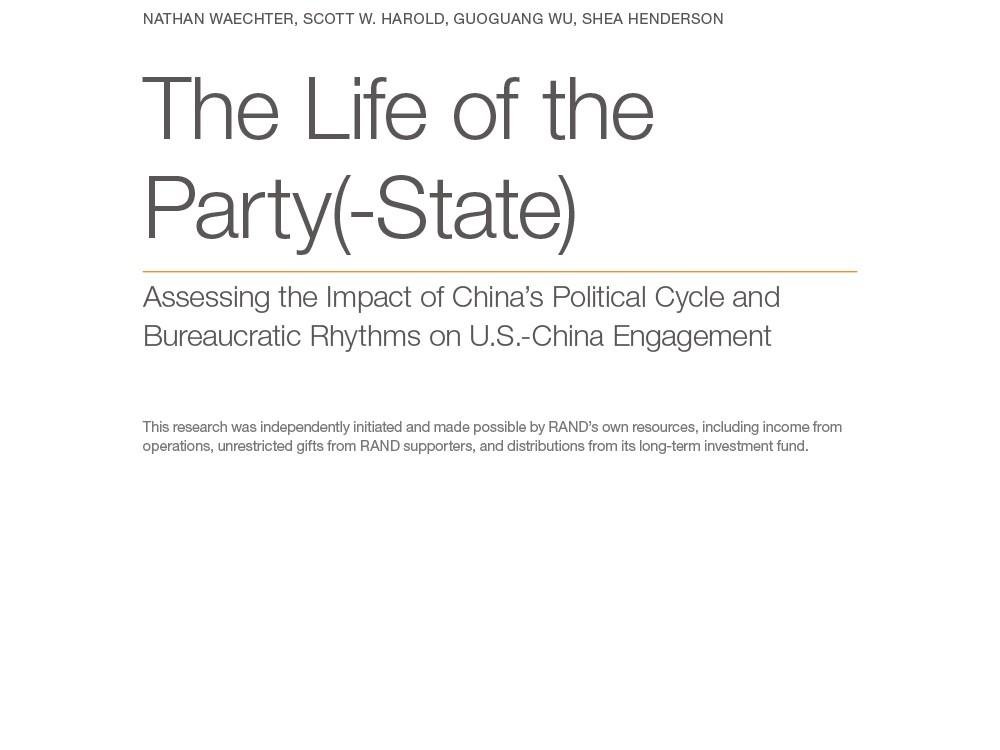
Waechter, Nathan, Scott W. Harold, Guoguang Wu, and Shea Henderson, The Life of the Party(-State): Assessing the Impact of China’s Political Cycle and Bureaucratic Rhythms on U.S.-China Engagement, RAND Corporation, RR-A4565-1, 2026. As of November 10, 2026:
Chicago Manual of Style
Waechter, Nathan, Scott W. Harold, Guoguang Wu, and Shea Henderson, The Life of the Party(-State): Assessing the Impact of China’s Political Cycle and Bureaucratic Rhythms on U.S.-China Engagement. Santa Monica, CA: RAND Corporation, 2026. .
This publication is part of the RAND research report series. Research reports present research findings and objective analysis that address the challenges facing the public and private sectors. All RAND research reports undergo rigorous peer review to ensure high standards for research quality and objectivity.
This document and trademark(s) contained herein are protected by law. This representation of RAND intellectual property is provided for noncommercial use only. Unauthorized posting of this publication online is prohibited; linking directly to this product page is encouraged. Permission is required from RAND to reproduce, or reuse in another form, any of its research documents for commercial purposes. For information on reprint and reuse permissions, please visit www.rand.org/pubs/permissions.
RAND is a nonprofit institution that helps improve policy and decisionmaking through research and analysis. RAND’s publications do not necessarily reflect the opinions of its research clients and sponsors.
