

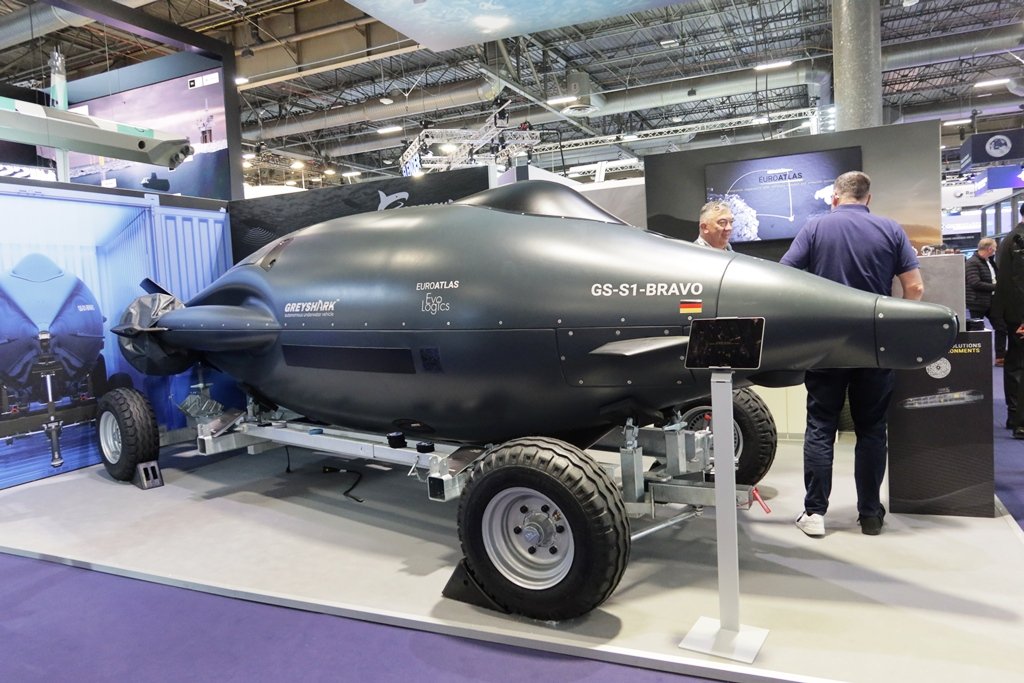
At Euronaval 2026 Euroatlas, the Bremen-based German company specialised in underwater autonomy, power electronics, day and night-vision systems, and counter-drone solutions, exhibited the production version of its Greyshark autonomous underwater vehicle, a pretty different vehicle compared to the prototype – or better the technology demonstrator – seen in previous exhibitions
The outside shape of the Greyshark, developed by Euroatlas in close cooperation with EvoLogics, a Berlin-based company specialised in underwater communication, accurate positioning, and advanced robotics, remains quite similar, however a major difference is immediately visible; past versions featured a single shrouded propeller at the rear which diameter was comparable to that of the hull, while the new and final configuration is fitted with two motor pods and smaller propellers (duly hidden under canvas) on the sides, which led to a complete redesign of the aft section.
EDR On-Line understood that when the AUV was swimming at slow speed and it needed to accelerate, the single propeller caused it to roll due to the propeller torque, generating some sort of instability. To cope with this Euroatlas adopted the two-propeller solution, propellers being counter-rotating, which increase stability, manoeuvrability and allow precise control in all conditions. Exploiting different rotation speed on the two motors allows to control yaw while two trim systems, one in the bow and one in the aft section, allow controlling pitch, so the Greyshark remains manoeuvrable even if it loses its rudders and dive planes.
Talking about control planes, earlier models featured a rear plane made of vertical and horizontal surfaces, while the production version is fitted with X-planes at the rear, dive planes being fitted at the front and on the motor pods.

Shifting to a two-motors configuration brought with it two more advantages; one is redundancy, the Greyshark being able to swim with a single engine, the second is a greater choice on the electric motor market, as the number of smaller motors on the market is greater, a plus under the supply chain aspect. No difference is obtained on acoustic stealthness; EDR On-Line was told that the sound is different, the two propellers spinning a bit faster, but signature level remains comparable.
The same applies at speed; the Greyshark has a transit cruise speed of 10 knots, which is with no ongoing sonar operations, dash speed is 14 knots, while maximum operational cruising speed is around 8 knots or lower, depending on sonar and mission.
Of course, speed has a considerable impact on endurance, however the product version of the Euroatlas AUV has a huge advantage over prototypes. What cannot be seen at first look is that the new configuration does not feature only visible differences, as most of them cannot be seen at naked eye. One is materials used to produce the hull; although no detailed information was provided, EDR On-Line was told that new material adopted allowed obtaining a stronger and lighter construction. “The prototype was too heavy and we needed to save a lot of weight,” a company representative told us, “So [adopting new material] we managed to save 700 kilograms in mass, while doubling the battery capacity,” hence range and endurance have increased, the Greyshark being now able to safely achieve over 320 nautical miles with the full payload operating with a speed of 4 knots, range being greatly increased reducing payload. The exact battery technology adopted on the production version was not disclosed, EDR On-Line understanding it is not Lithium-Ion. Euroatlas expects an improvement in battery performances in the next here-four years, which would further improve Greyshark performances. EDR On-Line understood that late next year a fuel cell version of the Greyshark will be available, range and endurance increasing dramatically compared to the battery-powered version.

The AUV production process is now someway more difficult, considering the shape of the rear part of the hull is much more complex, which led to more complex tooling.
“The prototype was not a prototype, it was basically a testbed or a technology demonstrator, but most of all it was a software development tool,” EDR On-Line was told. Part of the software developed until now was reused, but part of it was rewritten, and this will continue as the company will continue developing it in a typical spiral process.
Coming to payloads, in May 2023 Euroatlas shook hands with EvoLogics, which we understood being working on sensors and communications issues. Since inception it was decided to fit the Greyshark with all data collection sensors a navy might require; this does not mean that they are necessarily all present on an AUV, but the hull – and more importantly the software – will be able to accept it when needed, without any modification, a fitted-for-but-not-with solution. The 17 sensors on board allow to cover four main missions, intelligence-surveillance-reconnaissance (ISR), anti-submarine warfare (ASW), mine countermeasure (MCM) and finally marine critical infrastructure surveillance (MCI).
Some of those missions are easier than other to rain, the most difficult being of course ASW as creating fake mines is much easier than having a submarine at hand to look for.

As we could see the sensor suite is a pretty closed system, however the aim of Greyshark designers was since inception to have a solution capable to be easily interfaced with higher echelon systems, such as ship combat management system, feeding data acquired to improve situational awareness.
Euroatlas took part two years in a row in the REPMUS ((Robotic Experimentation and Prototyping with Maritime Unmanned Systems), organised by NATO along Portuguese coasts with the support of the Portuguese Navy and the European Defence Agency, deploying its technology demonstrator.
Euroatlas is currently producing the first Greysharks; the first items should be delivered to customers by year end, two undisclosed nations having signed contracts with the Bremen-based company, no details being made public yet.
The company is of course already considering a scale-up production programme, should more contracts be signed, and is looking at issues such as long lead items acquisition EDR On-Line understood that assembly time is relatively short, two weeks being needed to build the hull, one or two more weeks to assemble the whole AUV, and one or two more to complete sea trials and make it ready for commissioning. The main question remains on critical sensors, starting from optical gyroscopes, which cost means considerable investments to have them in-house waiting for orders.
Photos by P. Valpolini
