

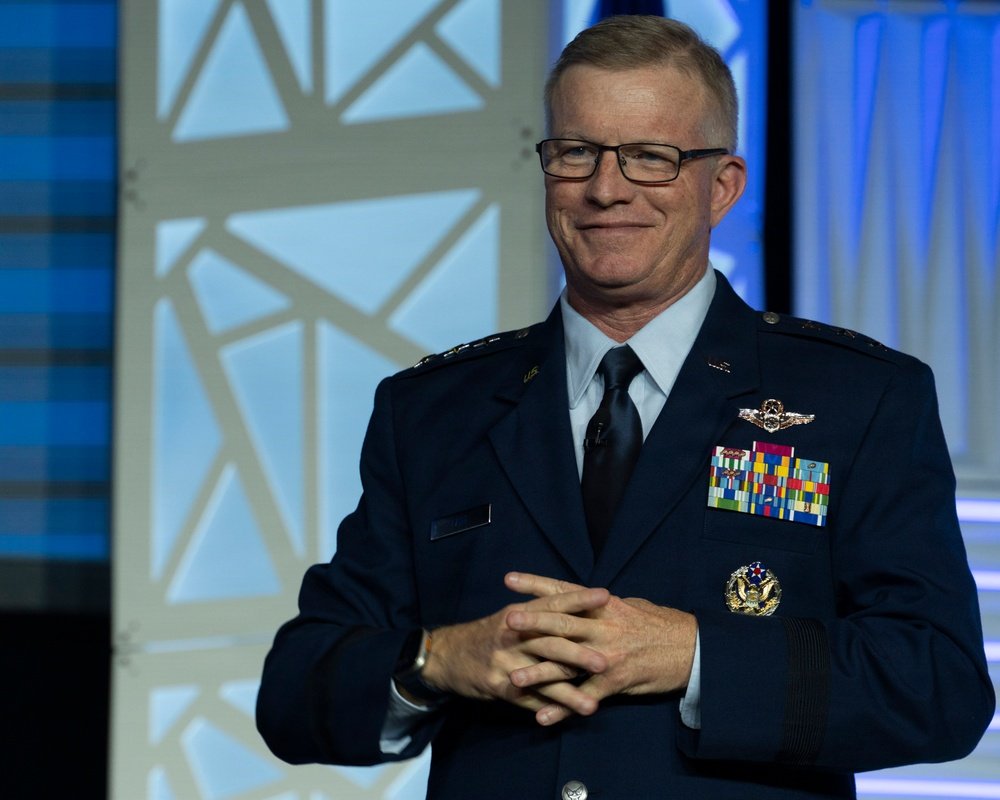
Lt. Gen. Paul Fast, Chief of Air Force Reserve and commander of Air Force Reserve Command, underscored the critical role Reserve Airmen play in the joint fight during his keynote address at the 2026 Airlift/Tanker Association Symposium in Kissimmee, Florida, Nov. 6.
During his address to hundreds of Airmen, industry partners and civic leaders, Fast depicted stories of everyday Citizen Airmen executing the mission.
“We’re at about 67,000 Citizen Airmen right now and about 10 percent are mobilized,” said Fast. “If you go to any of our tanker or strategic airlift bases, you will walk around and see very, very few airplanes, crews and maintainers because they are in the system, and they are getting the job done.”
Mobilizing for the fight
Setting the scene weeks before mobilizations to the Central Command Area of Operations last winter, Fast described the beehive of activity led by a Reserve aerial port squadron on those now empty ramps.
They’re assembling packs, cargo, and live ordnance to be loaded onto multiple aircraft, to go in concert with the active-duty associate units, said Fast.
“It’s absolute chaos, not day-to-day ops.”
The Reserve ‘Port Dawg’ team orchestrated this massive build-up coordinating efforts across multiple logistics teams to collectively provide maneuver for the Joint Force.
“They can’t do it without being ready, and that’s the whole point,” said Fast. “Their readiness did not start when they went on orders. Their readiness did not start when they were mobilized. Their readiness was a perpetual process.”
Fast admits the definition of readiness has been redefined since Operation Epic Fury.
“If you were a traditional reservist and you had a shot record and a deployment folder, we’d take care of the rest during pre-deployment,” said Fast. “My assumption was I’ll have 30 days to get you ready and out the door.”
Today, “we must be all green all the time,” he added.
Concurrently, Airmen from across other Reserve units reported for drill weekend with their bags packed.
“They had not yet been mobilized, but we knew that orders were flowing,” said Fast, “Airmen were told, ‘When you come in for drill this weekend, bring all your bags, bring all your gear. There’s a likely chance that you won’t go home.’”
During those next days, Airmen completed training, and critical gear was ferried from base to base using C-130s to ensure every Airmen had what they needed.
“If there’s any folklore about how hard it is to access the Air Force Reserve component, or how long it takes for us to be mobilized, that folklore no longer exists,” said Fast. “In 72 hours or less, we had thousands of Reserve Airmen mobilized and they were out the door.”
Into the Fight
Mobilizing efforts quickly gave way to operations. The general depicted the efforts of an HC-130 crew navigating significant threats to establish a Forward Area and Refueling Point. Connectivity was a significant challenge and Airmen went into action.
For hours, engines on, they continued to move through multiple refueling cycles. Meanwhile, overhead was one of the most complex airspace architectures ever seen in modern-day combat, stuffed with KC-135s, KC-46s, and a multitude of receivers.
“Receivers were being towed by the tanker, the tanker would get wind of a threat, then the receiver would break off,” said Fast. “They defended against the threat and then reconnected to finish up the top off.”
Fast added there were some extraordinary things taking place with total force Airmen flying together, but victories aside, improvements are still needed.
“We do not declare victory on connecting the fleet until every aircraft is connected, until every crew is full up and trained,” added Fast.
During a recent HH-60 flight on the Davis-Monthan Air Force Base, Arizona, ranges, Fast expanded on the need for connectivity.
“I was sitting in the back, looking at the mission display and not a whole lot on it,” said Fast. “I got a two-ship at 50 feet and we can’t see each other’s PPLI because there is imperfect situational awareness.”
Fast presented the challenge to the audience.
“Be very, very vocal in our requirements. Work within your commands to ensure we have what we need, and once it’s delivered, feverishly work all TTPs until we can use it every day,” urged Fast. “Until then, we don’t declare victory,”
The general emphasized that “we’re on a great path, and our industry partners are ready to help us. But we’re not there yet. Let’s be hard to satisfy.”
Preserving Service
Fast went on to recognize the uniqueness of the Reserve not just in employing forces but supporting them and their families during and after deployments.
Many Reservists live hundreds or thousands of miles away from their home station, which introduces some fog and friction to include receiving aid from Key Support Liaisons, said Fast.
A story that can be recounted many times over, the general shared one such anecdote of an Airman who mobilized quickly. He left his 11-year-old daughter and his fiancé who, along with her team at work, built and sent numerous care packages to support the deployers.
“Tony missed his 11-year-old’s birthday, as many others have missed birthdays, anniversaries, funerals and births,” noted Fast.
With the current high-ops tempo, the general shared his concerns about breaking the component.
Everyone, including active duty and the Guard are getting crushed, but there are just no alternatives right now, professed Fast.
“The Joint Force requires so much Air Force right now,” added Fast. “And as returning Airmen coming back from this conflict, we can say they are the most combat experienced Airmen in the entire Air Force. We are counting on them to be the instructors, the mentors, the exercise white force, helping to certify the next units going downrange.”
Fast stressed that the post-deployment downtime is absolutely needed.
“When you are coming back, we’re going to dial it back a little bit,” said Fast. “We may not be able to give you full dwell, but we’re going to dial it back a little bit so you can catch your breath.”
Fast added that the leadership challenge is how to preserve and protect the Reserve component way of life.
“If we do not have an attractive Air Reserve component, if it’s not a good place to be, then when people make that decision to leave the force, they’re just going to leave all the way, and that’s not a good place,” said Fast. “Leadership challenge accepted.”
Fight’s on!
