

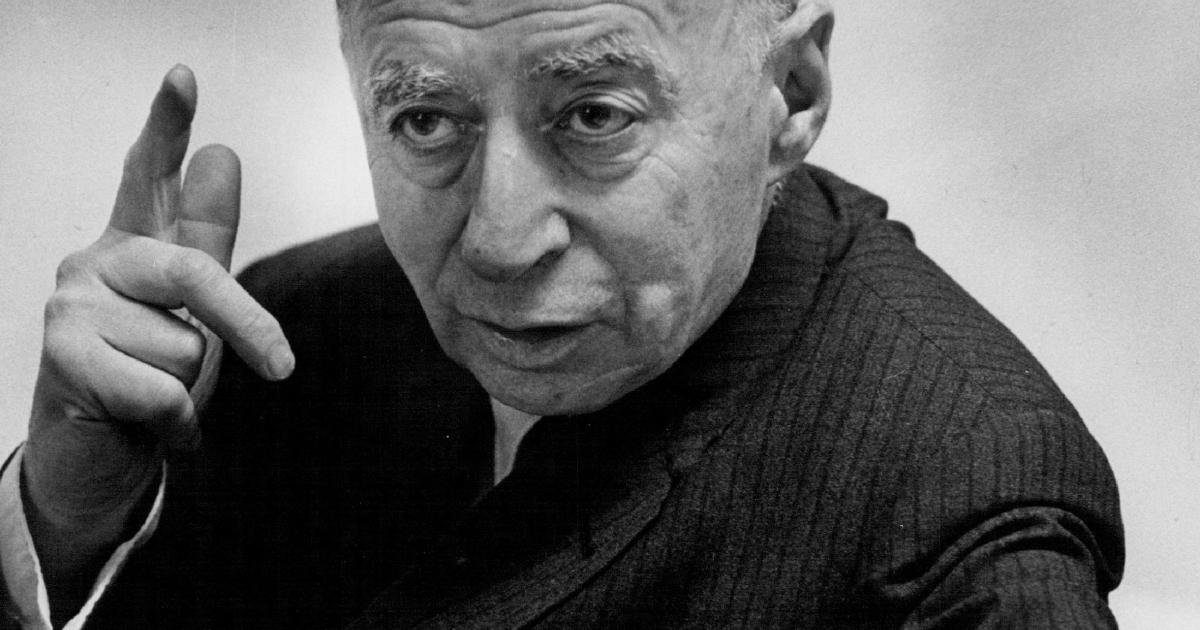
“International politics, like all politics, is a struggle for power.” Hans Morgenthau wrote this sentence from his desk in Chicago at the dawn of the Cold War, as the United States and the Soviet Union embarked on an open-ended competition for global dominance. Politics Among Nations, the volume that Morgenthau ultimately produced, would quickly become the most widely adopted international relations textbook in the United States and provide an intellectual framework—realism—that would guide generations of scholars and policymakers.
Although much has changed in the nearly eight decades since Morgenthau’s most influential work was published, the fundamentals remain the same. Human nature, which for Morgenthau drove the struggle for power, is unmoved. States are still the most significant actors in the international system and compete for influence. Great powers continue to drive the course of history. Much of today’s world would seem to affirm Morgenthau’s conclusions: Russia’s attempts to establish a sphere of influence in Eastern Europe, China’s quest for hegemony in East Asia, and the United States’ revival of the Monroe Doctrine in the Western Hemisphere all suggest the enduring primacy of national interests over moral aspirations and international norms.
For many, Morgenthau’s contributions begin and end with his identification of power as the key determinant of state behavior. But this reading misses one of his core observations: that even if humans tend to be power-maximizing creatures, they are also moral beings who seek to limit their own power. Morgenthau’s writings reveal a dialectic between power and morality—two seemingly incompatible concepts that he spent his life attempting to reconcile. Far from romanticizing power, Morgenthau saw the need to tame it.
An immigrant who escaped Nazi Germany and owed his life to the United States, Morgenthau had specific guidance to offer his fellow Americans. Even as he urged the United States to protect its vital interests by maintaining a favorable balance of power in key regions, he implored the country to wield its power prudently. Morgenthau saw the United States as the only country with both the capacity and the will to fight on behalf of transcendent values that he believed power had to serve. He was committed to preserving American power as a check on the violence and bigotry he experienced. Yet he feared that U.S. overreach would hollow out the foundations of that power. This, for Morgenthau, would be a tragedy for humanity.
Perhaps no government has misread Morgenthau more than the second Trump administration. Its officials revel in the exercise of military force around the world, from Iran to Venezuela and the Caribbean, while dismissing concerns of alleged war crimes and threatening long-standing allies. White House Deputy Chief of Staff Stephen Miller typified the Trumpian outlook when, in January, he invoked the “iron laws of the world,” one “governed by strength,” “governed by force,” and “governed by power.”
Some analysts have also erroneously rooted the Trump administration’s actions in realism. A lengthy essay in The New York Times Magazine, for instance, ran under the headline “The Theory That Gives Trump a Blank Check for Aggression.” This is understandable, as the Trump administration has repeatedly claimed its actions are underpinned by “flexible realism.”
But any reading of realism that does not consider the moral dimensions of Morgenthau’s theory is both mistaken and dangerous. When the United States limits its own power, abiding by international norms, consulting allies and partners, and wielding its strength in pursuit of transcendent values, countries find American influence more palatable, which helps sustain it. But if Washington’s actions become untethered from these restraints, others will no longer defer to American prerogatives, and the world will become a more dangerous place.
Returning to the foundations of realism—to the man who introduced this intellectual tradition to Americans—is critical. If Morgenthau were to witness this moment in U.S. history, he would conclude that the country had overlearned his lessons about the importance of power and erred in equating it with the use of force. He would see a need to elevate moral questions and rebuild normative constraints on the exercise of power. And he would warn against foreign entanglements that undermine American democracy, which remains the wellspring of the country’s power. These are the lessons that will help the United States navigate an era of intensified great-power competition, one in which the margin for error is thin and the cost of miscalculation could be catastrophic.
OUT OF EUROPE
Morgenthau was born into an assimilated, middle-class Jewish family in southern Germany in the winter of 1904. His conservative and authoritarian father, Ludwig, raised his only child to revere the monarchy and take pride in their country’s achievements. Morgenthau’s childhood might have passed as that of a shy, precocious boy in a self-assured bourgeois community, but Germany’s defeat in World War I and the rise of anti-Semitism set his life on a drastically different course.
In 1922, as a top student in his high school, Morgenthau was chosen to address his classmates and neighbors in a public ceremony honoring the school’s namesake. When he began to speak, he noticed that some had turned their backs and others were holding their noses at this “stinking Jew.” Morgenthau finished his remarks, but as he left the square, his classmates hurled anti-Semitic insults and spat on him. Just months later, Hitler descended on Morgenthau’s hometown of Coburg with hundreds of storm troopers, who assaulted protesters while the police looked on. Coburg soon gained the ignominious distinction of being the first town to elect the Nazis to power.
Morgenthau left Coburg hoping to become a writer or poet but was forced to pivot to law after hyperinflation ruined his family’s finances. During his apprenticeship under Hugo Sinzheimer, a leading left-wing labor lawyer, he saw conservative judges undermine the Weimar Republic and aid those who sought its destruction. Morgenthau later reflected in his intellectual autobiography that this led him to conclude that “what was decisive was not the merits of different legal interpretations but the distribution of political power.”
The struggle for power was inescapable.
As life for German Jews deteriorated, he fled to Geneva to teach law. Switzerland was unfortunately not far enough away; after Hitler took power in Germany, students began boycotting his classes because they did not want to learn German law from a Jew. He then found a teaching position in Madrid but was displaced by the Spanish Civil War and wandered through Europe before arriving in New York in 1937 as a penniless refugee. Having witnessed the rise of fascism up close, Morgenthau was shocked to find that so many Americans believed that human nature was fundamentally good, that peace was the normal condition of humanity, and that history was a story of progress.
In New York and then Kansas City, Morgenthau grew alarmed as the United States watched Nazi Germany rearm, annex Austria, and invade Czechoslovakia. He believed that a failure to understand human nature had inspired Western democracies’ blind faith in international law and the League of Nations, leading them down the path of least resistance with appeasement of Hitler, straight into the moral abyss.
Shaken by the fall of France in 1940, Morgenthau began writing his first English-language book, taking aim at Americans’ confidence that the methods of the natural sciences could make sense of the social world and that the sheer force of reason would eventually eliminate conflict. In Scientific Man vs. Power Politics, published in 1946, he charged that rationalism and liberalism had misunderstood the nature of man, the nature of the world, and the nature of reason itself. Humans, in addition to having rational needs, possessed irrational impulses that could not be reasoned away. Man’s “lust for power would be satisfied only … if he became like God.” Countries, like humans, sought to maximize their power over one another, making conflict inevitable.
Scientific Man received disastrous reviews, and Morgenthau later recalled that it “shocked people to no end.” He adjusted his approach, tailoring his message to Americans and packaging it in a textbook that would appeal to their pragmatism. He wanted this book to mark an evolution in American thinking about foreign policy, privately writing that it would differ from its predecessors “as an automobile differs from a horse and buggy.” Two years later, in Politics Among Nations, he achieved that goal. Morgenthau stressed that the struggle for power was inescapable. All states sought to keep, increase, or demonstrate their strength. Disarmament, collective security, and international law would not contain this struggle. Only a balance of power could prevent countries from attempting to overthrow the existing order. Power could be tamed only by countervailing power.
BARBARISM AND CIVILIZATION
It is easy to see why many misread Morgenthau as a champion of realpolitik—an heir to the likes of Machiavelli or Bismarck. After all, he placed power at the center of his analysis. But he never romanticized it. As he wrote in a private letter, “I am an analyst of the nation state and of power and have emphasized time and again their negative moral connotations.” Morgenthau’s personal encounters with power had taught him that its unbridled pursuit led to calamity. He understood that normative and moral limitations were required to keep the struggle for power within tolerable bounds. As he wrote in another letter, “It is the task of civilized societies to temper the power drives and direct them into socially useful channels.”
Indeed, Morgenthau had less tolerance for those who failed to reconcile power with morality than for those who underestimated power’s importance. Although President Woodrow Wilson’s universalism and idealism made him one of Morgenthau’s favorite targets, he preferred him to a Machiavellian prince: “Wilson’s failure was at least the failure of greatness, of too great a vision. Nobody will say as much for the epigones of Machiavelli.” He similarly criticized the British historian and political theorist E. H. Carr, whose moral relativism had led him to advocate for appeasing Hitler. Carr, he wrote, had “no transcendent point of view from which to survey the political scene and to appraise the phenomenon of power.” While both men are seen as pivotal realist thinkers, Morgenthau witheringly concluded of Carr that “it is a dangerous thing to be a Machiavelli. It is a disastrous thing to be a Machiavelli without virtù”—that is, it is ruinous to practice power politics without skill and judgment.
In Politics Among Nations, Morgenthau took issue with leaders who both glorify the struggle for power and reject any limits on their own use of power. He argued that “philosophies and political systems which have made the lust and the struggle for power their mainstay have proved impotent and self-destructive.” And he drew attention to common moral standards that could sustain order and moderate the struggle for power. He observed that throughout history, humans insisted on subjecting political action to ethical scrutiny. When such restraints held, countries did less than their power enabled them to do; once commonplace practices, such as assassinating a rival country’s leaders or killing a large portion of its civilian population to reduce its strength, became stigmatized. Morgenthau concluded, “What has changed is the influence of civilization which makes what is desirable and feasible ethically reprehensible and, hence, normally impossible of execution.”
In the immediate aftermath of World War II, however, he believed that the limitations on the struggle for power had reached their weakest point since the advent of the modern state system. Hitler had attempted to extinguish a whole people, and both the Axis and the Allied powers had bombed cities indiscriminately. Although Morgenthau believed the Allies were morally justified in taking such actions to defeat a genocidal regime, he nonetheless feared that the struggle for power was on its way to becoming boundless. In the nuclear age, failing to reestablish these moral barriers could mean the end of humanity.
The good fight
Morgenthau’s hard-nosed reputation has long obscured the moral core of his realism. He was unequivocal that power must be a means to an end—“an attempt to realize moral values through the medium of politics.” He recognized that maximizing power for its own sake was both destructive and pointless, arguing that “a nation must pursue its interests for the sake of a transcendent purpose which gives meaning to the day-to-day operations of its foreign policy.” In his view, ancient Greece and Rome are remembered because their power served a purpose that outlived their empires: Athenian democracy and philosophy, and Roman law and republican government.
As he assimilated and raised a family in Chicago, Morgenthau came to see the United States as the inheritor of this tradition. The country’s contribution to the world and the source of its power lay in its democracy and civic life. A realist approach—one that prudently wielded power abroad—was best suited to protect the American experiment at home, enabling Americans to live in freedom and security while offering an example for other countries to emulate. In other words, American power had to be bound to purpose—a purpose the country fulfilled “as a light to attract strangers, not as a flame to be spread throughout the world.” This was not merely the observation of a dispassionate scholar. The United States had accepted Morgenthau when no other country would, and it was a place where immigrants like him could rise to the top of their fields.
By the 1960s, Morgenthau saw that American power faced a threat of its own making. He began to develop deep misgivings about U.S. intervention in Vietnam, warning as early as 1961 that it could become a quagmire reminiscent of France’s war in Algeria. Two years later, as clashes between the South Vietnamese government and protesters intensified, Morgenthau urged the United States to get out. He built his opposition on realist grounds, arguing that a communist takeover of Vietnam would not affect the balance of power in Asia, thus rejecting the domino theory, which held that communism would spread inexorably outward once it gained a regional foothold. Morgenthau also recognized that communism was no longer monolithic and believed that Ho Chi Minh could lead a nonaligned country as Tito did in Yugoslavia. He saw the conflict as a civil war and worried that the United States was attempting to maintain a status quo that was itself the source of instability.
Successive administrations failed to heed Morgenthau’s warnings and instead plunged the United States deeper into the war. He came to resent American policymakers’ misappropriation of his lessons on power and entered public debate with new vigor. At a packed rally in New York’s Madison Square Garden in June 1965, he warned that a guerrilla war could be won only through the indiscriminate killing of the South Vietnamese people, which would tear at the moral fiber of the United States. Later that month, Morgenthau debated President Lyndon Johnson’s national security adviser, McGeorge Bundy, on national television. He led with his moral outrage: “I am opposed to our present policy in Vietnam on moral, military, political, and general intellectual grounds.”
The greatest risk of the war, Morgenthau discerned, was “the risk to ourselves, to our mission in the world, to our very existence as a distinct nation.” He lamented, “Here is the last best hope of the downtrodden and the enslaved, to which men of good will throughout the world have looked as a shining example, relieving its frustration in blind ideological fury and aimless destructiveness upon a helpless people.” Vietnam, in his telling, had corrupted the very purpose that gave American power its meaning.
SQUANDERED INHERITANCE
The Vietnam War validated Morgenthau’s belief that power untethered from questions of morality would lead to overreach. It proved that the United States had an interest in constraining itself, if only to avoid disaster. More fundamentally, Vietnam showed that misadventures abroad could boomerang, weakening American democracy and societal cohesion and, ultimately, undermining the country’s international standing.
The second Trump administration’s foreign policy record has thrown these insights into sharp relief. Its officials view questions of morality as a costly sideshow, the remit of woolly-minded idealists who do not understand how the world works. The White House has time and again resorted to military force, striking boats in the Caribbean, kidnapping Venezuelan President Nicolás Maduro, blockading Cuba, and waging war on Iran. It has also threatened military action against Canada and Denmark, two of the country’s long-standing allies.
American democracy, far from serving as “a light to attract strangers,” is fast becoming a cautionary tale. The second Trump administration has undermined the foundations of American power through attacks on the courts, the press, and universities. It has gleefully bulldozed through any checks on its writ. Its assault on institutions and its aggressive foreign policy are intertwined; the administration not only failed to seek congressional authorization for the war in Iran, but it also refused to even make the case to the American people before striking.
The Trump administration misunderstands the very concept of power.
President Donald Trump has justified his aggression on the basis of the “iron laws that have always determined global power.” Morgenthau would not have recognized this as realism. He contended that “superior power gives no right, either moral or legal, to do with that power all that it is physically capable of doing.” The Trump administration, by contrast, seems to believe that to not use the power at its disposal is to waste it. Morgenthau’s verdict on Carr applies equally to Trump: he is a “Machiavelli without virtù,” playing power politics without judgment and leading his country to disaster.
Morgenthau would argue that the Trump administration misunderstands the very concept of power, which should not be equated with military might and must instead be understood as a complex psychological relationship. Real power, Morgenthau insisted, lies in the ability to influence a country through consent, not coercion. In this view, the use of force signifies the abdication of political power rather than its culmination. The Trump administration’s belligerence betrays its weakness: its acts of aggression around the world are confessions of its inability to shape events through other means.
Although Morgenthau grew up on the statecraft of Bismarck, he came to admire Abraham Lincoln above all others, even attempting to write a book about him toward the end of his life. Morgenthau saw in Lincoln a rare leader who was never possessed by power, instead possessing it and, ultimately, subordinating it to transcendent values. Today, just as at the height of the Vietnam War, Morgenthau would see his task as restoring morality and ethics to their rightful place and highlighting the need for power to move the world toward justice.
The United States has lost its purpose, and unless it rediscovers it, discrete foreign policy successes will be irrelevant. As Morgenthau wrote, if the country loses its soul, any victories are merely “footnotes to the history of the decline and fall of a once great nation.”
Loading…
