

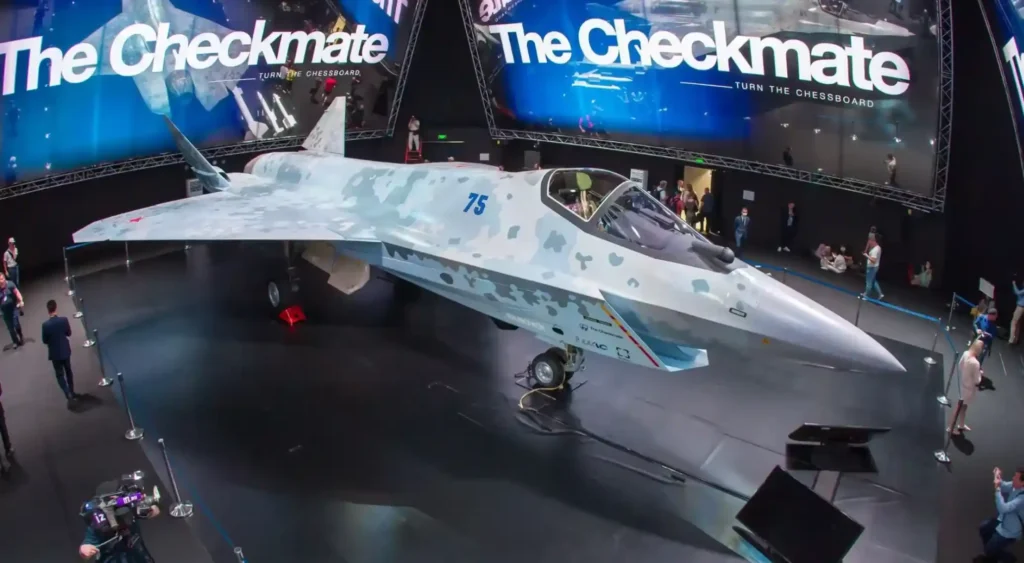
A fighter jet doesn’t need two engines to attract attention. Sometimes, one is enough to challenge an entire generation of military aviation.
That’s the idea behind the Sukhoi Su-75 Checkmate, Russia’s ambitious attempt to develop a lightweight, single-engine fifth-generation stealth fighter. Unveiled at the MAKS 2021 airshow, the aircraft immediately attracted attention with its futuristic design, internal weapons bays, and promises of advanced combat technology.
But there’s more to this project than an impressive airshow appearance.
Russia envisions the Su-75 as an affordable alternative to expensive Western stealth aircraft, particularly the American F-35 Lightning II. Unlike the larger, twin-engine Su-57, the Checkmate is designed around a simpler configuration that could reduce manufacturing and operating costs.
Its proposed capabilities sound impressive. These include low-observable technology, an active electronically scanned array (AESA) radar, advanced electronic warfare systems, and artificial intelligence-assisted pilot support. The aircraft is also expected to carry various air-to-air and air-to-ground weapons.
Yet impressive specifications don’t automatically translate into battlefield performance.
The biggest question is whether Sukhoi can turn these advertised features into a fully operational fighter. Development delays, financial pressures, international sanctions, and the challenge of building a new aircraft engine all complicate that ambition.
There’s also an important distinction between what Russia has announced and what the aircraft has actually demonstrated.
So, how advanced is the Sukhoi Su-75 Checkmate really? Does its stealth-oriented design give Russia a credible new competitor in the global fighter market, or is the project still more ambitious than practical?
Let’s examine its technology, performance, weapons, and development challenges to understand what this next-generation fighter could eventually deliver.
What Is the Sukhoi Su-75 Checkmate?
The Sukhoi Su-75 Checkmate is a proposed single-engine, fifth-generation multirole stealth fighter developed by Russia’s Sukhoi design bureau, part of the United Aircraft Corporation (UAC).
Its development reflects a different approach to modern combat aviation: rather than building another large, expensive fighter, Russia wants a smaller aircraft with advanced capabilities and potentially lower operating costs.
The aircraft made its public debut at the MAKS 2021 International Aviation and Space Salon near Moscow. Its unveiling attracted considerable attention, particularly because Russia presented it as an export-oriented fighter capable of competing in the international market.
But why does Russia need another stealth aircraft?
The answer partly lies in the Su-57. Although the twin-engine Su-57 was developed for demanding air-superiority and multirole missions, its size, complexity, and expected costs make it unsuitable for every potential customer. The Su-75 is intended to occupy a different market position.
A Smaller Fighter With Bigger Ambitions
Unlike the Su-57, the Su-75 uses a single-engine configuration. This design could simplify maintenance, reduce fuel consumption, and lower procurement costs compared with a comparable twin-engine aircraft. However, actual savings will depend on production volume, engine reliability, and maintenance requirements.
Sukhoi has also promoted the Checkmate as a multirole platform. Its proposed missions include air combat, ground attack, and operations against maritime targets.
Read also: Russia’s MiG-41 Fighter Program: Ambition or Illusion?
The aircraft is intended to appeal to foreign buyers seeking modern combat aviation technology without the acquisition costs associated with some Western fifth-generation fighters.
Its development also includes plans for different configurations, potentially including two-seat and unmanned versions.
Still, there’s an important distinction. The Su-75 remains a development project, not an established operational fighter. Its advertised capabilities have yet to be demonstrated through a complete flight-testing and combat-evaluation program.
How Advanced Is the Su-75 Checkmate’s Stealth Design?
Stealth isn’t simply about making an aircraft difficult to see. It’s about controlling how much information an enemy’s sensors can collect, especially before a fighter gets close enough to engage.
This is one of the most important features of the Sukhoi Su-75 Checkmate. Sukhoi designed the aircraft around low-observable principles intended to reduce its radar signature and improve survivability in heavily defended airspace.

Look at its exterior. The Checkmate features carefully shaped surfaces, an integrated fuselage, and a distinctive air intake beneath the forward section. These elements aren’t just styling choices. Their geometry can influence how radar energy reflects toward an enemy receiver.
Radar-Absorbing Design and Internal Weapons Bays
One major feature is its diverterless supersonic inlet (DSI). This intake arrangement uses a specially shaped surface to manage airflow entering the engine while avoiding conventional boundary-layer diverters.
DSI technology can also help reduce radar reflections associated with traditional intake structures. However, its effectiveness depends on the complete aircraft design, not the intake alone.
The internal weapons bays are equally important.
Carrying missiles and bombs inside the fuselage prevents exposed weapons from creating additional radar reflections. This allows the aircraft to preserve its intended low-observable configuration during combat missions.
External hardpoints may still be available when additional payload matters more than stealth.
How Does It Compare With Other Stealth Fighters?
The Su-75 follows design principles also found in the American F-35 and Russian Su-57. All three emphasize shaped surfaces and internal weapons carriage.

However, similarities in appearance don’t establish equivalent stealth performance. Actual radar cross-section measurements depend on numerous factors, including viewing angle, radar frequency, materials, and manufacturing quality.
That’s where the Checkmate faces its biggest test.
Its stealth characteristics remain largely unverified through operational testing. Without measured radar-signature data, claims about its ability to evade modern air-defense systems should be treated cautiously.
One particularly important detail is the aircraft’s internal weapons capacity. UAC advertises a low-observable configuration capable of carrying up to five air-to-air missiles internally. This suggests the Checkmate is being designed around stealth during actual combat missions, not merely during peacetime patrols.

The bottom line: The Su-75 has several recognizable stealth features, but its true radar performance remains an open question. Its eventual effectiveness will depend on engineering quality, materials, manufacturing precision, and testing, not just its futuristic exterior.
What Engine Powers the Su-75 and How Fast Can It Fly?
A stealth fighter can have sophisticated radar and advanced weapons, but none of that matters without a reliable engine. For the Sukhoi Su-75 Checkmate, propulsion is particularly important because its single-engine configuration must support demanding missions without the redundancy of a twin-engine design.
Sukhoi has designed the Checkmate around one turbofan engine, reflecting its intention to create a lighter and potentially less expensive fifth-generation fighter. This arrangement also reduces the number of engines requiring maintenance, although it places greater importance on individual engine reliability.
Single-Engine Configuration and Performance
The Su-75 is expected to use a Russian-developed turbofan from the AL-41F1 engine family or a related configuration, although its final production powerplant has not been conclusively established.
This distinction matters. An engine selected for a prototype or initial development phase doesn’t necessarily become the final production engine.

According to manufacturer specifications, the Checkmate is designed to reach a maximum speed of approximately Mach 1.8. That’s around 2,200 km/h under suitable high-altitude atmospheric conditions.
Its advertised performance also includes a flight range of approximately 2,900 kilometers and a service ceiling of around 16,500 meters.
These figures suggest an aircraft intended for more than short-range interception. It could potentially perform patrol, escort, and precision-strike missions across considerable distances.
Understanding the Su-75’s Advertised Flight Performance
Here are the main performance figures published by UAC:
| Performance specification | Advertised figure |
| Maximum speed | Mach 1.8 |
| Flight range | 2,900 km |
| Service ceiling | 16,500 m |
| Engine configuration | Single turbofan |
| Maximum combat payload | 7,400 kg |
One figure deserves closer attention: the advertised 2,900-kilometer range. This shouldn’t be confused with combat radius, which represents how far an aircraft can travel, conduct its mission, and return with appropriate fuel reserves.
Actual mission range will depend on weapon configurations, flight altitude, speed, and external fuel requirements.
There’s also uncertainty surrounding the final engine selection. Earlier development reporting associated the aircraft with the AL-41F1 engine used by the Su-57, while later reporting discussed potential next-generation propulsion options. UAC has not publicly confirmed the precise engine designation for the current prototype.
The real challenge is balancing everything. A lightweight fighter must combine acceleration, fuel efficiency, payload capacity, and reliable propulsion without compromising its intended stealth characteristics.
For the Su-75, those promises still need to survive the toughest examination: actual flight testing. Until then, Mach 1.8 and 2,900 kilometers remain impressive targets rather than proven performance figures.
What Weapons Can the Su-75 Checkmate Carry?
A stealth fighter is only as useful as the weapons it can deliver. For the Sukhoi Su-75 Checkmate, this means combining internal missile storage with the flexibility to carry different weapons for air combat and ground-attack missions.
Sukhoi has promoted the Checkmate as a multirole aircraft rather than a dedicated air-superiority fighter. Its proposed weapons configuration is designed to support engagements against aircraft, land targets, and potentially maritime threats.

The aircraft’s internal weapons bays are particularly important. By storing missiles and precision-guided weapons inside the fuselage, the Su-75 can preserve its intended low-observable configuration during combat operations.
When stealth becomes less important, external hardpoints could provide additional payload capacity.
Internal Weapons Bays and Missile Capacity
One advertised feature is the ability to carry up to five air-to-air missiles internally. This arrangement would allow the fighter to engage hostile aircraft without exposing its weapons beneath the wings.
Potential weapon integrations include:
- R-77: A beyond-visual-range air-to-air missile designed to engage aircraft at extended distances.
- R-74: A short-range infrared-guided missile intended for close-range aerial engagements.
- Kh-59MK2: A precision-guided air-to-surface missile designed for attacks against ground targets.
- Kh-58: An anti-radiation missile family intended to attack hostile radar installations.
These weapons illustrate the types of missions Sukhoi wants the Checkmate to perform. However, their appearance in proposed integration discussions does not mean every weapon has been tested or approved for the aircraft.
Air-to-Ground and Anti-Ship Weapons
The Checkmate is also intended to attack targets beyond the traditional air-combat environment. Its proposed weapons portfolio includes several Russian precision-guided systems.
| Weapon | Primary role |
| Kh-59MK2 | Precision ground attack |
| Kh-58UShKE | Anti-radiation missions |
| Kh-38 | Air-to-ground strikes |
| Grom-E1 | Guided air-to-ground attack |
| Kh-35UE | Anti-ship operations |
| KAB-250LG-E | Laser-guided bombing |
These weapons appeared in the aircraft’s announced or proposed armament options. Their actual integration and compatibility with the Su-75 remain subject to development and testing.
How Much Weaponry Can the Su-75 Carry?
UAC advertises a maximum combat payload of 7,400 kilograms. However, this figure should not be confused with the aircraft’s internal stealth-compatible weapons capacity.
The distinction is important. External weapons can increase payload, but they also introduce additional radar reflections and aerodynamic drag.
In other words, the Su-75 will need to balance firepower against survivability. Carrying more weapons isn’t always the best choice when facing advanced air-defense systems.
Its real advantage will depend on flexibility: the ability to switch between low-observable air combat and heavier multirole configurations without fundamentally changing the aircraft.
Su-75 Checkmate vs. F-35 and Su-57: How Do They Compare?
The Sukhoi Su-75 Checkmate is designed to enter a market already occupied by established fifth-generation fighters. Two aircraft provide particularly useful comparisons: the American F-35 Lightning II and Russia’s own Su-57 Felon.
All three emphasize stealth and advanced avionics, but their design philosophies differ considerably. Understanding those differences helps explain where the Checkmate could eventually fit.

Su-75 vs. F-35: A Different Approach to Stealth
The F-35 Lightning II is an operational single-engine stealth fighter developed by Lockheed Martin. It combines low-observable construction, sensor fusion, electronic warfare, and networked combat capabilities.
The Su-75 follows a broadly similar single-engine philosophy. Both aircraft are intended to perform multiple missions, including air-to-air engagements and precision strikes.
However, there’s a major difference in maturity. The F-35 has undergone extensive flight testing and entered operational service, while the Checkmate remains a development project.
That means comparing their advertised specifications doesn’t establish equivalent combat capabilities.
Su-75 vs. Su-57: One Engine or Two?
The Sukhoi Su-57 takes a different approach.
Its twin-engine configuration supports a larger aircraft designed for demanding air-superiority and multirole missions. The Su-75, meanwhile, targets a lighter and potentially more affordable segment.
This distinction affects more than propulsion. It influences aircraft size, maintenance requirements, payload arrangements, and intended procurement costs.
The Su-75 is therefore not simply a smaller replacement for the Su-57. Russia is pursuing two different aircraft concepts for different market and operational requirements.
Su-75 vs. F-35 vs. Su-57: Key Differences
| Feature | Su-75 Checkmate | F-35A | Su-57 |
| Country | Russia | United States | Russia |
| Engines | Single | Single | Twin |
| Maximum speed | Mach 1.8 (claimed) | Mach 1.6 | Mach 2 (claimed) |
| Maximum payload | 7,400 kg (claimed) | 8,160 kg | Not directly comparable |
| Development status | In development | Operational | Operational |
| Primary role | Multirole | Multirole | Air superiority/multirole |
The F-35 also benefits from an established international support network, extensive flight experience, and continuous software modernization. The U.S. Air Force describes its sensor fusion and secure data-sharing capabilities as central elements of its combat architecture.
The Checkmate doesn’t have that operational foundation yet.
Its potential selling points are different: a single-engine design, advertised lower operating costs, and a configuration intended to attract countries seeking modern fighter capabilities.
Ultimately, the comparison isn’t just about speed or payload. It’s about what each aircraft can actually accomplish, how reliably it performs, and whether its supporting infrastructure can sustain combat operations. Until the Su-75 completes development and testing, those comparisons remain provisional.
When Will the Su-75 Enter Service? Development Challenges and Future Prospects
The biggest challenge facing the Sukhoi Su-75 Checkmate isn’t necessarily its design. It’s turning that design into a functioning combat aircraft that can be manufactured, tested, and delivered to customers.
When Sukhoi unveiled the Checkmate in 2021, Russia presented an ambitious development schedule. The aircraft was expected to progress toward its first flight within a few years, followed by production and potential international deliveries.
However, those expectations proved difficult to meet.

Developing a fifth-generation fighter requires far more than assembling an airframe. Engineers must validate its engine, flight-control systems, radar, weapons integration, and low-observable materials. Each system needs extensive testing before the aircraft can become operational.
For the Checkmate, these challenges have contributed to a prolonged development process.
Prototype Development and Flight-Test Delays
One major milestone is the construction of a flying prototype. Unlike the static aircraft displayed at the MAKS 2021 airshow, a flying prototype must demonstrate that its structure, propulsion, and control systems work together under real flight conditions.
This distinction is crucial.
A successful first flight would represent meaningful progress, but it wouldn’t automatically mean the aircraft is ready for military service. The subsequent testing program would need to examine stability, maneuverability, engine performance, radar operation, and weapons compatibility.
Only after completing these stages could Russia move toward production and operational acceptance.
Funding, Sanctions, and Production Challenges
Money is another major obstacle.
Unlike established fighter programs backed by large procurement contracts, the Checkmate has faced uncertainty surrounding long-term financing and customer commitments. International sanctions have also complicated Russia’s access to certain advanced electronic components, manufacturing equipment, and aerospace supply chains.
These pressures matter because stealth aircraft require extremely precise manufacturing and sophisticated onboard electronics.
Russia has increasingly emphasized the Su-75’s potential affordability, with industry representatives discussing an expected export price of approximately $25–30 million. However, this remains a projected figure rather than an established production price.
Export Ambitions and Future Variants
Russia initially promoted the Checkmate toward potential customers in the Middle East, Asia, Africa, and Latin America. In June 2026, UAC chief executive Vadim Badekha reiterated that the aircraft was being developed for both Russian and international customers.
However, no confirmed production order or export delivery has established its commercial success.
UAC has also discussed potential two-seat and unmanned configurations, suggesting ambitions to develop an entire aircraft family around the original design.
As of November 2026, prototype construction has been reported, but the maiden flight remains unconfirmed. Some analysts anticipate a first flight between late 2026 and 2027.
For now, the Checkmate remains a promising but unproven project. Its future depends on whether Russia can move beyond prototype assembly, demonstrate its advertised technology, and secure enough funding and customers to support production.
