

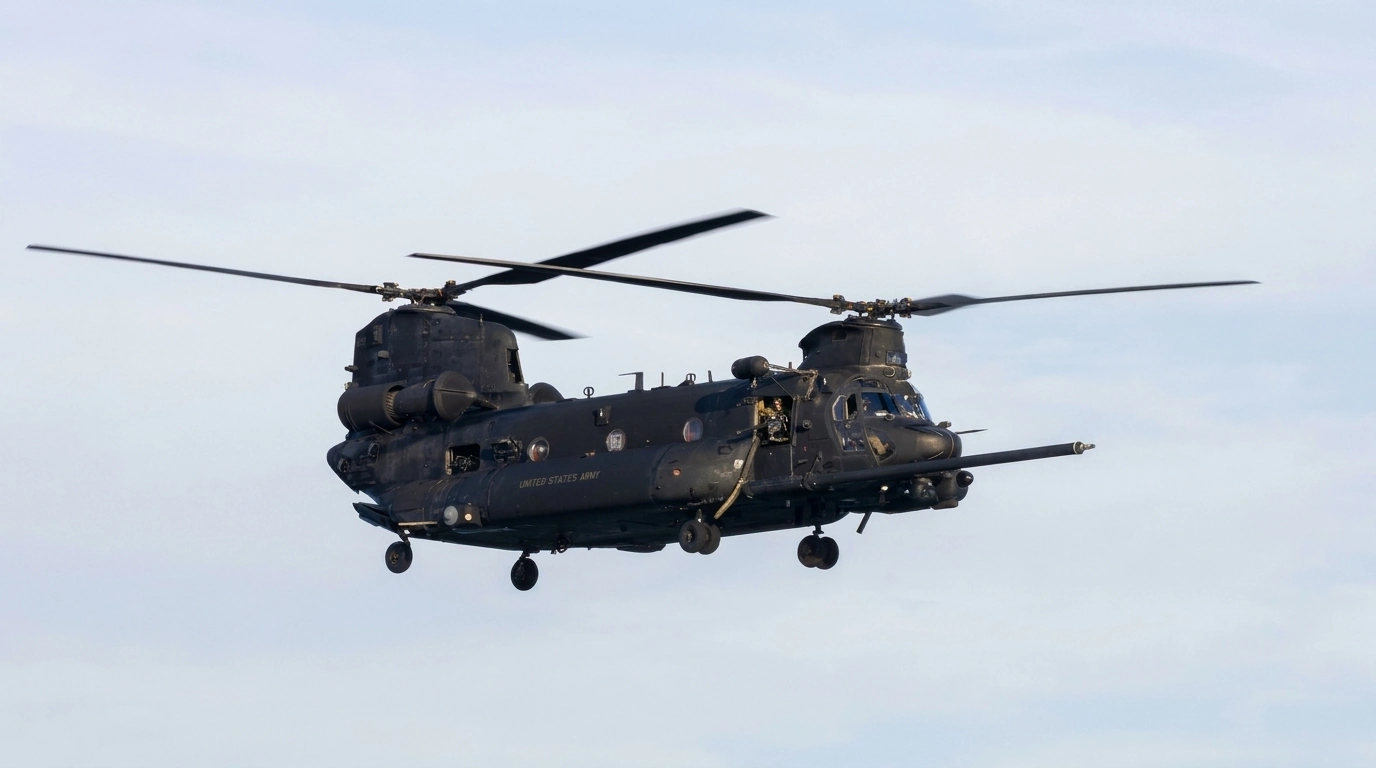
Imagine transporting an entire special operations team, its equipment, and essential supplies across hundreds of miles without relying on conventional airfields. That’s where the MH-47G Chinook becomes particularly valuable.
Boeing developed the MH-47 G Chinook for U.S. Army Special Operations Aviation Command as a specialized heavy-lift helicopter for demanding military missions. It combines the familiar tandem-rotor Chinook design with specialized navigation equipment, extended-range fuel systems, and advanced defensive technologies.
But its importance goes beyond transportation.
The aircraft supports the 160th Special Operations Aviation Regiment (160th SOAR), widely known as the Night Stalkers. This elite aviation unit provides specialized air mobility for U.S. Army Special Operations Forces, including missions requiring long-range transportation and operations in challenging environments.
What makes the MH-47G Chinook particularly interesting is its ability to perform several roles within the same mission. It can transport personnel, carry heavy equipment, support aerial refueling, and provide specialized insertion and extraction capabilities.
Its large cargo compartment also offers something smaller special operations helicopters cannot easily match: substantial transportation capacity.
So, how does the MH-47G Chinook support America’s special operations missions? Understanding its design, technology, and operational capabilities reveals why this helicopter remains an important asset in U.S. military aviation.
What Is the MH-47G Chinook and Why Was It Developed?
The MH-47G Chinook is a specialized heavy-lift helicopter developed for the U.S. Army’s most demanding special operations requirements. Based on Boeing’s CH-47 Chinook family, it combines substantial transportation capacity with equipment designed for long-range military missions.
Its development reflects a particular challenge. Special operations forces often need to travel beyond conventional military transportation routes, sometimes operating far from established airfields and logistical facilities. Standard transport helicopters cannot always meet those requirements.
The original CH-47 Chinook entered U.S. Army service in 1962. Its tandem-rotor configuration provided considerable lifting capability, making it valuable for transporting troops, cargo, and military equipment.
Over time, the U.S. Army recognized that special operations missions required additional capabilities. This led to the development of specialized MH-47 variants, eventually resulting in the MH-47G Chinook configuration.
From Conventional Chinook to Special Operations Helicopter
The MH-47G Chinook incorporates several modifications that distinguish it from conventional transport versions.
These include extended-range fuel systems, specialized navigation equipment, aerial refueling capability, and defensive systems. Its avionics are also designed to support demanding flight conditions, including nighttime operations and environments with limited visibility.
Another important feature is its association with the 160th Special Operations Aviation Regiment (160th SOAR), also known as the Night Stalkers.
Based at Fort Campbell, Kentucky, this specialized aviation unit operates several aircraft types supporting U.S. special operations forces. The MH-47G Chinook provides its heavy-lift transportation capability.
Unlike smaller helicopters designed primarily for lighter personnel transportation, the MH-47G Chinook can accommodate larger groups alongside substantial mission equipment. Its rear cargo ramp also makes loading and unloading considerably more flexible.
The helicopter can support personnel transportation, logistical resupply, and specialized insertion and extraction requirements.
Ultimately, the MH-47G Chinook was developed around a straightforward requirement: giving special operations forces reliable heavy-lift aviation support when distance, terrain, and operating conditions make conventional transportation difficult.
MH-47G Chinook Specifications and Heavy-Lift Capabilities
When discussing the MH-47G Chinook, its size is only part of the story. The real advantage comes from its ability to transport substantial loads while maintaining the performance needed for demanding special operations missions.
The helicopter uses a tandem-rotor configuration, with two large counter-rotating rotor systems positioned along its fuselage. This arrangement eliminates the need for a conventional tail rotor and provides considerable lifting capability.

Power comes from two Honeywell T55 turboshaft engines. Depending on the specific configuration, the engines produce approximately 4,800 shaft horsepower each. That’s a substantial amount of power for an aircraft designed to carry personnel, cargo, and mission equipment.
MH-47G Chinook Technical Specifications
| Specification | Details |
| Manufacturer | Boeing |
| Configuration | Tandem-rotor |
| Engines | 2 × Honeywell T55 |
| Engine power | Approximately 4,800 shp each |
| Maximum speed | Approximately 170 knots |
| Rotor diameter | 60 feet |
| Fuselage length | Approximately 51 feet |
| Maximum gross weight | Configuration-dependent |
| Primary mission | Special operations heavy lift |
| Cargo access | Rear loading ramp |
Figures are approximate and may vary between MH-47G Chinook configurations. Performance figures should not be treated as guaranteed operational payload or range.
Why the Tandem-Rotor Design Matters
The MH-47G Chinook’s distinctive rotor arrangement provides an important engineering advantage. Both rotor systems contribute to lifting the aircraft, allowing it to carry substantial weight without relying on a conventional tail rotor.
Its large cargo compartment provides room for personnel, equipment, and supplies. The rear loading ramp also makes transportation more flexible, particularly when handling bulky military cargo.
The MH-47G Chinook can additionally transport external loads using a sling-load system. This allows compatible equipment and supplies to be carried beneath the helicopter when internal cargo space is insufficient.

For special operations forces, that flexibility matters. A single aircraft can support personnel transportation while also carrying the equipment needed for a mission.
However, payload capacity always involves trade-offs. Fuel requirements, altitude, temperature, and environmental conditions influence how much weight the helicopter can safely transport.
That’s what makes the MH-47G Chinook valuable: substantial lifting capability combined with specialized equipment for long-range military transportation.
Long-Range Operations and Aerial Refueling Capabilities
Distance can become a serious challenge during special operations. Missions may require helicopters to travel far beyond conventional operating areas, sometimes without access to nearby airfields or refueling facilities. The MH-47G Chinook addresses this challenge through extended-range fuel systems and aerial refueling capability.
One of its most important features is an in-flight refueling probe mounted near the front of the aircraft. This allows the helicopter to receive fuel from compatible tanker aircraft while remaining airborne.
For special operations aviation, that’s a significant advantage.
Instead of depending entirely on the fuel carried before departure, the MH-47G Chinook can extend its operational reach through coordinated aerial refueling support.
Extended-Range Fuel Systems
The MH-47G Chinook incorporates specialized fuel arrangements designed to support longer missions. These include extended-range fuel tanks that increase the amount of fuel available during flight.
Additional fuel capacity is particularly important when transporting personnel and equipment across large geographical distances. It provides greater flexibility when mission requirements involve remote locations or limited ground infrastructure.
However, additional fuel also introduces weight considerations. The helicopter must balance fuel, personnel, and cargo while remaining within its approved operating limits.

How Aerial Refueling Extends Operational Reach
Aerial refueling allows the MH-47G Chinook to receive fuel from compatible tanker aircraft, reducing its dependence on ground-based refueling locations.
This capability becomes particularly valuable during missions involving distant operating areas. It can support extended transportation routes and provide additional flexibility when planning long-duration operations.
The process requires specialized equipment, trained crews, compatible tanker aircraft, and suitable environmental conditions. It isn’t something that can happen anywhere or under every circumstance.
Why This Matters for Special Operations
Consider a mission requiring the transportation of personnel and equipment across a large geographical area. Without aerial refueling, aircraft range and fuel reserves can become major planning constraints.
With tanker support, the MH-47G Chinook gains another option for extending its flight duration and operational reach.
Still, aerial refueling doesn’t eliminate every limitation. Weather, payload, fuel availability, and aircraft maintenance remain important considerations.
The advantage is flexibility. Combined with its heavy-lift capacity, the MH-47G can support special operations missions that would otherwise place greater demands on conventional helicopter transportation.
How the MH-47G Chinook Supports Special Forces Insertion and Extraction
Transporting special operations personnel is rarely as simple as moving troops from one airfield to another. Missions can involve remote locations, limited landing areas, and difficult environmental conditions. The MH-47G Chinook is designed to support these demanding transportation requirements.
Its large cabin, rear loading ramp, and specialized insertion equipment give crews several ways to transport and deploy personnel. Unlike smaller helicopters with more limited cargo capacity, the MH-47G Chinook can accommodate larger teams alongside their equipment and supplies.
This flexibility makes it particularly valuable to the 160th Special Operations Aviation Regiment.
Specialized Personnel Insertion Systems
One important capability is the Fast Rope Insertion and Extraction System (FRIES). It allows personnel to descend from a hovering helicopter using specialized ropes when conventional landing arrangements are unsuitable.
The aircraft can also support the Special Patrol Insertion and Extraction System (SPIES), which uses specialized equipment to transport personnel externally beneath the helicopter.
These systems provide additional transportation options when operating environments limit conventional access.
However, their use depends on mission requirements, equipment configuration, and environmental conditions.
Personnel Extraction and Recovery
The MH-47G Chinook is equally important when personnel need to be recovered from remote locations.
Its rear cargo ramp provides convenient access for loading personnel and equipment. The large cabin also offers room for additional passengers, medical supplies, and mission-related equipment.
For example, during a personnel recovery mission, the helicopter can transport recovery teams while providing space for individuals being evacuated.
Its heavy-lift capability also allows it to support missions involving equipment that smaller helicopters cannot easily accommodate.
Why Its Large Cabin Matters
The real advantage isn’t simply the number of people the helicopter can carry. It’s the ability to transport personnel and their equipment together.
Special operations teams frequently require communications equipment, protective gear, medical supplies, and other mission essentials. Having sufficient cabin space helps reduce transportation constraints.
The MH-47G Chinook therefore serves as more than a military troop carrier. It provides flexible air mobility for insertion, extraction, personnel recovery, and logistical transportation.
For special operations forces, that flexibility can make a significant difference when conventional transportation options are limited.

Defensive Systems, Survivability and Mission Protection
The MH-47G Chinook operates in environments where aircraft may face significant security threats. Its heavy-lift capability makes it valuable for special operations, but its large size also creates particular survivability challenges.
To address these risks, the helicopter incorporates defensive equipment designed to improve crew awareness and provide protection against potential threats.
These systems combine warning sensors, electronic countermeasures, and defensive armament. Together, they help crews respond to changing conditions while supporting demanding transportation missions.
Defensive Armament and Aircraft Protection
The MH-47G Chinook can be equipped with defensive machine guns, including M134 Miniguns and M240-series weapons, depending on configuration.
These weapons provide defensive coverage during missions where additional protection is required. Their primary purpose is to support aircraft and crew protection rather than serve as the helicopter’s main offensive capability.
The aircraft also incorporates defensive equipment designed to identify potential threats.

Radar and Missile Warning Systems
Electronic warning systems provide another important layer of protection.
Radar-warning equipment can alert crews to certain radar emissions associated with potential threats. Missile-warning sensors help detect indications of incoming missile activity, depending on the installed system.
The helicopter can also use countermeasure dispensers to release chaff and infrared flares.
Chaff is designed to interfere with certain radar-guided threats, while flares can help distract infrared-guided missiles.
These systems improve survivability, but they have limitations. Their effectiveness depends on the threat, sensor coverage, environmental conditions, and equipment configuration.
Why Survivability Matters for Special Operations
The MH-47G Chinook’s mission profile makes aircraft protection particularly important.
Unlike helicopters operating exclusively in relatively secure transportation environments, special operations aircraft may need to function where threat conditions are less predictable.
Its defensive architecture therefore supports several objectives: detecting potential threats, providing crews with warning information, and improving the aircraft’s ability to respond.
However, no combination of defensive equipment guarantees protection against modern air-defense systems.
Crew training, mission planning, intelligence support, maintenance, and coordination with other military assets remain essential.
Ultimately, the MH-47G Chinook’s survivability depends on more than its onboard defensive equipment. It requires a complete support system capable of helping the aircraft and its crew operate under demanding conditions.
MH-47G Chinook Block II and the Future of U.S. Special Operations Aviation
The MH-47G Chinook remains an important asset for U.S. special operations, but its long-term effectiveness depends on continuous modernization. Military requirements are changing, and aircraft expected to operate for decades must keep pace with evolving technology and operational demands.
This is where the MH-47G Chinook Block II modernization program becomes important.
Developed by Boeing, the Block II configuration introduces structural and mechanical improvements intended to increase the helicopter’s payload capability, reliability, and operational flexibility.
What Does the MH-47G Block II Bring?
One important improvement involves the aircraft’s airframe and structural design. Reinforced components help support increased operating weight while maintaining the helicopter’s heavy-lift capabilities.
The modernization also incorporates an improved drivetrain and updated fuel tank arrangements. These changes are intended to improve performance and address the demands of extended special operations missions.
Another important development involves the Advanced Chinook Rotor Blade (ACRB) technology. The redesigned blades are intended to improve aerodynamic performance and lifting efficiency.
Together, these improvements help ensure the aircraft remains relevant as transportation requirements become more demanding.

Boeing’s MH-47G Block II Procurement Program
The modernization program has also received continued procurement support.
In March 2025, Boeing received a contract for five additional MH-47G Block II helicopters, bringing the total number of aircraft under contract to 51.
The contract was valued at approximately $461 million, with deliveries of the five additional aircraft scheduled to begin in 2027.
This procurement reflects the U.S. Army’s continued investment in specialized heavy-lift aviation for its special operations forces.
What Lies Ahead for the MH-47G?
The future of special operations aviation will increasingly involve advanced communications, improved navigation, and closer integration with unmanned systems.
The MH-47G Chinook will need to operate within this changing environment while maintaining its core transportation capabilities.
Its large cargo compartment, aerial refueling capability, and specialized mission equipment provide a strong foundation for continued service.
The Block II program is therefore more than a routine aircraft upgrade. It represents an effort to preserve an important special operations transportation platform for future missions.
As long as U.S. special operations forces require reliable heavy-lift aviation, the MH-47G Chinook is likely to remain an important part of that capability.
