

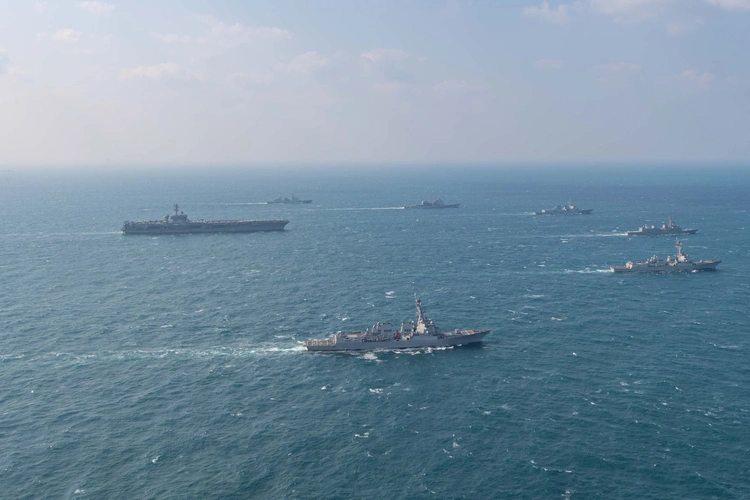
A growing consensus within the foreign policy retrenchment movement argues that the US should dismantle its forward-defense architecture in Northeast Asia. A recent proposal by Defense Priorities encapsulates this worldview, advocating that the US terminate its long-standing mutual defense treaties with the Republic of Korea (hereafter South Korea), Japan, and the Philippines. Under this framework, American military posture would pull back to the Second Island Chain—an arc anchored in Guam, Palau, and the Northern Mariana Islands. Proponents frame this as pragmatic restraint, but the strategy relies on a flawed operational premise: that open ocean provides strategic safety.
In modern state-on-state competition, retreating behind thousands of miles of open ocean does not deter conflict; it invites it. Effective deterrence requires physical proximity, immediate readiness, and unshakeable political credibility. Collapsing the forward edge of American posture to the Second Island Chain would unravel regional stability in Northeast and Southeast Asia, spark an uncontained cascade of nuclear proliferation, and surrender the world’s most dynamic economic artery to authoritarian coercion. This flawed strategy begins with a fundamental misunderstanding of geography and time.
The Tyranny of Distance and the Mechanics of a Fait Accompli
The foundational vulnerability of any offshore balancing or retrenchment posture is geographical. Advocates routinely overlook the physical constraints of theater geometry—what military strategists term the tyranny of distance. Guam sits approximately 1,500 nautical miles from the Taiwan Strait, 1,700 nautical miles from the Korean Peninsula, and more than 1,300 nautical miles from the primary sea lines of the South China Sea. High-speed surface naval combatants steaming at sustained transit speeds of 30 knots require more than 50 hours of continuous movement across open water simply to reach the operational periphery. Long-range tactical transport and air mobility assets face four or more hours of flight time before reaching contested airspace.
In an era defined by hypersonic missiles and broad-spectrum cyber strikes, high-intensity conflict unfolds across hours and minutes, not days and weeks. Forward installations along the First Island Chain maintain the tactical readiness to initiate a response within 15 minutes of initial indications and warnings. By relinquishing forward bases, the US presents revisionist powers with an open window for a rapid fait accompli. An adversary could seize key geographic choke points, neutralize localized defensive nodes, and deploy an impenetrable Anti-Access/Area Denial perimeter long before American strike packages could deploy in force.
Pullback proponents frequently argue that forward bases like Kadena Air Base in Japan or Camp Humphreys in South Korea are vulnerable missile sponges within an adversary’s strike envelope. Notwithstanding, the operational answer to adversary precision strike capabilities is not retreat—it is posture resilience. Survivability is achieved through passive defense and hardening, dynamic Agile Combat Employment that disperses air assets across distributed civil and military airstrips and layered Integrated Air and Missile Defense utilizing mobile Patriot and Terminal High Altitude Area Defense batteries. Fighting one’s way back into a heavily fortified maritime domain across an ocean surrendered without a shot demands exponentially more blood, treasure, and combat power than maintaining a persistent forward presence.
Alliance Rupture and the Proliferation Cascade
Far from being diplomatic courtesies, mutual defense treaties function as operational force multipliers that fundamentally shape an adversary’s risk-reward calculation. Unilaterally abrogating mutual defense treaties with Seoul, Tokyo, and Manila would permanently shatter American extended deterrence credibility on a global scale.
The US–South Korea Alliance has preserved peace on the Korean Peninsula for over seven decades, providing the security foundation that enabled South Korea’s transformation from a war-torn agrarian society into a global technological powerhouse. Abrupt withdrawal would send an unmistakable signal: American commitments carry an expiration date dictated by domestic fatigue.
When a superpower withdraws its security guarantees, frontline states must adapt to survive. Both South Korea and Japan possess the advanced industrial base, nuclear material reserves, and ballistic missile delivery platforms required to construct sovereign nuclear arsenals within months. A domino-effect nuclearization of Northeast Asia—introducing multiple independent, hair-trigger nuclear deterrents alongside those of China, Russia, and North Korea—would create a volatile security landscape fraught with heightened risks of strategic miscalculation.
The Reality of Authoritarian Synergy
Retrenchment advocates often compartmentalize regional challenges, treating the Korean Peninsula, the Taiwan Strait, and the South China Sea as disconnected theater dilemmas. This perspective fundamentally ignores the operational coordination linking Beijing, Moscow, Tehran, and Pyongyang.
This strategic alignment functions as a tightly coupled network. North Korean artillery shells and ballistic missiles directly fuel Russian operations in Ukraine, while Moscow repays Pyongyang with advanced aerospace, missile telemetry, and submarine technology. Meanwhile, Beijing’s trade channels cushion both capitals from international sanctions. Within this integrated theater dynamic, forward-deployed American assets generate strategic friction across multiple fronts.
The 28,500 US troops on the Korean Peninsula do far more than deter Pyongyang; they tie down substantial Chinese ground, air, and missile formations along Beijing’s northern flank. Abandoning these forward positions would dissolve that counterweight, allowing regional adversaries to consolidate their forces and freely redirect combat power southward toward Taiwan or the Philippine Sea.
The Economic Fallacy: Upfront Cost vs. Macroeconomic Catastrophe
The argument that forward defense imposes an unsustainable financial burden on American taxpayers collapses under rigorous budgetary scrutiny. Through Special Measures Agreements and host-nation support pacts, allies shoulder substantial portions of stationing costs. South Korea, for instance, funded over 90 percent of the $10.8 billion construction budget for Camp Humphreys, the largest overseas US military base. Direct cash contributions and labor support from Seoul and Tokyo often make it more economical to base military units in Northeast Asia than to house, maintain, and train them inside the continental US.
What is more, forward defense functions as the world’s most cost-effective macroeconomic insurance policy. The Pacific generates over 60 percent of global GDP and accommodates the maritime trade routes that sustain international commerce. Taiwan alone produces over 90 percent of the world’s leading-edge semiconductors. A military conflict, maritime blockade, or coercive interdiction along the First Island Chain would trigger global supply-chain disruptions estimated to wipe upwards of $10 trillion from the global economy. By comparison, the fractional portion of the defense budget allocated to sustaining forward posture represents a modest premium to avert catastrophic economic shocks.
Preserving the Forward Edge
Attempting to deter aggression and maintain maritime freedom across Northeast Asia from Guam, Hawaii, or the American West Coast defies the operational realities of modern warfare. The stability, open shipping lanes, and relative peace the Pacific has enjoyed for eight decades are the direct products of forward deployed combat power anchored by credible treaty alliances. Withdrawing to the Second Island Chain is not strategic restraint—it is strategic concession. The forward posture of the US along the First Island Chain remains the indispensable bulwark of Pacific security. Washington must maintain its watch at the forward edge, so it never faces the catastrophic dilemma of fighting to reclaim a theater it prematurely abandoned.
