

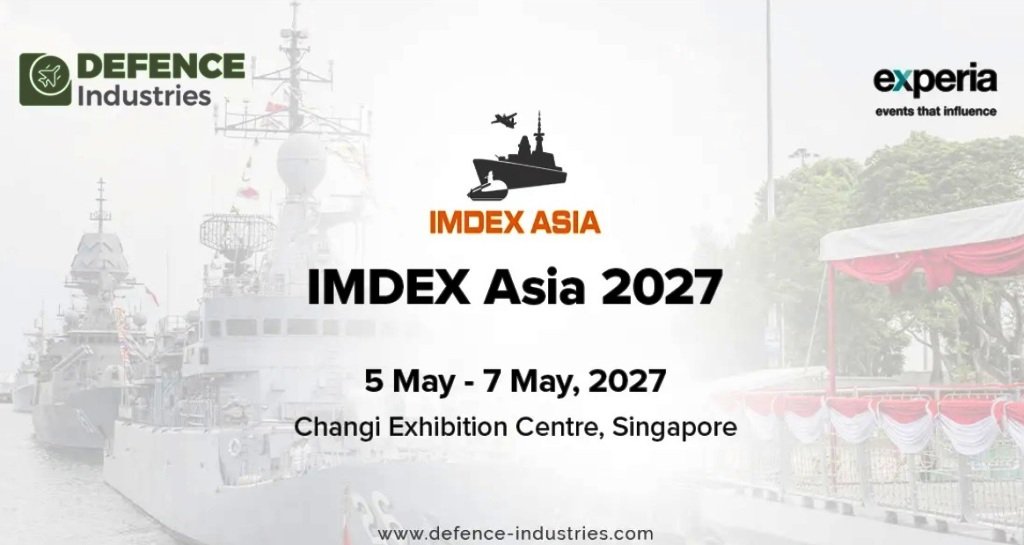
Singapore’s flagship maritime defence show is plotting a bigger course. Fresh from a record-breaking 14th edition in May 2025 – which drew more than 12,500 visitors over three days and gathered 17 warships from 13 countries at the Changi Exhibition Centre – IMDEX Asia is already looking beyond the horizon, and its helmsman sees no ceiling in sight
“We know we had a very successful edition in 2025. And based on what we are getting now and the feedback we have, I think the 2027 show should be at least the same, or even bigger than what it was in 2025,” says Leck Chet Lam, Managing Director of Experia Events, the organiser behind both IMDEX Asia and the Singapore Airshow. “We will still have the exhibitors and all the visitors from all over the world.”
A warship display set to grow
Central to the show’s pull is its unique warship display, and Leck is unequivocal about its future. “We are working very closely with the Republic of Singapore Navy to make sure that we will invite as many ships as we can – warships from different countries,” he confirms.
Rather than dwell on physical limits at the Changi Exhibition Centre, the Managing Director prefers to talk about content — and it is here that the most significant news emerges. With artificial intelligence and automation reshaping naval warfare, IMDEX Asia 2027 will feature a purpose-built showcase for the technologies driving that transformation.
“We are seeing a lot of AI and automation coming into play, and that is one of the areas that we are focusing on to bring in exhibitors,” Leck explains. “We are even going to curate a special zone called the Autonomous Zone in IMDEX 2027, so that we have a platform or area to showcase all the unmanned, uncrewed and AI-driven technologies.”
Live demonstrations, a hallmark of the show’s appeal, are also on the drawing board. “Discussions are ongoing. We will try our best to see whether it works,” he says, promising that anything definitive will be announced in due course.
The Asia-Pacific dividend
The strategic case for IMDEX Asia rests on simple arithmetic: defence budgets are rising across the world, but Asia-Pacific is outpacing the rest. “Data also shows that Asia-Pacific is actually one of the fastest-growing regions – there will be a lot of acquisitions, a lot of fleet renewals,” Leck notes. “A lot of spending will be coming from Asia-Pacific.”
For international exhibitors, and European national pavilions in particular, the pitch is direct: IMDEX Asia is the gateway platform to that market. “Our VIP guests – our Chiefs of Navies, Coast Guard directors and heads of maritime law enforcement agencies – they’re all from the Asia-Pacific region. We work closely with the Singapore authorities and the Republic of Singapore Navy to invite their counterparts to the show,” he says. “This is an opportunity and platform for all the exhibitors from around the world to have a first-hand experience in networking or meeting with these leaders, to explore potential ideas or explore potential business opportunities.”
A show built with the institutions
Few defence shows anywhere in the world can claim the institutional depth of IMDEX Asia, which enjoys the backing of the Republic of Singapore Navy, the Defence Science and Technology Agency (DSTA), the Maritime and Port Authority (MPA) and the S. Rajaratnam School of International Studies (RSIS). Leck insists this close partnership between private organiser and public institutions is not a mere badge of honour – it defines the show’s very identity.
“We have a very close working relationship with all these different organisations and government agencies. It’s about working together, making sure that we bring the correct message, invite the correct VIPs to the show, so as to make sure that the show is a value-adding networking platform,” he says. The aim is for “the whole naval community to converge and meet for the three days in Singapore, so that they can explore opportunities and really maybe chart the way forward for the maritime industry.”
Blurring lines, dual-use futures
Experia Events’ portfolio now spans the full spectrum: the Singapore Airshow, maritime defence, commercial maritime, business aviation and – most recently – space. Drawing on that breadth, Leck has identified what he believes is the defining trend of the decade: the end of technological silos.
“What we are noticing is that technologies are no more kept in their own industries. They become dual-use technologies – they can be in aerospace, can be in maritime, can be in space,” he observes. “The lines are blurring, whether it is an aerospace show or a maritime show or a space show or a business aviation show.”
The implication for exhibition organisers is profound, and Leck is clear about how Experia intends to respond. “We should provide a platform. Yes, we can still have the Airshow, we can still have the Maritime show, we can still have a business aviation show – but create platforms whereby different technology holders, different people who have different products, have the opportunity to come and share how their products can be used in different industries,” he says. “Products are no more used for one industry, but can be used for many industries.”
For the maritime defence community, the message from Singapore is unmistakable: IMDEX Asia 2027 will not simply repeat a winning formula – it intends to widen it, with grey hulls in Changi’s waters, an Autonomous Zone at its heart, and the Asia-Pacific’s decision-makers walking its aisles.
