

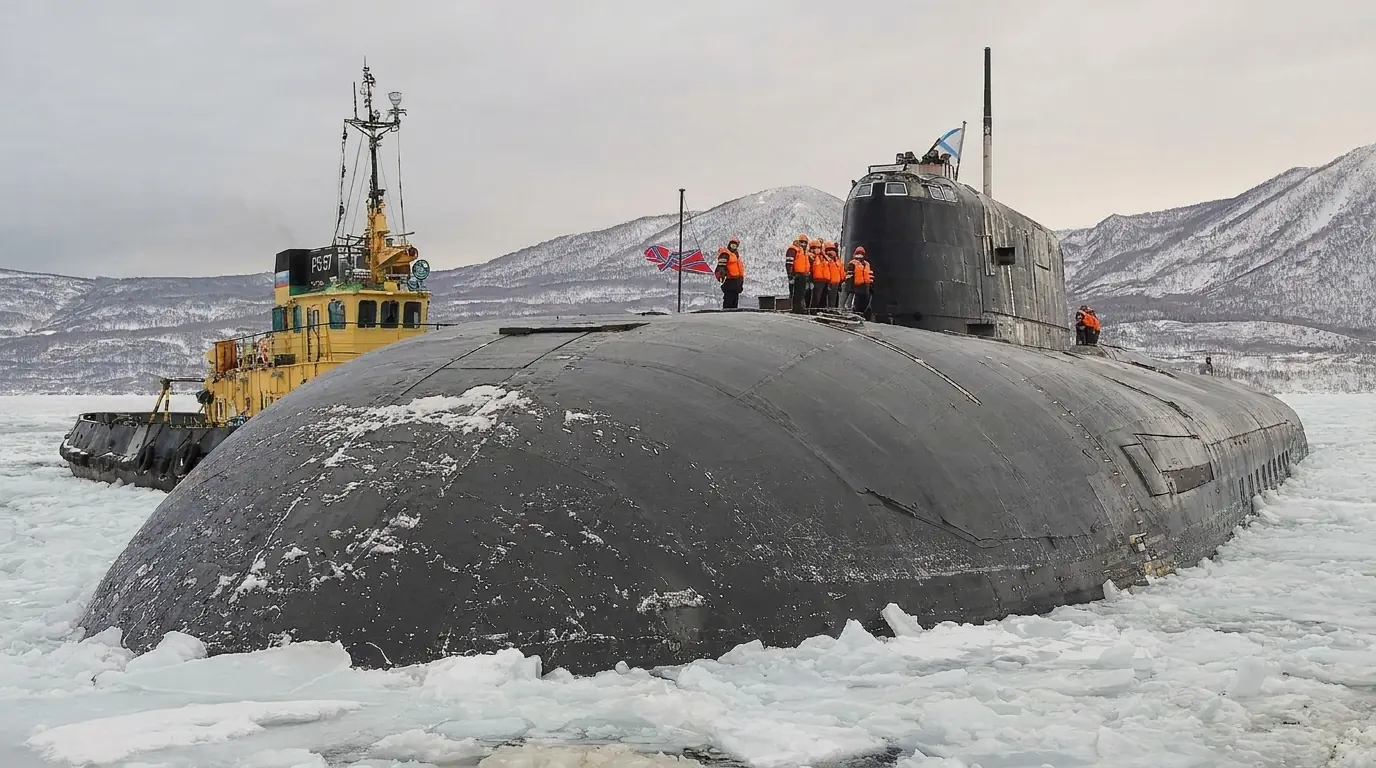
Imagine a submarine large enough to carry an entire arsenal of heavy cruise missiles beneath the ocean. It doesn’t need to surface to launch them, and its nuclear propulsion allows it to remain submerged for extended periods.
This is the engineering concept behind the Oscar II Class Submarine, one of the most distinctive nuclear-powered submarines developed by the Soviet Union.
Known officially as Project 949A Antey, the Oscar II Class Submarine was designed primarily to threaten major surface naval formations, particularly aircraft carrier groups. Its defining feature was an enormous missile arsenal: 24 launch tubes designed for the P-700 Granit anti-ship cruise missile.
But missile capacity was only part of the story.
The Oscar II Class Submarine’s unusually large hull accommodated nuclear propulsion machinery, extensive weapons systems, sonar equipment, and facilities for a substantial crew. Its double-hull architecture also provided space for the inclined missile launchers outside the main pressure hull.
That combination required considerable engineering. The Oscar II Class Submarine measured approximately 154 meters long and had a submerged displacement commonly reported at around 19,000–24,000 tonnes, depending on the source and configuration.
The Oscar II Class Submarine’s design reflected a particular Soviet naval strategy. Rather than relying exclusively on surface fleets, Soviet planners developed specialized submarines capable of operating underwater while carrying powerful long-range anti-ship weapons.
What Is the Oscar II Class Submarine?
The Oscar II Class Submarine is a nuclear-powered guided-missile submarine developed by the Soviet Union during the Cold War. Its official Soviet project designation is Project 949A Antey, while Oscar II is the NATO reporting name used to identify the class.
Designed by the Rubin Central Design Bureau, the Oscar II Class Submarine was built around a specific naval mission: carrying powerful anti-ship missiles over long distances while remaining submerged. Its primary targets were major surface naval formations, particularly aircraft carrier groups.
The Oscar II-class submarine belongs to the Soviet tradition of specialized cruise-missile submarines. These vessels were intended to provide a long-range maritime strike capability without relying on surface ships or aircraft operating nearby.
The class developed from the earlier Project 949 Oscar I design. Project 949A introduced several improvements, including a longer hull and modifications to internal arrangements. These changes supported updated equipment and improved the submarine’s overall capabilities.
One of the most recognizable features is its enormous size. The Oscar II Class Submarine has a double-hull configuration, with a strong inner pressure hull protected by an outer hull. This arrangement creates additional space for equipment and weapons systems, including the large inclined missile launchers positioned along the submarine’s sides.
The submarine also carries a substantial crew responsible for operating its nuclear reactor, navigation systems, sonar, weapons, and other onboard equipment. Its complex design reflects the demanding requirements of extended underwater missions.
Although the Oscar II Class Submarine was developed during the Soviet era, several units continued serving in the Russian Navy after the Soviet Union dissolved in 1991. Some have also received modernization programs intended to extend their operational relevance.
Ultimately, the Oscar II Class Submarine represents a major investment in underwater missile capability. Its design combines nuclear endurance, a large weapons payload, and specialized systems for long-range maritime operations.
Oscar II Class Submarine Specifications and Performance
The Oscar II Class Submarine is among the largest attack-oriented cruise-missile submarines ever built. Its enormous dimensions reflect the space required for nuclear propulsion, heavy weapons, sensors, and a substantial crew.
The submarine measures approximately 154 meters in length, with a beam of around 18.2 meters. Its submerged displacement is commonly reported between 19,000 and 24,000 tonnes, depending on the vessel and source. These figures make the Oscar II Class Submarine an exceptionally large platform for underwater missile operations.
The Oscar II Class Submarine’s double-hull design contributes to the submarine’s considerable width. The outer hull surrounds the pressure hull and provides space for missile launchers, ballast tanks, and other equipment. This arrangement also supports the vessel’s structural requirements during deep-water operations.

Performance figures vary across published sources, but the Oscar II Class Submarine is generally reported to reach speeds of approximately 15 knots on the surface and 32 knots submerged. Its maximum operating depth is often estimated at around 500 meters, although exact operational limits are not publicly confirmed.
The Oscar II Class Submarine’s range is effectively limited by its supplies, crew endurance, and maintenance requirements rather than conventional fuel consumption. Nuclear propulsion allows it to remain underwater for extended periods without regularly surfacing to recharge batteries.
Its large internal volume also supports long deployments. The vessel carries provisions, technical equipment, spare components, and facilities for a crew commonly estimated at around 100 to 130 personnel.
| Specification | Commonly reported figure |
| Project designation | Project 949A Antey |
| Length | Approximately 154 m |
| Beam | Approximately 18.2 m |
| Submerged displacement | 19,000–24,000 tonnes |
| Surface speed | Approximately 15 knots |
| Submerged speed | Approximately 32 knots |
| Maximum operating depth | Often estimated around 500 m |
| Crew | Approximately 100–130 |
These figures provide a useful overview, although exact specifications can differ between individual submarines and modernization variants. The Oscar II Class Submarine’s size and performance are closely connected to its central mission: carrying a substantial missile payload across long distances while operating beneath the surface.
Nuclear Propulsion and the Oscar II Class Submarine’s Underwater Mobility
The Oscar II Class Submarine uses nuclear propulsion to support long-duration underwater operations. This system gives the submarine considerable endurance without requiring frequent returns to the surface for fuel.
At the heart of its propulsion system are two nuclear reactors. These generate heat through nuclear fission, producing steam that drives turbines. The turbines provide power for the submarine’s propulsion system and onboard electrical equipment.
This arrangement allows the Oscar II Class Submarine to maintain propulsion without relying on conventional diesel engines. It also reduces the need to surface regularly for battery charging, an important advantage for a submarine designed to conduct extended missions.
The propulsion system drives two propeller shafts, providing the thrust needed for underwater movement. Some technical descriptions also identify the use of auxiliary propulsion arrangements to support maneuvering and operational flexibility.

Speed is another important aspect of its design. The Oscar II Class Submarine is commonly reported to reach approximately 32 knots underwater, although actual performance depends on operating conditions. This capability allows the submarine to reposition across large maritime areas and respond to changing mission requirements.
Nuclear propulsion also supports the operation of essential onboard systems. These include navigation equipment, sonar, communications, environmental controls, and weapons systems. Maintaining these systems requires a reliable supply of electrical power throughout the deployment.
Read also: Top 5 Biggest Submarines in the World Ever Built
However, nuclear propulsion does not mean unlimited endurance. The submarine still depends on food supplies, maintenance, spare parts, and the physical endurance of its crew. Reactor servicing and other technical requirements also influence its long-term availability.
The Oscar II Class Submarine’s propulsion architecture therefore serves a broader purpose than simply providing speed. It enables the submarine to remain submerged for extended periods, travel across distant operating areas, and maintain the mobility expected of a nuclear-powered guided-missile submarine.
The Oscar II Class Submarine’s 24 P-700 Granit Missile Arsenal
The defining feature of the Oscar II Class Submarine is its large anti-ship missile arsenal. Each submarine was originally designed to carry 24 P-700 Granit cruise missiles, providing substantial long-range maritime strike capability.
P-700 Granit Missile Characteristics
The P-700 Granit, known by NATO as the SS-N-19 Shipwreck, was developed by the Soviet Union during the Cold War. It is a heavy supersonic anti-ship cruise missile designed primarily to engage large surface vessels.
The missile uses a solid-fuel rocket motor for initial acceleration, followed by a turbojet engine for sustained flight. It is commonly reported to reach speeds of approximately Mach 2.5, although actual performance depends on flight conditions.
Its range is generally estimated at around 500–600 kilometers. Published figures vary, and actual engagement distances depend on factors such as target information, flight profile, and guidance arrangements.

Missile Launch System and Guidance Technology
The Oscar II Class Submarine carries its missiles in 24 inclined launch tubes positioned between the inner and outer hulls. This arrangement allows the submarine to launch its weapons while remaining submerged.
The Granit uses an advanced guidance architecture for its era. It combines inertial navigation with other guidance methods designed to support target acquisition during the final stages of flight.
Soviet descriptions also emphasized coordinated missile launches against larger naval formations. This approach was intended to help the missile system address multiple targets within a fleet.
The Oscar II Class Submarine’s 24 launch tubes therefore represent more than an impressive weapons count. They reflect the submarine’s original operational concept: carrying a concentrated anti-ship missile arsenal into distant maritime areas while remaining concealed beneath the surface.
However, the P-700 Granit is an older missile design. Some modernized Oscar II submarines have received alternative weapons systems, including newer cruise missiles, expanding their potential operational roles.
Torpedoes, Sonar and Advanced Submarine Systems
Although the Oscar II Class Submarine is best known for its 24 anti-ship missile launchers, its capabilities extend well beyond cruise missiles. It also carries torpedoes and a range of underwater sensors designed to support navigation, detection, and self-defense.
The Oscar II Class Submarine is equipped with multiple torpedo tubes, commonly reported as six. These include larger-diameter tubes capable of launching heavy torpedoes and smaller tubes for lighter weapons. Its torpedo armament provides another option for engaging underwater or surface targets.
Torpedoes can also serve defensive purposes. They give the submarine a means of responding to underwater threats, including hostile submarines operating within engagement range. The exact weapons carried can vary depending on the vessel’s configuration and modernization history.
Detection is equally important. The Oscar II Class Submarine uses a sonar suite to gather information about its underwater surroundings. Sonar systems detect and interpret sound waves, helping the crew identify potential contacts, assess their movement, and navigate in challenging conditions.

Passive sonar is particularly valuable because it listens for sounds generated by other vessels without actively transmitting signals. Active sonar, by contrast, sends out acoustic pulses and analyzes their returning echoes. Each method has different operational advantages and limitations.
The submarine also relies on navigation systems, periscopes, communications equipment, and electronic sensors. Together, these systems help its crew maintain situational awareness while operating beneath the surface.
However, detailed information about the Oscar II’s complete sensor configuration remains limited in publicly available sources. Equipment can also differ between individual submarines, particularly those that have undergone modernization.
These systems highlight an important aspect of submarine operations: weapons alone do not determine effectiveness. Detection, navigation, communication, and crew coordination are equally important. For the Oscar II, its combination of missile armament, torpedoes, and underwater sensors supports a broader role as a multi-mission nuclear-powered submarine.
Double-Hull Design, Crew Facilities and Survivability
The Oscar II Class Submarine uses a distinctive double-hull architecture that contributes to its large dimensions and internal layout. The design consists of a strong pressure hull surrounded by a lighter outer hull, creating additional space for equipment and structural components.
The inner pressure hull protects the crew and essential systems from the enormous water pressure encountered at depth. It contains the submarine’s main compartments, including control spaces, machinery areas, accommodation facilities, and other critical equipment.
The outer hull provides space for ballast tanks and other systems. It also accommodates the inclined missile launchers that hold the submarine’s P-700 Granit missiles. This arrangement allows the weapons to sit outside the main pressure hull while remaining integrated into the overall structure.
Another important feature is the submarine’s compartmentalized construction. Internal bulkheads divide the vessel into separate sections, helping contain flooding or damage within affected areas. This arrangement can support damage-control efforts and protect other compartments.

The Oscar II also incorporates several features intended to improve operational survivability. These include a substantial structural design, acoustic insulation, and machinery arrangements intended to reduce noise. Lower acoustic signatures are particularly important because submarines rely heavily on remaining difficult to detect.
Life aboard such a large nuclear-powered submarine also requires extensive facilities. The vessel accommodates a crew commonly estimated at approximately 100 to 130 personnel. Crew spaces include sleeping areas, food preparation facilities, medical support, and systems for maintaining breathable air and suitable internal conditions.
These facilities are essential during extended deployments. Nuclear propulsion can keep the submarine underwater for long periods, but the crew still needs food, rest, maintenance support, and reliable environmental controls.
The Oscar II’s architecture therefore reflects several demanding requirements. Its double hull supports weapons integration and internal capacity, while compartmentalization and acoustic measures contribute to operational resilience. Together, these features help explain why the submarine required such a large and complex engineering design.
Oscar II Class Submarine History, Kursk Disaster and Modernization
The Oscar II Class Submarine emerged during the final decades of the Cold War, when the Soviet Navy sought to strengthen its long-range maritime capabilities. The first Project 949A submarines entered service in the late 1980s, with additional vessels joining the fleet around the end of the Soviet period.
Following the dissolution of the Soviet Union in 1991, the Russian Navy inherited several Oscar II submarines. However, maintaining these large nuclear-powered vessels became increasingly challenging as budgets tightened and maintenance requirements grew.

The class entered international headlines in August 2000 following the loss of K-141 Kursk in the Barents Sea. The submarine suffered explosions during a training exercise and sank, resulting in the deaths of all 118 crew members.
The disaster prompted a major international rescue effort and raised serious questions about submarine safety, emergency procedures, and the condition of Russia’s naval infrastructure. It also brought wider attention to the technical and operational challenges associated with maintaining complex nuclear-powered submarines.
Despite this tragedy, the Oscar II class remained an important part of Russia’s submarine fleet. Some vessels continued operating, while others underwent extensive maintenance or modernization programs.
One significant development involved replacing or supplementing older missile systems with newer weapons. Modernization programs for selected submarines have included the integration of Kalibr cruise missiles and, according to Russian announcements, the P-800 Oniks anti-ship missile.
These upgrades aim to extend the operational relevance of the class by expanding its weapons options. However, modernization progress and equipment configurations vary between individual vessels.
The Oscar II’s history therefore reflects several stages of Russian naval development: Cold War strategic planning, the challenges of post-Soviet fleet maintenance, and efforts to update aging platforms.
More than three decades after its introduction, the class remains a notable example of large-scale submarine engineering. Its continued modernization also illustrates how navies attempt to extend the service life of expensive platforms rather than replace them immediately.
