

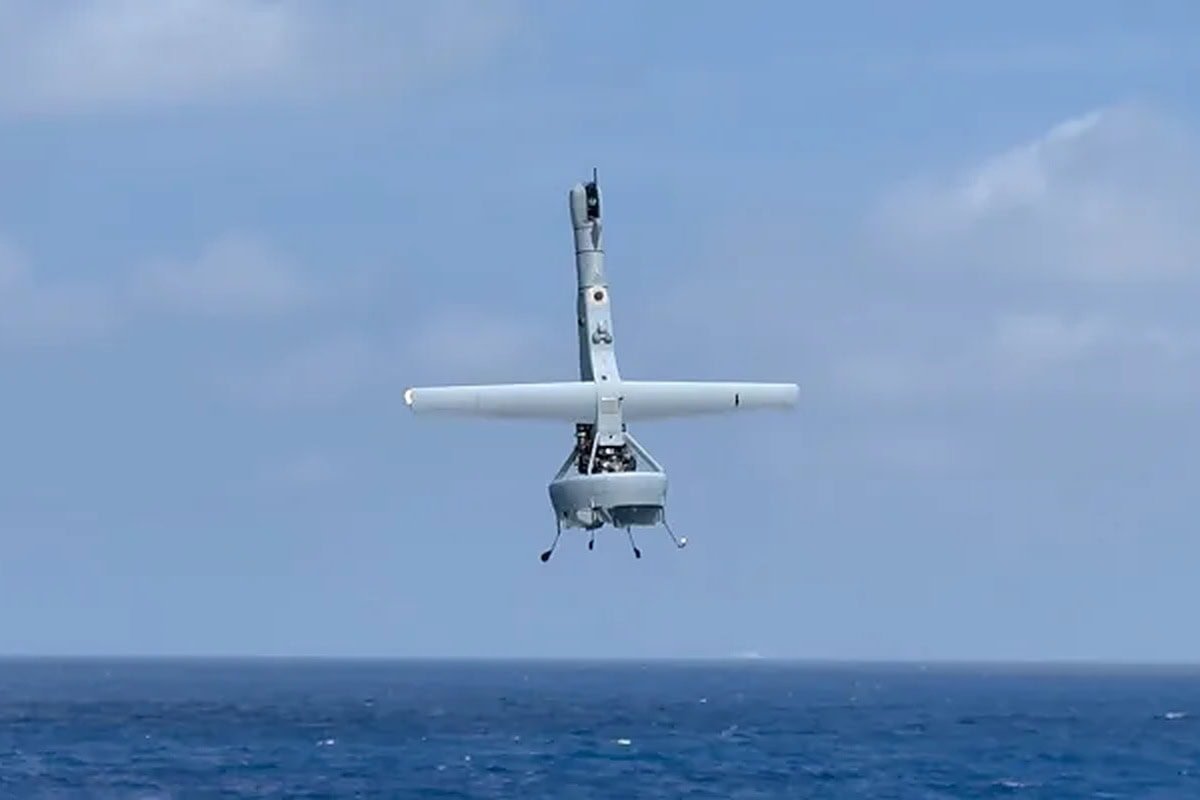
Taiwan’s Republic of China Navy (ROCN) is seeking to significantly expand its unmanned aerial vehicle (UAV) fleet to enhance its maritime domain awareness and targeting capabilities.
According to 2027 defence budget details released in late August this year, Taiwan has earmarked NT$52.78 billion (US$1.67 billion) to acquire two types of UAV.
The first is a vertical take-off and landing (VTOL) UAV being procured under Project Yuan Xiao (Distant Owl).
When the project was first reported as part of the NT$1.25 trillion (US$40 billion) special defence budget in late 2025, the UAV was specified to have a full-load endurance exceeding 13 hours, a guidance range of more than 130km, and an operating altitude above 15,000ft. Payload requirements included thermal and optical imaging, as well as laser-ranging capabilities.
It is understood the ROCN has set its sights on Shield AI’s V-BAT VTOL platform. A total of NT$36 billion (US$1.14 billion) is allocated for the programme between 2026 and 2029 to procure 280 Group 3 UAVs, 140 guidance and control systems and 82 transport vehicles.
The definition of a Group 3 UAV is one weighing between 25kg and 599kg, able to fly at altitudes between 3,500ft and 18,000ft, and with a top speed of less than 250kt.
The V-BAT has been combat-proven in Ukraine, where its autonomous systems enable it to operate in GPS-denied and communications-degraded environments.
According to reports, V-BATs could be deployed aboard ROCN surface combatants equipped with helidecks, providing them with an organic, persistent UAV capability to find, fix, track, target and engage adversary vessels.
V-BATs could also serve with the ROCN’s Haifeng brigades under its Littoral Combatant Command. These units operate both land-based mobile and fixed Hsiung Feng II and III anti-ship missile systems.
Shield AI and its local partner, the Aerospace Industrial Development Corporation (AIDC), announced on 13 October 2026 that they had delivered the first of twelve V-BATs ordered by Taiwan’s Coast Guard Administration for its shipborne UAV programme in July.
When asked by the media about the ROCN’s requirement, Shield AI declined to provide details, but it did confirm it would bid for the programme.

The second system mentioned in defence budget documents is the National Chung-Shan Institute of Science and Technology’s Rui Yuan II (Albatross II) medium-class UAV.
Plans call for the procurement of 32 aircraft, eight control stations and 48 transport vehicles between 2026 and 2029, at a cost of NT$16.78 billion (US$530 million).
The Rui Yuan II has an endurance of 16 hours, and a guidance and control range exceeding 300km. Its modular payload configuration can accommodate sonobuoy dispensers and various effectors, including the Jinfeng-1 reconnaissance and strike loitering munition. The UAV is also equipped with a ventral radome housing a maritime search radar.
The Rui Yuan II is expected to replace the Rui Yuan I platform, which was transferred from the ROC Army to the ROCN about a decade ago, and which is equipped with a limited electro-optical payload.
Among its priority targets in opening strikes, the People’s Liberation Army would likely include ROCN land-based maritime radar stations and command-and-control (C2) facilities, seeking to disrupt Taiwan’s maritime surveillance and coordination capabilities.
Cut off from C2 networks, defence analysts say ROCN surface combatants and Haifeng brigades may have to take the initiative by relying on organic UAV capabilities such as the V-BAT to independently complete the kill chain.
by Roy Choo
