

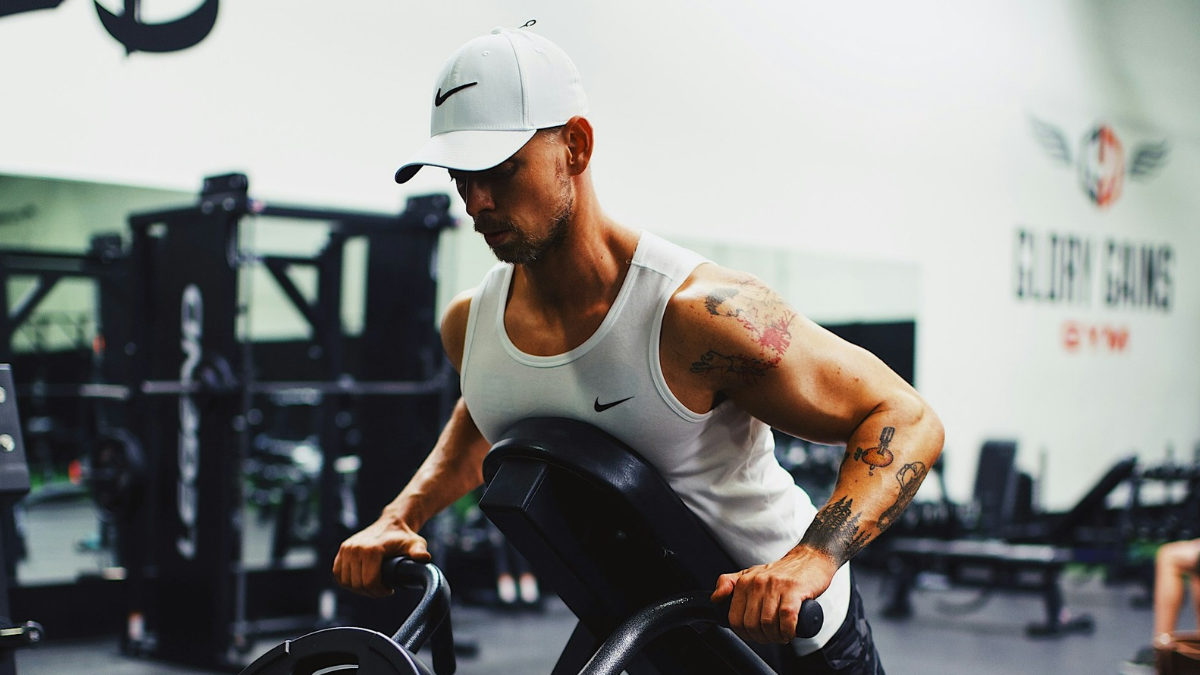
Building chest muscle does not require a complicated routine or a room full of equipment. This is what you need to maximize the results from the machines.
1. Start with a chest press machine you can adjust
Set up the machine for your body
A seated chest press is a useful first exercise because the machine guides the movement while you learn how to press with control. Research comparing machine based and free weight training found similar muscle growth between the two approaches. That means a machine can be a sound option if it suits your goals and feels comfortable to use.
Before choosing a weight, adjust the seat so the handles are around mid chest level. Sit with your back against the pad and your feet flat on the floor. Hold the handles and press them forward until your arms are nearly straight, without locking your elbows. Bring the handles back slowly until you feel a comfortable stretch across your chest. If the handles start too far behind your body or you feel pain in your shoulders, adjust the seat or reduce the range to a comfortable position.
Keep the movement controlled
Press smoothly, then return the handles with control. Avoid letting the weight stack crash between repetitions. The goal is to move the weight with your muscles, not to use momentum to get through the set. A machine helps guide the path, but you still need to find a position that feels natural for your shoulders and arms.
2. Pick a weight that lets you finish your reps well
Use a manageable repetition range
You do not need to lift the heaviest weight in the room to build muscle. Research reviews have found that muscle growth can occur across a range of resistance loads. Heavier loads tend to be better for improving maximum strength, but they are not required for hypertrophy.

For a beginner, try a weight that lets you perform about 8 to 12 controlled repetitions. If you can easily do many more while keeping good form, the weight may be too light. If you cannot complete several smooth repetitions, or you have to jerk your body to move the handles, lower the weight. This range is a practical starting point, not a strict rule.
Stop before your form breaks down
You do not have to push every set until you cannot complete another repetition. Research comparing training to failure with stopping short has not found that reaching momentary failure is necessary for muscle growth. A useful approach is to end most sets when you think you could manage one to three more good repetitions. As you learn what that effort feels like, you can adjust your sets while keeping the movement controlled.
3. Add enough weekly work, then build it gradually
Begin with a routine you can repeat
Muscle growth responds to the amount of resistance training you do, and research has found a relationship between more weekly sets and greater muscle growth, with diminishing returns as volume rises. That does not mean you should start with a large number of sets. A manageable beginning could be two or three working sets on the chest press, followed by two or three sets on a pec deck or another chest machine.

Do this routine once or twice a week at first, with time between sessions to recover. Research suggests that when the total number of weekly sets is similar, training frequency itself does not have a meaningful effect on muscle growth. Choose a schedule you can maintain and that gives you enough time to do your planned sets well.
Make small, trackable increases
Write down the machine, weight, and repetitions you complete. When you can perform the top end of your chosen repetition range for all your sets with steady form, increase the load by the smallest available amount. You may then do fewer repetitions until you build back up.
This gradual approach gives you a clear way to progress without guessing. Increasing the weight is one option, but doing an extra controlled repetition with the same weight can also be progress. Avoid changing several things at once, so you can tell what is working and keep your sessions consistent.
4. Use a pec deck to add a second chest movement
Understand what the exercise adds
The pec deck, sometimes called a chest fly machine, lets you bring your arms together in front of your body while keeping your elbows slightly bent. It gives you a different movement from the chest press, which involves pressing the handles away from your chest. Using both exercises can make a simple session feel more complete without adding a long list of movements.
Adjust the seat so the machine’s pivot points line up roughly with your shoulders, if the machine has visible pivots. Keep your back against the pad and bring the pads or handles together smoothly. Return to the starting position slowly, stopping when you feel a comfortable stretch. Do not force your arms far behind your body.
Keep the session focused
You can use the chest press as your main exercise and the pec deck as a second exercise. This is enough variety for a beginner to practice two useful patterns while keeping the workout easy to track. More exercises are not automatically better. Multiple sets are supported by research as an effective way to build muscle, while a straightforward routine can make it easier to practice and repeat your training.
5. Rest long enough to do your next set well

Give yourself time between sets
If you rush into the next set while you are still breathing hard or struggling to grip the handles, your repetitions may drop. A review of research on rest periods found that muscle growth is possible with a range of rest times, with a small potential benefit from resting more than 60 seconds compared with shorter breaks. The evidence did not show a clear added benefit from resting more than 90 seconds for hypertrophy.
10 Quick Tips for Beginners To Build More Muscle
For a beginner, resting about one to two minutes between sets is a reasonable starting point. Take a little longer if you need it to perform the next set with control. Your rest period does not need to be exact each time. The goal is to be ready to repeat the exercise with good technique.
Be patient with progress
Muscle growth takes time, and a single workout cannot tell you whether a routine is working. Focus on repeating your training and gradually improving your repetitions or weight. A consistent plan with manageable sets, controlled movement, and adequate rest gives you a practical foundation to build on.
Key takeaways
| Focus | What to do |
|---|---|
| Machine setup | Adjust the seat so the handles begin around mid chest level and use a comfortable range of motion. |
| Weight choice | Start with a load you can lift for about 8 to 12 controlled repetitions. |
| Effort | Finish most sets with one to three good repetitions still possible. |
| Weekly training | Start with a manageable number of sets once or twice a week, then build gradually. |
| Progress | Track your workouts and add a repetition or a small amount of weight when your form stays steady. |
| Rest | Rest about one to two minutes between sets, or longer when you need it to be ready. |
References
- Carvalho, L., Moriggi Junior, R., Barreira, J., Schoenfeld, B.J., Orazem, J. and Barroso, R. (2022) ‘Muscle hypertrophy and strength gains after resistance training with different volume matched loads: a systematic review and meta analysis’, Applied Physiology, Nutrition, and Metabolism, 47(4), pp. 357–368.
- Currier, B.S., McLeod, J.C., Banfield, L., Beyene, J., Welton, N.J., D’Souza, A.C., Keogh, J.A.J., Lin, L., Coletta, G., Yang, A., Colenso-Semple, L., Lau, K.J., Verboom, A. and Phillips, S.M. (2023) ‘Resistance training prescription for muscle strength and hypertrophy in healthy adults: a systematic review and Bayesian network meta analysis’, British Journal of Sports Medicine, 57(18), pp. 1211–1220.
- Haugen, M.E., Vårvik, F.T., Larsen, S., Haugen, A.S., van den Tillaar, R. and Bjørnsen, T. (2023) ‘Effect of free weight versus machine based strength training on maximal strength, hypertrophy and jump performance: a systematic review and meta analysis’, BMC Sports Science, Medicine and Rehabilitation, 15, article 103.
- Refalo, M.C., Helms, E.R., Trexler, E.T., Hamilton, D.L. and Fyfe, J.J. (2023) ‘Influence of resistance training proximity to failure on skeletal muscle hypertrophy: a systematic review with meta analysis’, Sports Medicine, 53(3), pp. 649–665.
- Schoenfeld, B.J., Ogborn, D. and Krieger, J.W. (2017) ‘Dose response relationship between weekly resistance training volume and increases in muscle mass: a systematic review and meta analysis’, Journal of Sports Sciences, 35(11), pp. 1073–1082.
- Schoenfeld, B.J., Grgic, J. and Krieger, J. (2019) ‘How many times per week should a muscle be trained to maximize muscle hypertrophy? A systematic review and meta analysis of studies examining the effects of resistance training frequency’, Journal of Sports Sciences, 37(11), pp. 1286–1295.
- Singer, A., Wolf, M., Generoso, L., Arias, E., Delcastillo, K., Echevarria, E., Martinez, A., Androulakis Korakakis, P., Refalo, M.C., Swinton, P.A. and Schoenfeld, B.J. (2024) ‘Give it a rest: a systematic review with Bayesian meta analysis on the effect of inter set rest interval duration on muscle hypertrophy’, Frontiers in Sports and Active Living, 6, article 1429789.
