

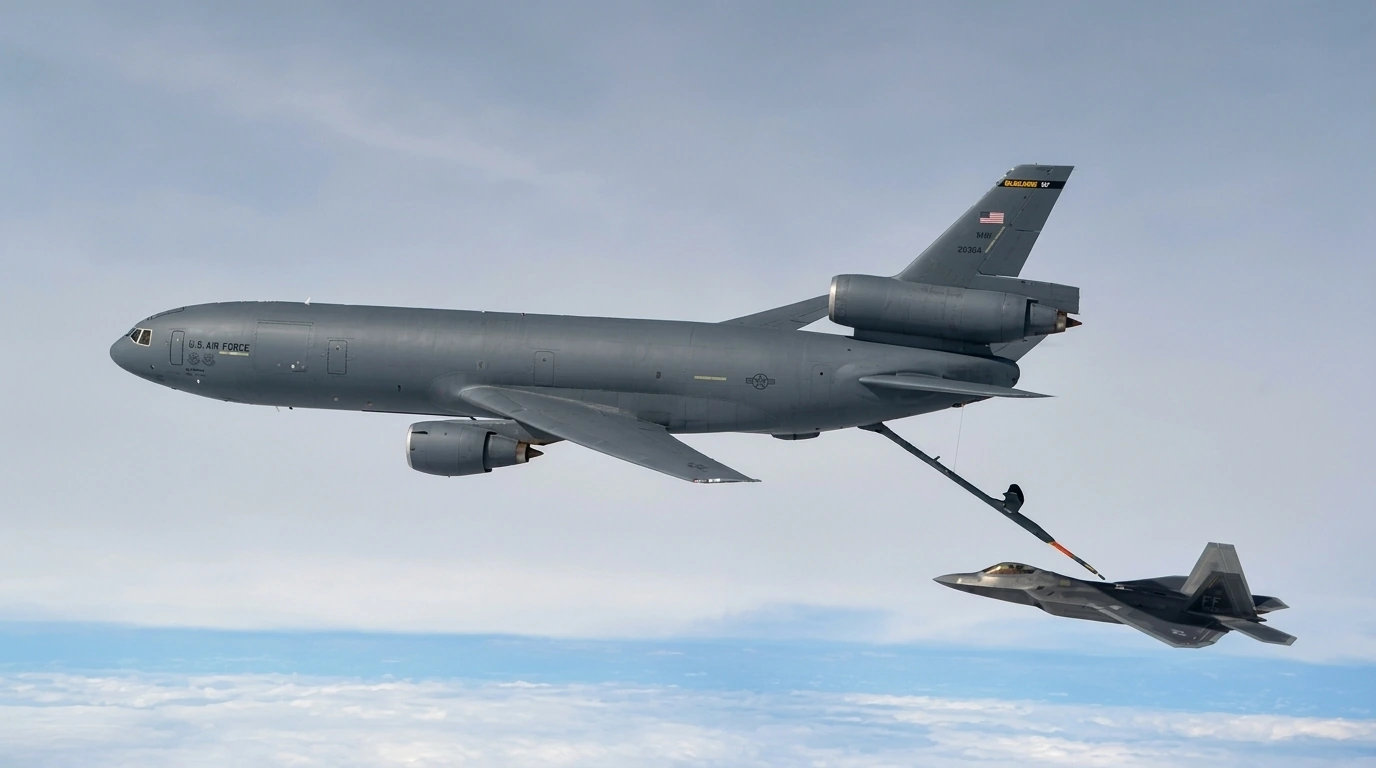
Imagine flying thousands of miles from home, with no runway nearby and a mission that cannot afford an early return. For a military aircraft, fuel can become the limiting factor long before its engines reach their limits.
The KC-10 Extender was built to help solve that problem.
Developed by McDonnell Douglas from its commercial DC-10 airliner, the KC-10 Extender became a major aerial refueling and transport aircraft for the U.S. Air Force. It could transfer fuel to other aircraft while carrying cargo and personnel, giving military planners more flexibility during long-distance operations.
Its size was impressive. The aircraft had three turbofan engines, a maximum takeoff weight of approximately 590,000 pounds, and a maximum fuel capacity exceeding 356,000 pounds. Those figures helped it support demanding missions across vast distances.
Yet the KC-10 Extender’s importance wasn’t simply about carrying more fuel. Its refueling equipment supported both boom and hose-and-drogue operations, allowing it to serve different types of compatible aircraft. Think of it as a flying logistics hub, connecting airborne forces with the fuel and supplies they needed.
The KC-10 Extender entered U.S. Air Force service in 1981. Over the following decades, it supported deployments and operations that required sustained airpower far from established bases.
Its story also reflects an important reality of military aviation: combat aircraft depend on an extensive network of support systems. A fighter may capture the headlines, but tanker aircraft often help determine how far and how long that fighter can operate.
The KC-10 Extender retired from U.S. Air Force service in September 2024, closing a remarkable chapter in aerial refueling history.
So, what made this aircraft distinctive? From its three-engine design to its advanced refueling systems, the KC-10 Extender offers a revealing look at the technology behind long-range military airpower.
What Is the KC-10 Extender?
The KC-10 Extender was a U.S. Air Force aerial refueling and transport aircraft designed to keep military aircraft flying longer while moving personnel and cargo across long distances. Based on the commercial McDonnell Douglas DC-10, it adapted a proven widebody airliner design for demanding military missions.
Its development addressed a practical challenge. Fighter aircraft can travel considerable distances, but their operational reach depends heavily on fuel availability. Tanker aircraft help overcome that limitation by transferring fuel while receiver aircraft remain airborne.
Read also: Boeing KC-46 Pegasus: How It Stacks Up Against Legacy Tankers
The KC-10 Extender took this role further. It could refuel other aircraft and transport supplies during the same deployment, making it a valuable asset for missions involving distant operating areas and limited ground support.
From commercial airliner to military tanker
The KC-10 Extender program emerged during the 1970s, when the U.S. Air Force sought additional aerial refueling capacity. The service selected McDonnell Douglas’s DC-10-based proposal, and the first KC-10 Extender entered service in March 1981.
Although the aircraft retained the basic shape of its commercial counterpart, military modifications made it much more than a passenger airliner. These included specialized refueling equipment, military communications systems, and arrangements for carrying cargo and personnel.
The aircraft’s three-engine configuration also provided the thrust required to move its substantial airframe and fuel load. Its design supported long-distance operations where refueling aircraft could make a significant difference to mission planning.
What made the KC-10 Extender distinctive?
Three capabilities defined the aircraft’s role:
- Aerial refueling: It could transfer fuel through a flying boom or hose-and-drogue equipment.
- Strategic transport: Its cargo compartment accommodated equipment, supplies, and personnel.
- Long-range support: Its substantial fuel capacity helped sustain extended military air operations.
These capabilities worked together. For example, a KC-10 Extender supporting a fighter deployment could help aircraft remain airborne longer while also moving essential equipment between operating locations.
The KC-10 Extender eventually became an important part of the U.S. Air Force’s tanker fleet. Its retirement in September 2024 ended more than four decades of service, but its operational history illustrates why aerial refueling remains central to modern military aviation.
KC-10 Extender Specifications and Performance
The KC-10 Extender was built around a simple requirement: carry enormous quantities of fuel without sacrificing the range and payload needed for military transport. Its widebody airframe and three-engine configuration gave it the capacity to support demanding long-distance missions.
The aircraft’s dimensions were substantial. At more than 181 feet long, it could accommodate specialized refueling equipment alongside a large cargo compartment. Its performance depended on fuel load, cargo weight, weather, and mission profile.
KC-10 Extender specifications at a glance
| Specification | Details |
| Manufacturer | McDonnell Douglas |
| Aircraft type | Aerial refueling and transport |
| First entered service | March 1981 |
| Length | 181 ft 7 in |
| Wingspan | 165 ft 4.5 in |
| Powerplant | 3 General Electric CF6-50C2 turbofan engines |
| Thrust | Approximately 52,500 lb per engine |
| Maximum takeoff weight | 590,000 lb |
| Maximum fuel capacity | More than 356,000 lb |
| Maximum cargo payload | Approximately 170,000 lb |
| Maximum speed | Approximately 619 mph |
| Range without cargo | Approximately 11,500 miles |
Figures are based on published U.S. Air Force specifications. Actual performance varies with operating conditions and configuration.
Three engines, one demanding mission
The KC-10 Extender used three General Electric CF6-50C2 turbofan engines. Each produced approximately 52,500 pounds of thrust, giving the aircraft the power needed to carry substantial fuel reserves and equipment.
That power mattered most during takeoff and long-distance flight. The aircraft had to move a heavy airframe, maintain efficient cruising performance, and retain enough fuel for its own journey while supporting other aircraft.
Its maximum takeoff weight of 590,000 pounds illustrates the scale of this challenge. However, maximum takeoff weight isn’t the same as payload capacity. Fuel, cargo, crew, and other equipment all contribute to the aircraft’s total operating weight.

Why range and payload matter
The KC-10 Extender’s range allowed it to support missions far from its home base, while its cargo capacity added flexibility to deployment planning. Yet these capabilities involved trade-offs: carrying more cargo or transferring more fuel could change how far the aircraft could travel before landing.
That’s the key to understanding its performance. The KC-10 Extender wasn’t simply a large aircraft with powerful engines; it was a carefully configured platform designed to balance fuel, range, and transport requirements during complex military operations.
How the KC-10 Extender’s Aerial Refueling Technology Works
Imagine a fighter jet traveling far from its home base, with fuel running low but its mission still underway. The KC-10 Extender could help by transferring fuel while both aircraft remained airborne. No landing required.
This capability depended on two distinct refueling systems: a flying boom and a hose-and-drogue arrangement. Together, they allowed the KC-10 Extender to support a wide range of compatible military aircraft.
The flying boom: controlled fuel transfer
The KC-10 Extender’s primary refueling method used a rigid telescoping boom mounted beneath the rear fuselage. A trained boom operator controlled the assembly from a dedicated station inside the aircraft.
During refueling, the receiving aircraft moved into position behind the tanker. The operator then guided the boom toward the receiver’s refueling receptacle, establishing a connection for fuel transfer.
The system could deliver fuel at approximately 1,100 gallons per minute under suitable conditions. That high flow rate made the boom particularly useful for aircraft designed to receive fuel through this method.
It wasn’t an entirely automatic process. Precise positioning, communication, and coordination remained essential throughout the transfer.

Hose-and-drogue: another way to refuel
Some aircraft use a probe rather than a boom receptacle. The KC-10 Extender could support these receivers through a hose-and-drogue system, which uses a flexible hose ending in a small, basket-shaped fitting.
The receiving aircraft approaches carefully and inserts its probe into the drogue. Once the connection is established, fuel flows through the hose.
The KC-10 Extender’s hose-and-drogue system could transfer fuel at approximately 470 gallons per minute. Although slower than its boom system, it expanded the aircraft’s usefulness across different receiver designs.
| Feature | Flying boom | Hose-and-drogue |
| Connection | Rigid telescoping boom | Flexible hose and basket |
| Receiver requirement | Compatible refueling receptacle | Compatible refueling probe |
| Published transfer rate | About 1,100 gal/min | About 470 gal/min |
| Control | Boom operator guides the boom | Receiver pilot establishes the connection |
Why having both systems mattered
Aerial refueling equipment must match the receiving aircraft. By supporting both methods, the KC-10 Extender offered military planners greater flexibility when organizing multinational deployments and complex air operations.
The technology also demanded careful fuel management. Every gallon transferred reduced the tanker’s remaining reserves, affecting its ability to continue supporting aircraft and return safely.
That balance made the KC-10 Extender more than a flying fuel reservoir. It was a specialized airborne support platform, where engineering, crew coordination, and mission planning worked together to extend the reach of military aviation.
Cargo Capacity, Range and Multirole Capabilities
The KC-10 Extender was more than a flying fuel station. Its ability to transport cargo and personnel made it a flexible asset for military deployments, particularly when aircraft needed to move supplies across long distances.
Imagine a fighter squadron preparing to operate from a distant airbase. The aircraft need fuel support, but the personnel, spare parts, and equipment must also reach their destination. The KC-10 Extender could contribute to both requirements, depending on the mission configuration.

How much could the KC-10 carry?
The aircraft combined a substantial fuel capacity with a large cargo compartment. According to published U.S. Air Force specifications, its maximum cargo payload was approximately 170,000 pounds.
| Capability | Published figure |
| Maximum cargo payload | Approximately 170,000 lb |
| Maximum fuel capacity | More than 356,000 lb |
| Passenger capacity | Up to 75 people |
| Maximum takeoff weight | 590,000 lb |
These figures describe different operating limits, not amounts that can necessarily be carried simultaneously. Fuel, passengers, cargo, and equipment all contribute to total aircraft weight.
That distinction matters. A KC-10 Extender carrying a heavy cargo load would have different fuel and range considerations from one configured primarily for aerial refueling.
Supporting deployments beyond the runway
The KC-10 Extender’s cargo capability helped move military equipment, supplies, and personnel between operating locations. Its transport role could complement aerial refueling support during broader deployment efforts.
For example, a military operation involving aircraft stationed overseas might require both fuel support in the air and equipment delivered to a forward location. The KC-10 Extender’s multirole design gave planners another option for coordinating these needs.
The aircraft could also support aeromedical evacuation missions when appropriately configured. This added another dimension to its usefulness, although the specific medical arrangements depended on mission requirements.
The trade-off between fuel and cargo
Every long-range mission involves choices. Carrying additional cargo increases weight, while transferring fuel to other aircraft reduces the tanker’s remaining reserves. Both factors influence how far the KC-10 Extender can travel and how much support it can provide.
Its strength lay in balancing these demands. Rather than serving only as a tanker or only as a transport aircraft, the KC-10 Extender could support a combination of logistics tasks.
That flexibility helped make it valuable to the U.S. Air Force for decades. It also illustrates a broader principle of military aviation: moving fuel, equipment, and people is often just as important as moving combat aircraft themselves.
KC-10 Extender in Military Operations and Strategic Airpower
A fighter aircraft’s range is measured in miles, but its operational reach depends on something less visible: the support network that keeps it moving. The KC-10 Extender helped provide that network, allowing U.S. military aircraft to operate farther from established bases.
During its service, the KC-10 Extender supported overseas deployments, long-distance aircraft movements, and military operations requiring sustained aerial refueling. Its combination of fuel capacity and transport capability made it useful when forces needed to move quickly across regions.
Operation El Dorado Canyon: A demanding long-range mission
One notable example of the strategic importance of aerial refueling came in April 1986, when U.S. forces conducted Operation El Dorado Canyon against targets in Libya.
The mission involved F-111 aircraft operating from the United Kingdom. The long journey to and from Libya required extensive aerial refueling, demonstrating how tanker support could extend the reach of combat aircraft beyond their normal operating distances.

The KC-10 Extender was part of the broader tanker capability supporting U.S. air operations during this period. The mission illustrated an important principle: long-range airpower depends on carefully coordinated aircraft, fuel planning, and support crews, not simply the performance of the aircraft conducting the primary mission.
Supporting deployments across distant regions
The KC-10 Extender also supported military movements involving personnel, equipment, and aircraft deploying overseas. Its transport capability helped move supplies, while its tanker role supported aircraft during long-distance flights.
These functions became particularly valuable when forces operated far from permanent infrastructure. Tankers could help aircraft reach destinations without requiring intermediate landings, reducing dependence on suitable airfields along the route.
However, aerial refueling did not eliminate logistical constraints. Tanker availability, weather, airspace permissions, maintenance, and fuel planning all influenced mission feasibility.
Why tanker aircraft shape strategic reach
The KC-10 Extender’s contribution was often indirect. It rarely attracted the same public attention as fighter aircraft, yet it helped determine how long aircraft could remain airborne and how far they could travel.
Its large fuel capacity allowed it to support demanding refueling missions, while its cargo compartment provided additional logistical flexibility. This combination helped the U.S. Air Force sustain operations across vast distances.
The broader lesson is straightforward: airpower depends on endurance as much as performance. The KC-10 Extender demonstrated how a specialized support aircraft could influence deployment planning and operational reach without directly carrying out the primary combat mission.
KC-10 Extender Technology, Reliability and Operational Challenges
Operating a large aerial refueling aircraft involves more than keeping three engines running. The KC-10 Extender had to manage enormous fuel loads, maintain specialized refueling equipment, and remain dependable during missions that could stretch across continents.
That created a demanding maintenance environment. Every flight depended on the airframe, engines, fuel systems, communications equipment, and refueling hardware working together. A problem in one area could affect the entire mission.

Managing a complex aircraft
The KC-10 used three General Electric CF6-50C2 turbofan engines, each producing approximately 52,500 pounds of thrust. These engines provided the power needed to carry substantial fuel reserves and cargo, but they also required regular inspections and maintenance.
Its refueling systems introduced additional technical demands. The flying boom included moving components that required careful inspection, while hose-and-drogue equipment had to remain reliable under repeated use. These systems operated in a challenging environment, with aircraft moving close together at altitude.
The tanker also needed accurate fuel monitoring. Crews had to track onboard reserves, estimate transfer requirements, and preserve sufficient fuel for the aircraft’s own route and landing.
Aging airframes and sustainment demands
As the KC-10 Extender fleet accumulated decades of service, sustaining its availability became an important consideration. Older aircraft can require more attention to structural inspections, component replacement, and maintenance planning.
This does not mean every KC-10 Extender suffered from the same reliability problems. Aircraft condition varies with usage, maintenance history, and operating environment. However, maintaining a mature fleet can become increasingly demanding as components age and specialized support requirements continue.
There was also a practical challenge: keeping enough tankers available while individual aircraft underwent maintenance. Military planners had to account for maintenance schedules when assigning refueling support to major deployments.
Why reliability mattered strategically
A tanker that cannot fly when needed can affect more than its own schedule. Aircraft depending on its fuel may require different routing, additional tankers, or revised mission plans.
For this reason, reliability was an operational capability in its own right. The KC-10 Extender’s value depended not only on its impressive fuel capacity, but also on whether crews could safely deliver that fuel when required.
Its long service history illustrates the balance facing military aviation: powerful, specialized aircraft can remain useful for decades, yet their continued operation requires sustained investment in maintenance, trained personnel, and technical support.
