

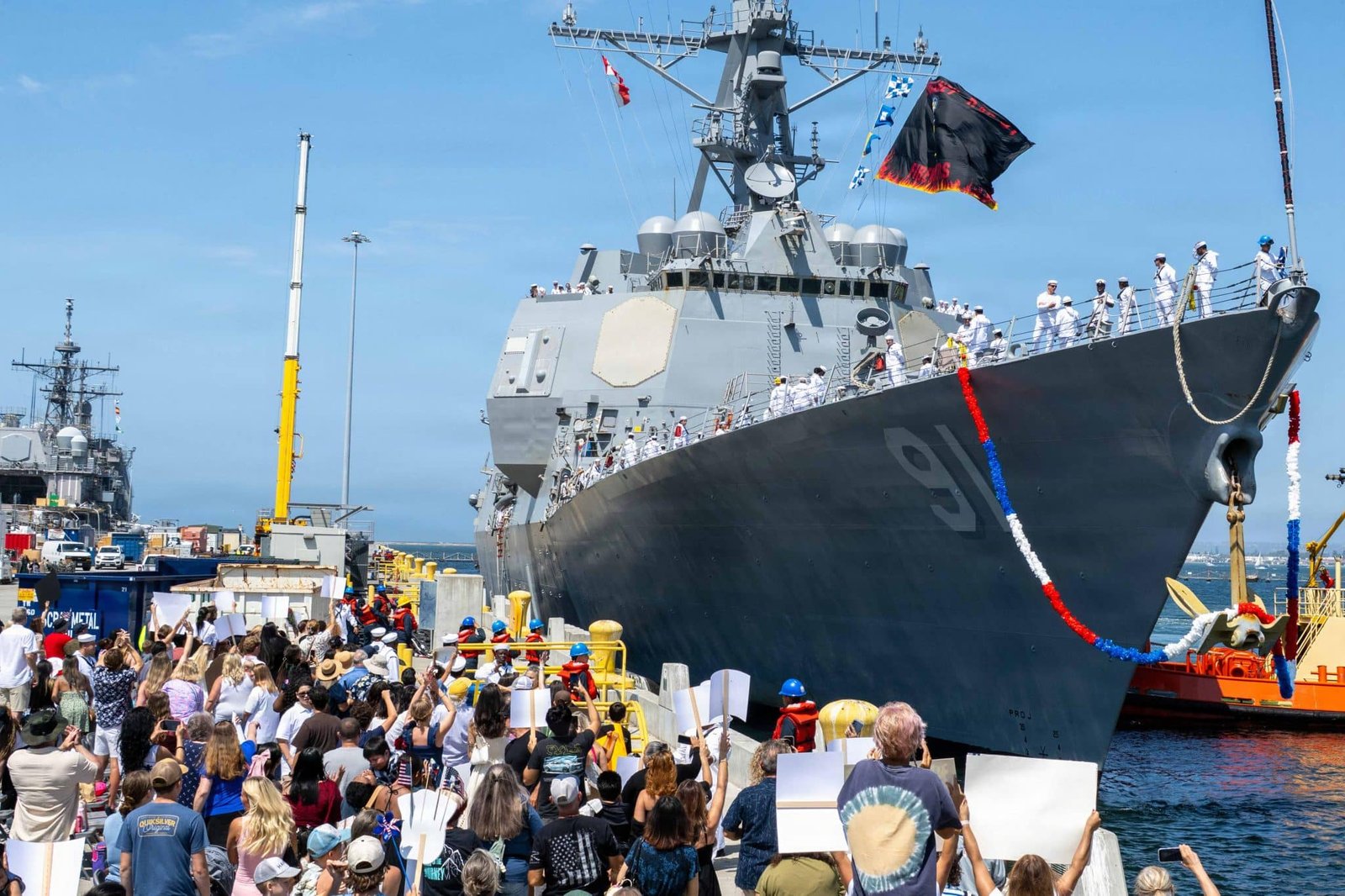
USS Pinckney becomes the first U.S. Navy destroyer to enter Phase Two of the DDG MOD 2.0 program, adding advanced SPY-6 radars to counter growing global threats.
San Diego-based USS Pinckney (DDG 91) began its second phase of DDG MOD 2.0 at a General Dynamics NASSCO drydock following its eight-and-a-half month deployment to the Middle East and Pacific, setting up the first of a series of ships slated to receive Raytheon’s AN/SPY-6(V)4 radars and associated equipment. During its deployment Pinckney proved a number of advanced warfare capabilities, according to the U.S. Navy.
The work, part of a $149.6 million contract awarded to General Dynamics, is expected to wrap up by September 2028.
“The collective effort by all stakeholders has finally brought us to the point of execution. Upon Depot Modernization Period completion, USS Pinckney will rejoin the Fleet equipped with the most comprehensive multi-spectral integrated sensor suite designed to maintain maritime superiority for decades to come,” said Capt. Tim Moore, program manager, DDG MOD 2.0 in a media release.
DDG MOD 2.0 is one of the U.S. Navy’s major modernization efforts for Arleigh Burke-class guided missile destroyers, equipping a series of four ships with the distinct-looking SLQ-32(V)7 Surface Electronic Warfare Improvement Program (SEWIP) Block III in phase one, prior to a later refit with the new radars. The ships are also being upgraded with Lockheed Martin’s Aegis Baseline 10, a core component of the radar upgrade that will enable simultaneous air and ballistic missile defense.
USS Pinckney (DDG 91), USS Chung-Hoon (DDG 93), USS James E. Williams (DDG 95), and USS Halsey (DDG 97) have all already completed major milestones or Depot Modernization Periods under the program.

These four ships are serving as a trial for future MOD 2.0 installations that will eventually combine both upgrades into a single shipyard availability, starting with USS Sterett (DDG 104), according to Moore.
The shift to a single modernization period is intended to reduce the amount of time destroyers spend out of service for major upgrades, allowing the Navy to install both the electronic warfare suite and new radar during the same shipyard availability rather than requiring ships to return for a second round of work.
The upgrades come as the Navy faces growing demands on its surface fleet, particularly in the Indo-Pacific and Middle East, where destroyers have increasingly been tasked with defending carrier strike groups, commercial shipping and other naval assets against increasingly sophisticated missile and drone threats. Recent combat operations in the Middle East have severely tested these defenses against unique anti-ship weapons, including one instance where a drone came within a mile of striking a deployed ship off the coast of Israel.
