

This is the first half of the last part (I, II IIIa, IIIb) of our series looking at the vision of history advanced by Hearts of Iron IV, Paradox Interactive’s World War II grand strategy game and one of the most popular strategy games on the market today.
In the last part (split over two posts), we discussed how HoI4 models domestic politics and ideology. In both cases, game design considers – in particular the desire to streamline domestic politics to highlight the military aspects of the game and the desire to simply avoid the topic of crimes against humanity altogether – congealed to create a game that fails to accurately represent the history of the period and worse yet errs in a consistent direction. On the one hand, the simplified political model, combined by a game design ‘need’ to make the Axis powers ahistorically strong, leads to a political system that values state power, is unconcerned with the role of regular people and in which authoritarian government forms offer the player more freedom of decision without any drawbacks. Meanwhile the game actively avoids discussion of any of the real human costs of those ideologies, unintentionally producing a game that functions as a ‘clean Wehrmacht myth’ simulator.
In both cases then, the game – unintentionally, but forcefully – reproduces World War II as authoritarians would like to imagine it, rather than as it actually was, doing some violence to the historical record in a way that is also frankly irresponsible in the present moment as well. To be clear, in these sorts of questions, I believe the truth is an absolute defense – history is often unpleasant to modern eyes (and past ones too) – but this depiction is not accurate.
Now, as the series comes to a close we turn to Hearts of Iron IV‘s industrial model and strategic ends, the former this week and the latter next week. It may seem strange to group these two topics together, but the strategic ends of the aggressor nations were fundamentally rooted in economic objectives. To put it in the classic formulation, World War II was a war for resources. And while the Allies fought to preserve the status quo, rather than obtain new resources, the nautre of their post-war competition, between the western Allies (soon to be NATO) and the Soviet Union, was also fundamentally economic with one of the core ideological bones of contention being whose economic system could better provide prosperity in a post-war world.
Unfortunately, in this realm as well, Hearts of Iron IV stumbles in much the same way it did in the last part: the effort to streamline everything that isn’t the operational simulation means that HoI4 ends up accepting as true many of the fundamental premises of the Axis powers, despite the fact that the rather resounding verdict of the war (and the subsequent Cold War period) was that these assumptions – that centralized state direction was efficient, that autarky was a viable economic strategy, that it was better to dominate than to trade, that highly militarized economies could durably sustain national power – were false.
In an effort to give the Axis a real chance to win the war, HoI4 is forced to assume that Nazi, fascist and militarist theories about the economy were correct – the very thing the war itself so decisively disproved.
But first, if you like what you are reading here, please share it, as I rely on word of mouth to replenish my manpower pool after poorly considered post topics. If you really like it, you can support me, my academic work and my public writing, including this project on Patreon! I can’t promise to use your support to buy a division worth of tanks, but I also will not promise not to do that. If you want updates whenever a new post appears or want to hear my more bite-sized musings on history, security affairs and current events, you can follow me on Bluesky (@bretdevereaux.bsky.social). I am also active on Threads (bretdevereaux) and maintain a de minimis presence on Twitter (@bretdevereaux).
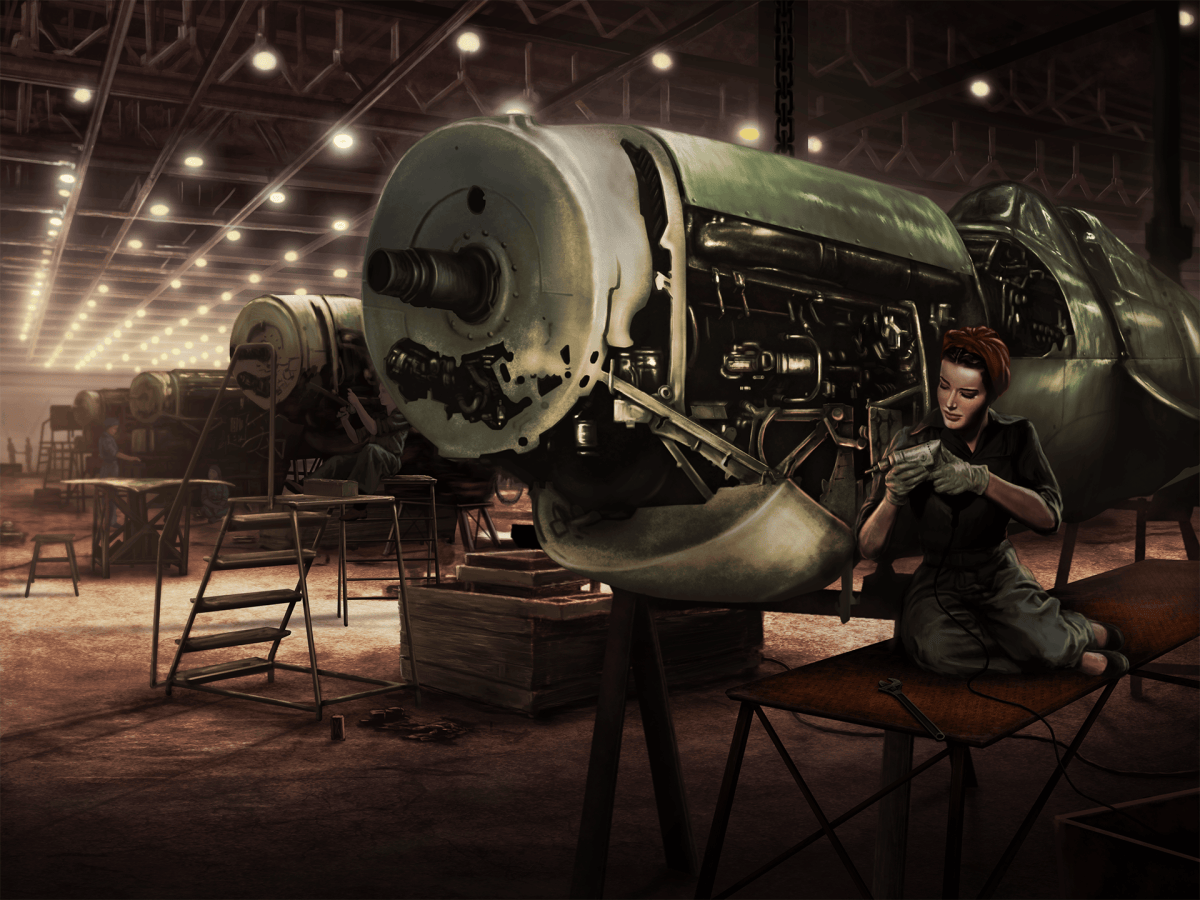
The Allies were far quicker to do so, with women working in factories in the USA, UK and USSR very early in their involvement in the war and women serving in non-combat roles in the UK and US militaries and even in some combat roles in the Red Army. As far as I can tell, Hearts of Iron IV doesn’t simulate this at all, despite the very clear impact it had on production during the war.
But it gets a neat picture!
Industrial War Industry
We should start by laying out the basics of the game’s economic model. Unlike previous Hearts of Iron games, which represented a country’s industrial might with a single ‘industrial capacity’ number, HoI4 splits industry into civilian factories and military factories. Civilian factories build other buildings – infrastructure, railways, ports and other factories (both civilian and military) – and a portion of them are reserved for ‘consumer goods.’ Meanwhile military factories build military equipment: rifles, tanks, aircraft, etc. There is a third category, dockyards, which build ships, but we’ll leave them aside for now except to note that they function more or less exactly like military factories save for what they build.
It is possible to convert factories from one type to another (meant to represent the sort of plowshares-into-swords crash mobilization of the US, UK and USSR’s economy) but almost never worthwhile, to the point that this conversion is almost a dead mechanic.
Unsurprisingly, given the game’s focus, there is quite a lot of granularity in military production. Players set up ‘lines’ of production for specific equipment and then assign a certain number of factories to that equipment. Military factory efficiency (‘production efficiency’) scales up over time as long as they are producing the same thing, to represent process streamlining and impose a penalty for the kind of rapid design switching that, for instance, Germany engaged in. Produced equipment goes into a national stockpile (which exists on a balance sheet, not anywhere in the world). The player then trains division templates which demand the equipment being produced and it is automatically shifted to those divisions (generally during the training process or when they take losses; it is rarely worthwhile to deploy a half-trained, half-equipped division) as needed.

In addition to factories, military production also demands raw materials (aluminum, rubber, tungston, steel and chromium), with sharp speed penalties for missing ingredients. All factories also require coal to operate at full speed (and oil is converted into fuel in a system that we needn’t get into here, though it does matter a lot for operational planning).
Finally, it is worth noting there are two mutually exclusive pathways for industrial technology, which apply significant bonuses; in practice researching these technologies as they become available is effectively mandatory for nearly all countries. Concentrated Industry, representing the approach of the United States, United Kingdom and Soviet Union, offers 5% more raw factory output per level, while Dispersed Industry, representing the approach of Germany and Japan, offers better production efficiency and strategic bombing resistance. For quite a while now, dispersed industry has been the ‘meta’ choice, which as discussed below is a bit baffling as it was very clearly the less effective approach during the war itself.

Each equipment type is thus its own individual line which needs unique management. A minimally capable army is likely to need at least production lines for infantry equipment, support equipment, artillery, anti-air, anti-tank, tanks, trucks and at least a few kinds of aircraft so at minimum that is around 10 different production lines, each with its own set of assigned factories, unique resource demands (which may need to be traded for, see below), variable production efficiency and so on.
The military industrial production side is thus a fairly complex game of anticipating equipment needs in advance and assigning factories – allowing due time for them to gain production efficiency – to maximize the production of the equipment that divisions need, in the ratios they need it, when they need it. If I expect, for instance, to be at war by 1939 (as in the Britain playthrough we’ve been doing screenshots of), I am going to workout my intended army size, quickly math out the required amount of equipment on a piece of paper and then proportion my production accordingly.
Gameplay-wise, it is a neat system which encourages player to think ahead and is, ironically, one of the closest systems to actually force a player to actually think about their doctrine in the real sense of the word: trying to predict how they will need to fight and then building the equipment to create the kind of divisions appropriate for that fight.

Civilian Industry and Civilians
By contrast, the civilian industrial system is extremely simplified – streamlined might be a more generous term.
Civilian factories, as noted, build other factories (including other civilian factories) as well as a number of other buildings (forts, infrastructure, ports, railways, etc.), but our main focus here is on their role building factories. Apart from the coal all factories require to run, civilian factories consume no resources and they require far less management. They do not gain in productivity over time working at the same kind of project, instead always being perfectly interchangeable with each other. In practice, the player merely creates a priority list of projects and the civilian factories get to the job of marching down the priority list in order, one by one, with up to 15 civilian factories per project.

Civilian factories are also responsible for consumer goods production. The number of factories required for this is determined by adding military and civilian factories (but not dockyards) together and then taking a percentage of that total: that number of civilian factories are then removed from use, serving to supply the civilian economy. Unlike in previous Hearts of Iron games, where civilian industry put to civilian use generated money (representing tax revenues), in HoI4, mechanically, consumer goods represent wasted production. We’ll come back to this, but for now mechanically the player cannot allocate more factories than required for consumer goods, nor is there any benefit at all for having more consumer goods producing factories.
In Hearts of Iron IV, consumer goods production has no value: it does not impact stability or war support or politics. Notably, consumer goods production is entirely independent of civilian population: factories do not really consume any labor nor do they actually feed, cloth or house anyone. Instead, consumer goods function as a ‘tax’ to suppress the production of certain countries (the pre-war democracies, generally) and to prevent a player from focusing entirely on military production. In the latter case, as a player builds out a military industrial complex, the number of total factories (and thus the consumer goods requirement) rises, leading to fewer and fewer civilian factories free to build more military factories.

Civilian factories are also ‘spent’ to gain raw resources (for military factories) via trade, essentially transferring one civilian factory per a set number of units of raw resources (usually 8) transferred the other way.
One missing element you may have noticed is labor: labor is barely simulated at all. At most the effect here is expressed through conscription and mobilization laws, in a relatively blunt way. The highest economic mobilization law (‘total mobilization’) reduces the recruitable population (with a 3% modifier), reflecting military-aged men kept in the factories, while the highest conscription laws (‘service by requirement’ ‘all adults serve’ and ‘scraping the barrel’) lower factory output to reflect the labor shortages they generate. Notably, both of these effects happen regardless of the number of people in service or the number of factories: a country with Service by Requirement suffers its 10% penalty to factory output even if it has no army at all and a country on Total Mobilization suffers its 3% penalty to recruitable population even if it has almost no factories to absorb those workers.
As is consistently the case with Hearts of Iron IV‘s design, civilians do not matter very much: not for politics, not for war, not even for industry.

The Implications of the System
Having outlined in a general sense the shape of this system, it is worth going through the way that it generally develops over the course of any given playthrough, because there is a fairly predictable pattern and of course that pattern of mechanics speaks to the vision of history that Hearts of Iron IV is presenting, particularly because it more or less always happens.
One of the first questions is where countries make the shift-over point from focusing primarily on building civilian industry to focusing primarily on military industry. If a country only builds civilian industry, its industrial capacity total grows geometrically, as the more civilian factories are built, the faster new ones are built. However, since the only real product of this system are weapons churned out by military factories, this produces a sort of calculation – the player estimates when they expect to be at war and then initially builds civilian industry (to expand how much military factory they can build in a given unit of time), before shifting over to military factories in an effort to maximize the amount of military factories they’ll have at war’s start. For some countries this ‘turnover’ point is very early, for others it is a few years into the game.
Economic mobilization laws figure highly into this calculation. For the most part, economic mobilization laws do not really represent tradeoffs, but instead escalation: later laws are simply better than earlier ones. Civilian economy and partial mobilization provide maluses to construction speed (you build factories, even civilian factories, slower), while War Economy and Total Economic Mobilization provide bonuses to the same. Earlier laws also require a higher percentage of consumer goods factories, while later laws require less and since consumer goods are represented in game basically as waste (they offer no value whatsoever), this is also just a pure economic malus. There is no benefit to a civilian economy for the player and thus players are strongly incentivized to mobilize as much as their political system will let them and to stay at that maximum mobilization as much as they can. Rising world tension and being at war are generally what unlock the war support necessary for later economic mobilization laws.
As a result, globally, the percentage of industrial production devoted to consumer goods falls over time, which dramatically increases the factories available to expand industry, while construction speed for new factories rises as countries move to more aggressive mobilization laws (technology also pushes in this direction). Consequently, the number of factories globally rises dramatically over the course of the game, with countries often hitting the limits of how many factories can fit in the states they control by the mid-1940s. Thus, for instance, in the current run, the UK starts the game with just 31 factories; by the time I was ready to form the Commonwealth of Nations in 1942, the United Kingdom already had well over three hundred factories. Needless to say, the historical 1930s and 1940s did not witness a 10x growth in global GDP (global production a-little-more-than-doubled between 1930 and 1955).
That runaway factory growth produces systemic absurdities in HoI4‘s economy, because the raw material supply cannot keep up. While there are ways (technology, infrastructure) to realize modest increases in the amount of raw materials available in the game, these are a lot more modest than the order-of-magnitude increase in industrial production and while civilian industry only consumes coal, the churning of many hundreds of military factories begins, by the mid-1940s, to demand more resources than are globally available.
The way trade laws work in this system is that more export-oriented (or trade-friendly) trade laws reserve a percentage of the raw materials a country produces for export regardless of if someone is buying them. Trade-friendly laws also provide modest but significant industrial bonuses, so they make sense to adopt early, however in the long run trade in this system must reduce the overall quantity of resources available, because any resources that are reserved for trade but cannot be traded (because you are at war with the country, for instance) are wasted. Consequently as the major powers build up their industry, they’re pushed towards autarky to ‘unlock’ those trade-reserved resources, which results in the late-game economy fracturing into a set of beggar-thy-neighbor autarkies, which is to put it bluntly, not what happened historically.

The result, paradoxically, is that faced with resource shortages, one by one major powers shift to autarky in their trade laws (‘closed economy’ being the in-game label, though Germany gets a special version of limited exports called ‘autarky’ which replaces some of the penalties with bonuses instead, an absurd bit of design from a historical perspective given how conspicuous the failure of German autarky was). Autarky is an economic system which aims to produce all required goods entirely internally, without any trade (or minimal trade) with the outside world. For both ideological and political control reasons, autarky has often been the cherished goal is totalitarian regimes, both right and left. In particular – and we’ll discuss this more next week – economic autarky was the very specific economic goal that both Germany and Japan pursued in their attempted conquests in World War II. It was the thing they were fighting for (and the thing everyone else was fighting against) in a very real sense.

At this point, I should note, the war is basically decided. After all, I had the offensive superiority in late 1942 to break through and attack and each of my ‘pushes’ gives me more factories and denies them to the Axis. We’re now well past the point of recovery: the only hope of the Axis here would be if I ran out of manpower but I’m still only on Limited Conscription, so there are a few million men sitting behind the 900k currently in my manpower reserves.
Meanwhile, production shortfalls means that German divisions are getting weaker and are increasingly incapable of stopping me. We’re rapidly approaching the point where I can just attack everywhere and win. That said, I am still operating on the assumption I am going to also fight the USSR over Poland’s full territory, so I am not simply attacking everywhere as I need to conserve manpower.
Germany in Hearts of Iron IV
Now, before we get into how all of these mechanics come together to express a coherent – but deeply flawed – theory of history, I want to take a ‘sidebar’ on a topic. You may have noticed something of a trend in some of the design choices we have been discussing, but it is worth pulling them out. The developers want Hearts of Iron IV to simulate a World War II that proceeds roughly along the lines of the original, with France falling in 1940 and the Wehrmacht nearly reaching Moscow in 1941.
The problem, which the developers have discussed in the past, is that those events were fairly unlikely and significantly the part of bad decisions made by the allies (particularly France and the USSR), which left them unprepared and surprised by German attacks. But the developers cannot compel player!France to fail to adequately protect against a push through the Ardennes, nor compel player!United Kingdom to wait too long to rearm, nor compel player!USSR to trust Hitler completely up to – and indeed beyond – the very moment German tanks roll over the border into the Soviet Union. AI controlled countries could be made to make these mistakes, but that too is a poor solution from a game-design standpoint – it isn’t that interesting playing against an AI that is mandated to make specific errors.
The solution was instead to ‘power up’ Germany, making it a-historically powerful. Historically, Germany and the United Kingdom had similar levels out economic output through the war; in-game Germany starts with 73 factories to the United Kingdom’s 31 and gets stronger special laws and focuses that enable it to decisively outproduce the United Kingdom well into the game. Historically, Germany’s policy of autarky was a self-defeating one; in-game it is a special version of trade law that is simply a better form of ‘limited exports’ in every way.
Meanwhile Germany’s opponents are severely weakened. Both Britain and France are saddled with negative ‘national spirits’ that sharply limit their industry, political stability or ability to raise forces (whereas Germany gets bonuses to military organization and somehow the ability to raise air wings with less manpower). The United States is perhaps the worst victim of this, as it alone starts with the ‘Great Depression’ national spirit that pumps the consumer goods ratio (again, remember, purely waste in the game’s system) to 60%, while lowering recruitable manpower by 50% and raw resource production by 20%, as if the Great Depression only happened in one country. In practice, the purpose of the modifiers are to suppress US economic production so that the American industrial juggernaut emerges on schedule in 1942 and not earlier.
From a game design perspective, you can just about understand why all of these decisions were made: the game is more interesting if Germany has a potentially realistic shot at beating the combined efforts of the UK, France, the USSR and the United States. But historically, Germany didn’t have such a realistic shot (and Japan certainly didn’t). One of the facts that emerges quite clearly out of modern historiography on the war was that Germany’s often inefficiently-organized economy had little hope of providing a realistic path towards victory. The disparity in industrial capacity, once the allies turned to the task of reducing Germany to rubble, was enormous and unbridgeable.
But the broader problem here is how it fits into an overall trend where the design commitment to having Germany have a realistic shot at winning World War II on the terms the Nazis waged it compels the developers to treat Nazi (economic) ideology as if it were true, when it wasn’t. Fascist claims about the ‘trains running on time’ are effectively treated as accurate in the way HoI4 assigns economic potential, even when ‘the fascists made the trains run on time’ (in Italy) is one of the most persistently debunked historical myths out there. Meanwhile, the the Third Reich, Adam Tooze’s The Wages of Destruction (2006) remains essential reading on the fundamentally hollow nature of Nazi economic propaganda: the Nazis didn’t make the German economy hum either.
Fascist Economics
All of these mechanical simplifications make a kind of sense in getting the player to the ‘fun stuff’ of the war itself (much as with the political mechanics), but collectively they add up to a vision of history which establishes the Axis view of economics as its foundation. In effect, it takes the debate about the nature of economic life in the 1930s and 1940s and grants the conclusion to the fascist ideological assumptions a priori. It begins with the assumption that the Nazis were fundamentally right about how an economic global order would function.
Which is a real problem for a number of reasons, not the least of which is that the Nazis were famously wrong about that.
Take the question of concentrated vs. dispersed industry. Industrial dispersion in Germany wasn’t simply a response to strategic bombing, but was also rooted in an ‘artisanal’ approach to production that was both a holdover from earlier German industrialization but also something rooted in Nazi ideology. After all, the Nazi ideology of racial superiority – that German soldiers and workers were Übermenschen who could outproduce racially ‘lesser’ men – didn’t make much sense in a Taylorist or Fordist approach to production, which aimed for efficiency through assembly-line production in massive-scale facilities where workers functioned not as individual artisans but as pieces of a well-oiled machine. The Wehrmacht‘s preference for frequent revisions in design likewise reflected an assumption about war rooted in Nazi race ideology – that racially superior soldiers, equipped with the very best equipment, produced by racially superior craftsmen would be victorious in battle.
And they were very obviously wrong.
To take some figures from Overy (1995), op. cit., in 1942, Germany – controlling at that point most of Europe, mind you – produced 9,200 tanks and 15,409 aircraft. The United Kingdom – despite having its imports choked by submarine warfare all year – produced 8,611 tanks and 23,672 aircraft, exceeding, albeit modestly, German production. The USSR, by contrast, produced 24,446 tanks and 25,436 aircraft – absolutely blowing German production away. And the United States, despite having been on a war footing for less than a month at the start of the year, produced in 1942 some 24,997 tanks and 47,826 aircraft. These differences in production would only grow wider as the war progressed. Worse yet, it was also simply not the case that Germany obtained a technological edge for all of this rapid design shifting – indeed, as the war went on increasingly the best designed equipment was American, British or Soviet.
And while we’re here, Japan – whose approach is also in theory modeled by the ‘dispersed industry’ technology which is (as I noted), the optimal ‘meta’ choice for most HoI4 countries in the current build – produced just 1,191 tanks and 8,861 aircraft in 1942. Utterly unable to compete with even the beleaguered United Kingdom, much less the industrial behemoths of the United States and the USSR.
Meanwhile there is the question of autarky and trade. We’ll come back to this next week as well, but establishing an effective autarky was a core goal – arguably the core goal – behind both Germany and Japan’s program of aggressive warfare and it failed. In both cases, Germany and Japan sought to create extractive empires which would provide sufficient raw materials internally for both countries to no longer be reliant on trade. In the case of the Third Reich, this plan explicitly involved the murder – mostly through intentional starvation via the Hunger Plan – of tens of millions of people to create the ‘living space’ (Lebensraum) for a mass program of German settlement in Eastern Europe that (combined with the use of slave labor) would render a super-sized Third Reich self-sufficient in foodstuffs. Japan envisaged something more akin to the older European colonial empires – an overseas empire based around resource extraction in which the indigenous population were a resource to be extracted as well as a captive market which could be compelled to buy Japanese goods.
There is an irony here that in a sense the Axis powers (we can include Italy here) were trying to build early modern empires of the sort European states had constructed from the 1490s through the 1930s, despite the fact that by the 1930s the failures of that model were already becoming apparent. For one, Germany had demonstrated that with trade, such an empire was unnecessary to emerge as a European Great Power. The Germans had spent four years (1914 to 1918) standing the rest of Europe on its head without any vast colonial empire of note to rely on.
Even more to the point, the major imperial powers (Britain and France, but also to an extent the United States) were already starting to shed their empires. By the 1930s, the British had been compelled to abandon most of Ireland and the writing was clearly already on the wall that the cost of maintaining British rule in India would far outstrip the returns of doing so. The United States was already in the process of transitioning the Philippines to independence. I don’t want to overstate this point: all three of these countries had fought hard and would fight hard to keep their empires and would do many terrible things in that process. All of them still maintained powerful – indeed, dominant – ‘pro-imperial’ constituencies in their politics. Nevertheless it was already becoming apparent, as Germany, Italy and Japan set out to build new empires, that imperialism of that sort was a fading model which had long since become more cost than benefit to the imperial center. Of course we can see, as many in the 1930s and 1940s could not, the final failure and collapse of the empires – but of course the developers of Hearts of Iron IV certainly can and certainly could design their mechanics accordingly!
Moreover, if the 1900s demonstrated anything, they demonstrated that autarky was a losing economic strategy: trade oriented countries soundly and consistently outperformed countries that aimed for autarky. Adam Tooze’s The Wages of Destruction: The Making and Breaking of the Nazi Economy (2006) documents quite well the failure of Nazi autarky. Meanwhile, Soviet efforts to limit trade and run a largely internally self-sufficient economy over the course of this period and indeed through much of the rest of the Cold War produced well-known and eventually obvious economic deficiencies compared to more trade-engaged western economies.
We have discussed this before, but trade is good because it is positive sum. Both in the sense that a country trading some raw resource they have in abundance for one they have in scarcity increases the overall utility in the system (everyone has more of what they actually want, even if the amount of stuff has stayed constant), but also because through trade regions and countries can specialize, focusing on the raw resources and products they are best situated to produce. The result is more production overall and thus a higher overall standard of living and – so long as you do not go to war with your trade partners (as Germany did in both 1939 and 1941) – greater capacity for an effective defense industry.
In Hearts of Iron IV, by contrast, taking a trade-orientation to an economy is at best zero-sum: if all of the resources a country has reserved for trade are bought by someone then the number of factories and resources in the system remains constant. However – as is typically the case – if some resources are not being bought at any given moment, they are not returned to the selling country but simply lost, meaning that while trade in the real world is positive-sum, trade in Hearts of Iron IV is negative sum: it reduces the total quantity of goods available.
Meanwhile every country in Hearts of Iron IV runs as a state-controlled command economy. Now it is certainly the case that countries at war tend to see a lot more government control in their economic activity, but there were still radical differences between Nazi and Soviet command economies and American and British market economies during the war. By effectively making every country a command economy, Hearts of Iron IV loses the capacity to simulate differences between these approaches to production. Historically, centrally directed command economies generally performed poorly in the 1900s, while increased market orientation has been fairly strongly correlated with improved economic growth and production.
Hearts of Iron IV reverses this. Instead, because consumer-oriented civilian economies (the ones that most reliably produced economic growth over the historical 1900s) have slower factory construction speed and must devote far more factories to consumer goods, they grow their industrial potential more slowly than highly state controlled countries under a ‘war economy’ or ‘total mobilization’ law. This follows along the line of traditional folk history wherein ‘World War II ended the Great Depression,’ but while WWII did reduce unemployment – by employing men in either the infantry or in graves – it certainly didn’t improve standard of living. To a significant degree, rearmament in WWII acted as a kind of economic stimulus, but it is hard not to notice the world might have been a better place if governments had done the same economic stimulus directed at making automobiles and refrigerators instead of tanks and bombers. In the post-war world – which Hearts of Iron IV declines to simulate economically in any way – it was the countries which shifted back to consumer production the quickest which reaped the rewards of peace.
So Hearts of Iron IV‘s economic model proposes that military mobilization is what produces a-historically extreme amounts of economic growth by suppressing consumer goods (because ‘standard of living’ in HoI4 is – again – just economic waste; the best economy in HoI4 is one that consists entirely of soldiers and starving, overworked peasants), which inexorably pushes major powers towards empire and autarky, the losing economic models in the actual history of this period. As historical simulations go, this is not a very good match for the trends we observe in the 1940s. From a design perspective, I imagine, that is because it isn’t really meant to be. Most Hearts of Iron IV games (both single-player but also, in my understanding, multiplayer as well) are effectively decided by 1942 – the war isn’t over yet, but the outcome is likely clear. Thus from a game-design perspective it doesn’t really matter if the system spirals into nonsensical outcomes in 1945, because by that point the player is probably just wrapping up a ‘run’ whose conclusion has been determined – indeed, overdetermined – for years of in-game time already.
Instead, the economic system: the no-trade-offs escalating set of economic laws and industry growth-curves are really built to simulate rearmament and the economic situation of the late 1930s specifically, to capture the different rates at which the major powers prepared for war and in particular to set conditions whereby Germany is economically in a position to challenge the USSR and the western allies in the 1940s – indeed, to set conditions in which Germany is far more prepared than it historically was to do so, because the design of the game aggressively and intentionally increases German war-making potential at every turn.
The result is a game that constructs a fictional, parallel world in which the failing Nazi, fascist and Japanese-militarist economic vision works. Relentlessly directing an entire economy towards a war-footing even in peacetime isn’t political and economic malpractice (as it is in the real world; note the economic condition of North Korea for a contemporary example of what this does to a country), but rather is the key to boundless economic growth. Trade is a sucker’s bet in Hearts of Iron IV. Slave labor – unmentioned (as we noted last week), yet implied by Germany and Japan’s extraction-empire focus in conquest – also simply works and works better than trade, despite the historical record of the 1900s being about as close to the opposite of this outcome as it is possible to imagine. German-style artisanal production even beats Fordist-style assembly lines, in an astounding historical absurdity that cuts against functionally all of the historical work on the war economies of the 1940s.
In short, Hearts of Iron IV takes a war which in the real world proved the Nazis wrong about the nature of production and instead posits a world in which they were right. It does this out of an understandable desire to make Germany a real competitive foe to the allies, but the result, quite frankly, is historical malpractice. We’ve talked before about the persuasive power of simulation – that in playing a simulation, a player can ‘learn’ how a set of historical interactions work out with far greater clarity and confidence than if those interactions are explained. And if an exercise is carefully designed, this can be a really powerful and useful teaching tool, so long as the simulation accurately represents (to a reasonably degree of simplification) the actual historical interactions being studied.
But simulations are captive to their assumptions and so those assumptions must be made with care. When it comes to industry and production, HoI4‘s assumption may fairly be summed up as, “what if the Nazis were right about everything?” I do not say that approach is irresponsible simply because I do not like Nazis – although I famously do not like Nazis – but as a historian it is irresponsible because it is wrong. And it is wrong – I cannot stress enough the failure of fascist economic thinking is one of the most comprehensively demonstrated facts of the first half of the 1900s: permanent war economies do not work, command economies do not work, autarky does not work, mass forced labor does not work, imperialism as an economic strategy stopped working some time ago. HoI4 takes a war that was fundamentally about a contest of economic systems and – for gameplay reasons – gives the losing economic system all of the advantages and then dresses up the result in all of the persuasive power of simulation, with every ounce of historical verisimilitude that can be mustered.
Hearts of Iron IV‘s economic model thus – and I do not say this lightly – employs all of the persuasive power of simulation to create what is effectively a propaganda tool for fascist economics: it is not intentionally designed to persuade players of the effectiveness of fascist economics, but it is not clear to me what, if any, decisions would have been made differently if it was. If it were not for the catastrophic lack of treatment HoI4 applies to Axis atrocities, this would easily be the most irresponsible set of design decisions, I think, in the modern Paradox library. And it has, in turn, equally dire implications for how Hearts of Iron IV understands strategic ends, which is where we will turn next.

