

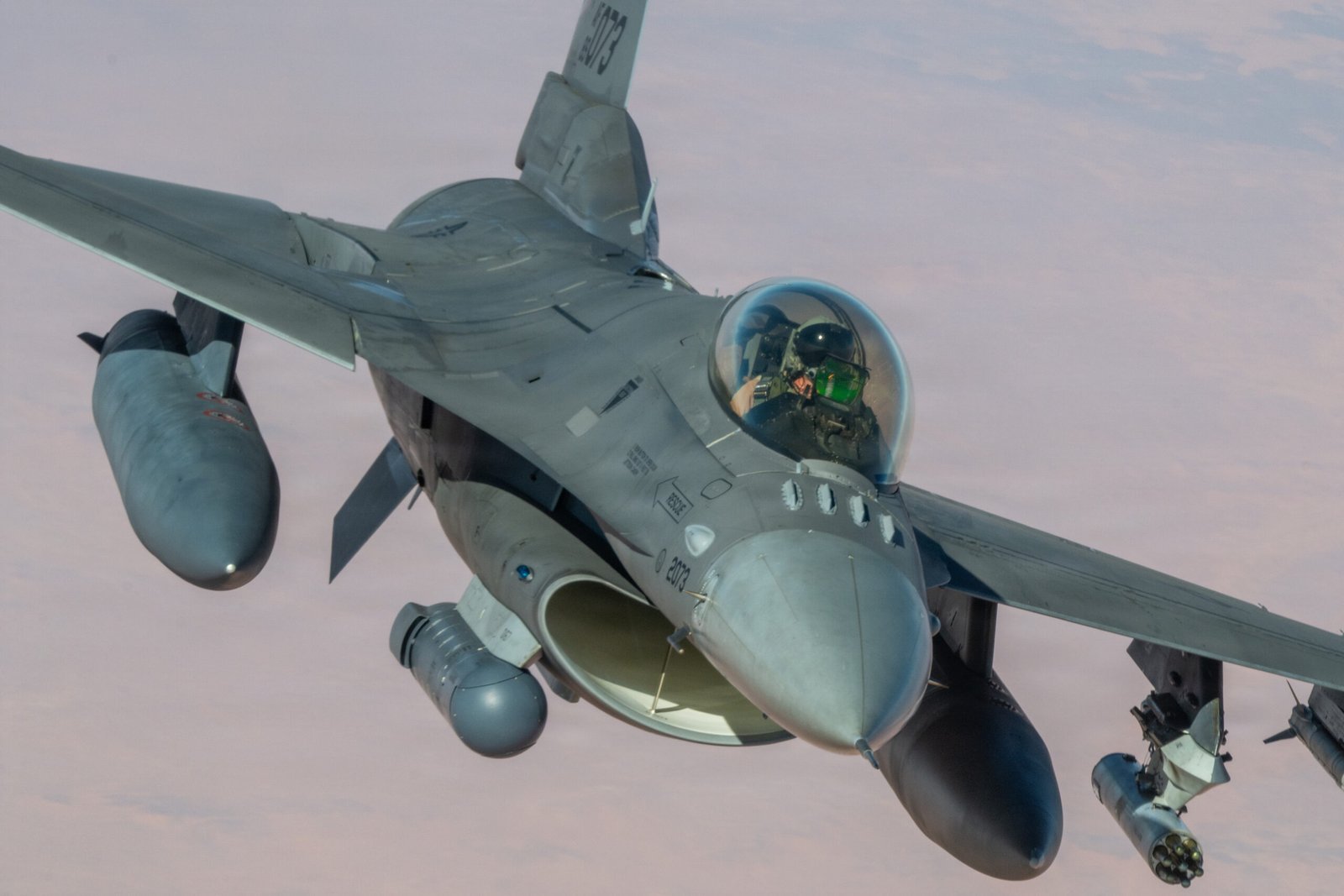
The Pentagon has concluded a new agreement to buy laser-guidance kits that turn rockets into drone-killing weapons.
BAE Systems and the Defense Department announced a framework deal of up to seven years for 25,000 Advanced Precision Kill Weapon System guidance kits annually for the U.S. military.
Another 10,000 kits could be produced each year for international customers, who are increasingly interested in the system.
APKWS is a laser-guidance kit that converts 2.75-inch unguided rockets into precision munitions. It is currently fielded by the U.S. Air Force, Army, Marine Corps, and Navy, as well as U.S. allies.
APKWS has become the preferred method for U.S. warplanes to down drones fired by Iran and Iranian-backed militias in the Middle East over the past few years. But it is not just an air-to-air weapon. APKWS munitions can also be fitted to various platforms for air-to-surface, surface-to-surface, and surface-to-air use.
APKWS is an attractive capability for the Pentagon because of its low cost—roughly $35,000, according to officials. That gives the Air Force a way to shoot down drones without expending costly air-to-air missiles.
For compraison, Advanced Medium-Range Air-to-Air Missiles cost roughly $1 million each, and AIM-9s cost hundreds of thousands of dollars depending on the variant. The most capable model is the AIM-9X, which costs around $500,000. APKWS was first tested in an air-to-air role in 2019. The Air Force did not pursue the idea heavily until a few years later, before fielding it in combat in 2024.
“We were on the wrong side of the cost curve in our munitions employment,” former Air Force Chief of Staff Gen. David Allvin said in an interview with Air & Space Forces Magazine.
“The great thing about it is that there wasn’t a formal requirement set out for this. This was sort of organic. People started figuring it out without it being a big program of record,” Allvin added. “Good thing they did.”
Now, just a few years later, the Pentagon is betting big on APKWS’ future.
APKWS scored its first combat air-to-air kill in the fall of 2024 in the Middle East by F-16 from the 510th Fighter Squadron at Aviano Air Base, Italy, current and former officials told Air & Space Forces Magazine.
When the 480th Fighter Squadron from Spangdahlem Air Base, Germany, deployed to the Middle East soon after, they scored dozens more aerial kills—108 in total using all weapons during their deployment.
By the spring of 2025, the Air Force began flight testing APKWS on F-15E Strike Eagles, and fielded the capability in the Middle East within roughly a week. Around the same time, U.S. Air Forces in Europe also fielded APKWS for its air-to-air training. The system has also been on A-10s to shoot down drones.
The APKWS has its origins in the decades-old Hydra rocket system and was first used as precision air-to-ground weapon during the Global War on Terror, deploying in 2012.
It was adapted to serve in an air-to-air role when Air Forces Central, commanded by then-Lt. Gen. Alexus G. Grynkewich from 2022-2024, began looking for an alternative to using costly air-to-air missiles against drones. CENTCOM and the Air Force supported the effort.
The framework agreement is intended as a signal of what the Pentagon plans to buy, subject to specific contracts and the congressional funding needs for those deals.
BAE says the new agreement will help expand production at its facilities in Hudson, N.H., and Austin, Texas.
“This agreement highlights the importance of sustained investment in critical munitions to strengthen readiness and equip forces for evolving operational needs,” BAE Systems president and CEO Tom Arseneault said in a statement.
“By securing multiyear demand, this agreement keeps production lines running at capacity, provides our forces with interceptor inventory, and flips the cost calculus in the taxpayer’s favor,” Michael Duffey, undersecretary of defense for acquisition and sustainment, added.
APKWS can also be used in a ground-to-air role, as the modifications needed to hit aerial targets are largery limited to software and the use of a proximity fuse. It can be fitted to anti-air systems such as Sierra Nevada Corporation’s BRAWLR, which is deployed overseas by the U.S. military, and L3Harris’ VAMPIRE, which is used by Ukraine and is being supplied to the U.S. It has been fitted to other nations’ fighter platforms and has been tested on the MQ-9 Reaper as well.
“This drone problem is not going away,” retired Lt. Gen. Derek C. France, who led Air Forces Central from April 2024-August 2026, said in a recent interview with Air & Space Forces Magazine. “It’s accelerating in tactics, speed, advancements, and the numbers. That’s the direction that we’re going.”
