

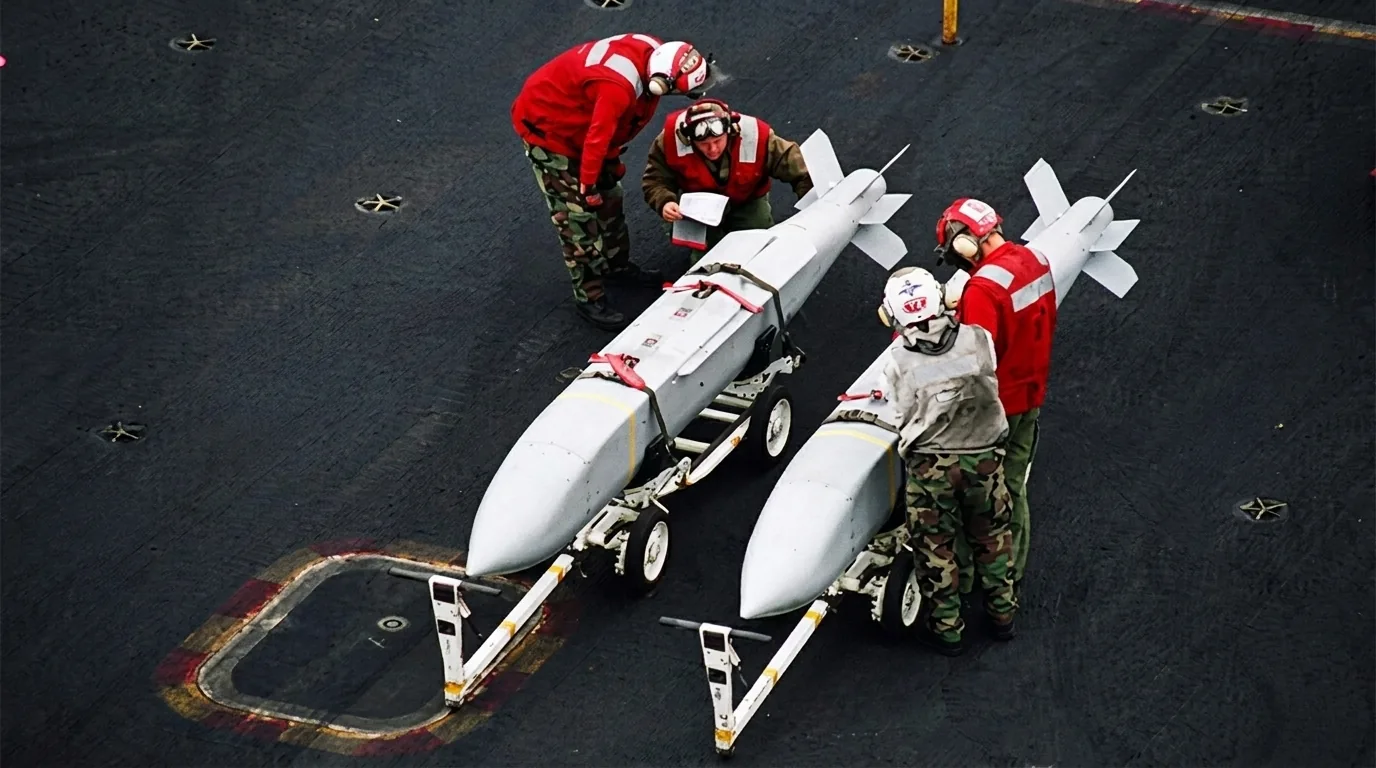
A bomb doesn’t need its own engine to reach targets far from the aircraft that releases it. The AGM-154 JSOW (Joint Standoff Weapon) proves the point with folding wings, satellite navigation, and guidance systems built for accurate delivery.
That design changes the risk for the aircraft crew. Instead of flying directly over a defended target, a pilot can release the AGM-154 JSOW from a distance and let it glide toward the designated area. The launch aircraft can stay farther from some air defense threats, depending on the target’s location and the weapon’s release conditions.
But range alone doesn’t explain why the AGM-154 JSOW matters. Its real value comes from combining standoff reach with different payloads and guidance options. The AGM-154A was designed for area targets, while the AGM-154C added an imaging infrared seeker and a unitary warhead for more precise engagement. The later AGM-154C-1 also gained a data link that supports updates in flight and engagement of moving maritime targets.
That flexibility gives the AGM-154 JSOW family more than one job. It can support missions against fixed land targets, while the C-1 variant extends its role toward ships. The weapon still depends on accurate target data, suitable launch conditions, and the right variant for the mission.
There’s a catch, though. A glide weapon isn’t a cruise missile, and its performance changes with release altitude, speed, and the target’s position. Public range figures vary by launch profile, so one headline number rarely tells the whole story.
To understand what the AGM-154 JSOW can actually do, start with the way it finds its target and uses the energy from the launching aircraft.
How Does the AGM-154 JSOW Deliver Precision?
The AGM-154 JSOW uses its wings to turn the aircraft’s forward motion into a long glide toward the target. Unlike a powered cruise missile, it carries no engine. That keeps the weapon’s design simpler while allowing the launching aircraft to release it well before reaching the target area.
After release, the AGM-154 JSOW deploys its wings and follows a programmed flight path. Its guidance system uses inertial navigation and GPS to track its position and steer toward the assigned coordinates. Inertial navigation measures movement from the weapon’s starting point, while GPS helps correct errors using satellite signals.
This combination matters because neither system is perfect on its own. Inertial navigation can drift over time, while GPS performance depends on signal access and the conditions around the weapon. Using both gives the AGM-154 JSOW a way to guide itself without requiring the pilot to keep directing it after release.
The weapon’s glide range depends heavily on the launch profile. Releasing it from higher altitude generally allows a longer glide than releasing it close to the ground. Aircraft speed, target position, and the weapon variant also affect the distance it can cover.
Public figures often cite ranges from roughly 12 nautical miles at low altitude to around 70 nautical miles under favorable high-altitude conditions, though published figures vary.
The AGM-154C adds another layer. Its imaging infrared seeker helps guide the weapon during the terminal phase, allowing it to use an image of the target area rather than relying only on preset coordinates. The AGM-154C-1 adds a data link for updated targeting information, including support for moving maritime targets.
That doesn’t make the AGM-154 JSOW immune to failure. Poor target data, navigation interference, or an unsuitable launch profile can still reduce its effectiveness. Precision depends on the full chain, from identifying the target to guiding the weapon onto it.
AGM-154 JSOW Specifications, Speed, Range, and Payload
The AGM-154 JSOW gets its reach from aerodynamic lift, not engine thrust. Its folding wings let it glide toward a target after release, giving the launching aircraft more room to stay outside some defended areas. The trade-off is clear: its range depends on the aircraft’s speed, altitude, and release conditions.
The weapon belongs to the 1,000-pound class, making it suitable for aircraft that carry other precision-guided air-to-ground weapons. Its physical design balances a compact shape for carriage with wings that extend after release.
| Specification | AGM-154 JSOW |
| Weapon type | Air-to-ground glide weapon |
| Length | Approximately 160 inches (4.1 metres) |
| Body diameter | Approximately 13 inches |
| Wingspan | Approximately 106 inches when deployed |
| Launch weight | Around 1,065 pounds |
| Propulsion | Unpowered glide, no onboard engine |
| Navigation | Inertial navigation and GPS |
| Published range | Roughly 12 nautical miles at low altitude, up to around 70 nautical miles in favorable high-altitude profiles |
| Payload | Depends on the variant |
These figures describe the general weapon family. Payload details and guidance features differ between versions, so the table shouldn’t be read as a complete specification for every AGM-154 model.
Range deserves particular care. The often-quoted figures are not a guarantee that every aircraft can reach a target at those distances. A high release altitude gives the weapon more time to glide, while a low-altitude release reduces that opportunity. Aircraft speed and the target’s position also shape the result.

Payload is another key distinction. The AGM-154A uses submunitions intended for area targets, while the AGM-154C carries a unitary warhead designed for a more focused effect. The C-1 adds a data link that supports updated targeting information.
There is no single payload description that fits every AGM-154 JSOW. When comparing the weapon with a guided bomb or cruise missile, check the exact variant first. Otherwise, range, target type, and warhead details can easily get mixed together.
What Are the Main AGM-154 JSOW Variants?
The AGM-154 JSOW family was built around a practical idea: one basic airframe could support different missions by changing its payload and guidance systems. That gave the US military options for attacking area targets, engaging specific land targets, and targeting moving ships without designing an entirely new weapon for each task.
The AGM-154A was the original operational variant. It carries submunitions designed to engage fixed or relocatable soft targets across an area. This makes it different from a weapon designed to focus its effects on a single point. The US Navy reports that AGM-154A weapons were used in combat in Afghanistan and Iraq, demonstrating the variant’s role in operational air campaigns.
The AGM-154B was developed with an anti-armor role in mind, using sensor-fuzed submunitions. However, development was completed without moving into production. That distinction matters: a weapon can pass through development without becoming a fielded capability at scale.

The AGM-154C took a different approach. It combines a unitary warhead with an imaging infrared seeker, giving it a more focused way to engage targets. Its warhead uses blast, fragmentation, and penetration effects, while the terminal seeker helps refine the weapon’s aim during the final part of flight.
The AGM-154C-1 adds a data link to the C variant. That lets the weapon receive updated information after launch and supports engagement of moving maritime targets. The US Navy declared initial operational capability for the C-1 in June 2016.
| Variant | Main role | Key feature |
| AGM-154A | Area targets | Submunitions |
| AGM-154B | Anti-armor targets | Sensor-fuzed submunitions; production deferred |
| AGM-154C | Specific land targets | Unitary warhead and imaging infrared seeker |
| AGM-154C-1 | Land and moving maritime targets | Data link for in-flight updates |
The key distinction is not simply which variant is newer. It is whether the mission calls for effects across an area, a more focused land-target engagement, or the ability to update targeting information against a moving ship.
What Targets Can the AGM-154 JSOW Engage?
The AGM-154 JSOW can engage different target types, but the right choice depends on the variant and the mission. Its design gives aircraft crews a way to deliver guided weapons from a distance, while the payload determines what the weapon can do once it reaches the target.
The AGM-154A was designed for fixed or relocatable soft targets spread across an area. Its submunitions make it different from a weapon that carries one large warhead aimed at a single point. This design can suit targets such as parked aircraft or other vulnerable equipment, depending on the mission and the specific payload. It is not a universal answer for every target, especially where effects must be tightly limited.
The AGM-154C takes a more focused approach. Its unitary warhead combines blast, fragmentation, and penetration effects, while an imaging infrared seeker helps guide the weapon during its final approach. This makes the variant better suited to selected land targets where a more concentrated effect is required. The exact result still depends on the target’s structure, the warhead, and the conditions at impact.

The C-1 variant extends the AGM-154 JSOW’s reach into maritime missions. Its data link supports updates after launch, allowing the weapon to receive new targeting information as a ship moves. That addresses a basic problem with moving targets: coordinates gathered before launch can become outdated while the weapon is in flight.
But a moving target is harder to engage than a fixed set of coordinates. The weapon needs usable tracking data and a suitable update path, and the target’s movement must remain within the system’s engagement limits.
The distinction matters when comparing the AGM-154 JSOW with other precision weapons. It is not just about hitting a point accurately. It is about matching the payload and guidance system to the target, while keeping the launching aircraft farther from some threats. No single variant is equally suited to area targets, hardened structures, and moving ships.
Which Aircraft Can Carry the AGM-154 JSOW?
The AGM-154 JSOW gives air forces more options when planning a strike mission because several tactical aircraft can carry the weapon. That flexibility lets a military use existing aircraft fleets rather than rely on a single specialized platform. But compatibility depends on the aircraft variant, software integration, and the weapon configuration.
The US Navy has operated the AGM-154 JSOW with the F/A-18C/D Hornet and F/A-18E/F Super Hornet. These carrier-based fighters can release the weapon while remaining at a distance from the target, helping crews manage exposure to air defense threats. The weapon’s unpowered glide design also means aircraft crews must account for release conditions when planning a mission.
The F-16 Fighting Falcon is another listed AGM-154 JSOW platform. Its use of precision-guided weapons supports missions where aircraft need to engage targets without flying directly over them. However, the presence of the AGM-154 JSOW in a platform’s published compatibility list doesn’t mean every version of that aircraft can carry every AGM-154 JSOW variant under all conditions.

The F-35 family adds another dimension. The F-35A, operated by the US Air Force, and the F-35B and F-35C, used by the Marine Corps and Navy, have been associated with the AGM-154 JSOW integration. The F-35C’s carrier role makes it particularly relevant to naval air operations, while the F-35B’s short takeoff and vertical landing design serves a different set of basing needs.
Official platform lists have also included aircraft such as the B-1, B-2, B-52, F-15, A-10, AV-8B, and F-117. However, historical integration listings should not be treated as proof that every aircraft remains an active AGM-154 JSOW carrier today.
That distinction matters. Operational compatibility can change as aircraft retire, software is updated, or forces shift to newer weapons. For a current fleet assessment, the specific aircraft model and the AGM-154 JSOW variant matter more than a broad list of platforms.
How Does the AGM-154C-1 Engage Moving Maritime Targets?
A ship doesn’t stay where it was when a pilot first spots it. That simple problem explains why the AGM-154C-1 matters. Earlier GPS-guided weapons work best when the target’s location is known and remains fixed. Against a moving vessel, those coordinates can become outdated before the weapon arrives.

The AGM-154C-1 addresses this challenge by combining the JSOW’s glide design with a data link. After launch, the weapon can receive updated targeting information, helping it adjust its approach as the target’s position changes. This capability supports engagement of moving maritime targets, rather than relying only on coordinates entered before release.
The C-1 also retains the AGM-154C’s imaging infrared seeker for terminal guidance. GPS and inertial navigation help the weapon follow its planned route, while the seeker supports guidance during the final phase. The data link adds another layer by allowing information to be updated during flight.
The US Navy declared the AGM-154C-1 operational in June 2016. That milestone marked a shift from a weapon designed mainly around preplanned target coordinates toward one better suited to a changing maritime picture.
Still, the data link doesn’t make every moving ship an easy target. The weapon needs usable tracking information, and the target must remain within the system’s engagement limits. Delayed updates, lost communications, or major changes in a ship’s course can complicate the engagement. Public information also doesn’t establish a single guaranteed hit probability for every scenario.
The strategic value is straightforward. Naval forces often operate across large areas, where aircraft may need to engage a ship without approaching it closely. A glide weapon with in-flight updates gives planners another option, especially when paired with reliable surveillance and targeting systems.
The lesson is that the AGM-154C-1’s advantage isn’t simply longer reach. It’s the ability to keep the weapon’s target information relevant after launch, when a moving vessel can make fixed coordinates less useful.
