

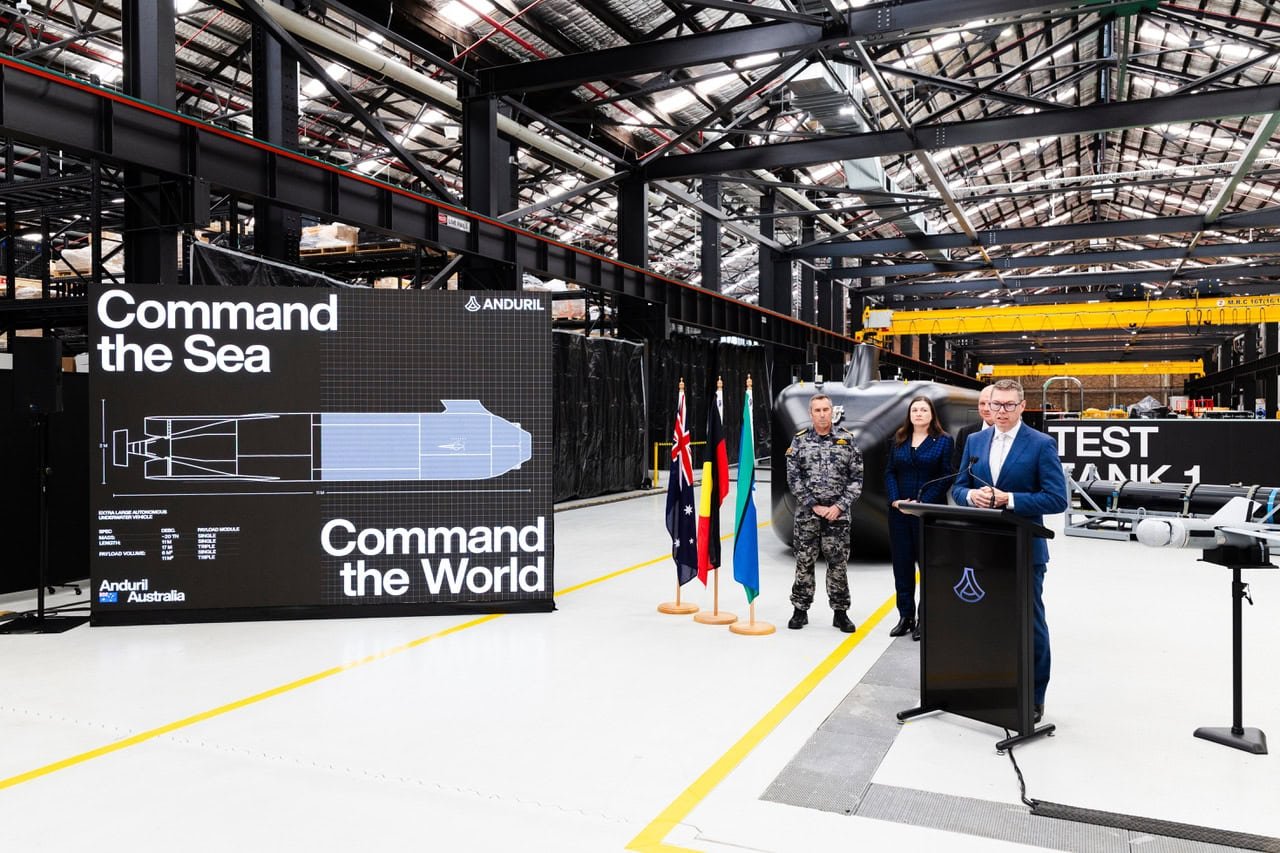
Australia’s Department of Defence has disclosed new details of the payloads being developed for its Anduril-built Ghost Shark extra-large autonomous underwater vehicle (XLAUV), including modules for logistics, sea mines and loitering munitions.
At the unveiling at Anduril’s production facility in Sydney on 19 October 2026, Minister of Defence Industry Pat Conroy said the Ghost Shark would be capable of carrying either twelve sea mines or Anduril Altius loitering munitions. A video released several days later showed the vehicle equipped with a dozen launch tubes designed to deploy the loitering munitions near the water’s surface.
Conroy described the Ghost Shark XLAUV programme as the fastest peacetime acquisition of a major platform for the Australian Defence Force (ADF), taking three years from concept to delivery. The first vehicle was also delivered a year ahead of schedule.
David Goodrich, Anduril Australia’s CEO, said the platform’s modular architecture would allow the Royal Australian Navy (RAN) to introduce new payloads and test missions more rapidly.
“We’re able to integrate new payloads, test missions and provide potent options to navy faster than the threats can evolve,” Goodrich said. He added that the approach would enable the RAN to deliver operational effects at scale and at a fraction of the cost of relying solely on traditional surface and subsurface assets, all without putting sailors in harm’s way.
Goodrich also said, “Ghost Shark’s large payload bays also support the deployment of heavyweight and lightweight torpedoes, including modern, unmanned, cost-effective, undersea effectors, and the vehicle will be capable of engaging threats independently.”
The announcement comes as Australia, the UK and USA advance autonomous systems and other technologies under AUKUS Pillar II. The partners have identified the development of payloads and sensors for autonomous vessels as an early flagship project, with the technologies potentially available to other partners.
Conroy indicated that the systems could be offered to existing and prospective AUKUS Pillar II partners, including Japan.
Separately, Conroy confirmed that Ocius Technology’s Bluebottle unmanned surface vessel (USV) would be equipped with a thin-line towed-array sonar for submarine detection. On 25 August 2026, Australia revealed contracts for ThayerMahan’s Outpost acoustic intelligence system and Thales Australia’s BlueSentry thin-line acoustic array.
The Australian uncrewed systems will deploy to southern California to participate in the US Navy’s (USN) Maritime Big Play Pacific exercise, which is intended to integrate mature robotic and autonomous systems into AUKUS coalition maritime operations.
According to the USN, the exercise will feature more than 40 technologies from government and industry, highlighting efforts to integrate uncrewed platforms and sensor systems into maritime operations.
by Chen Chuanren
