

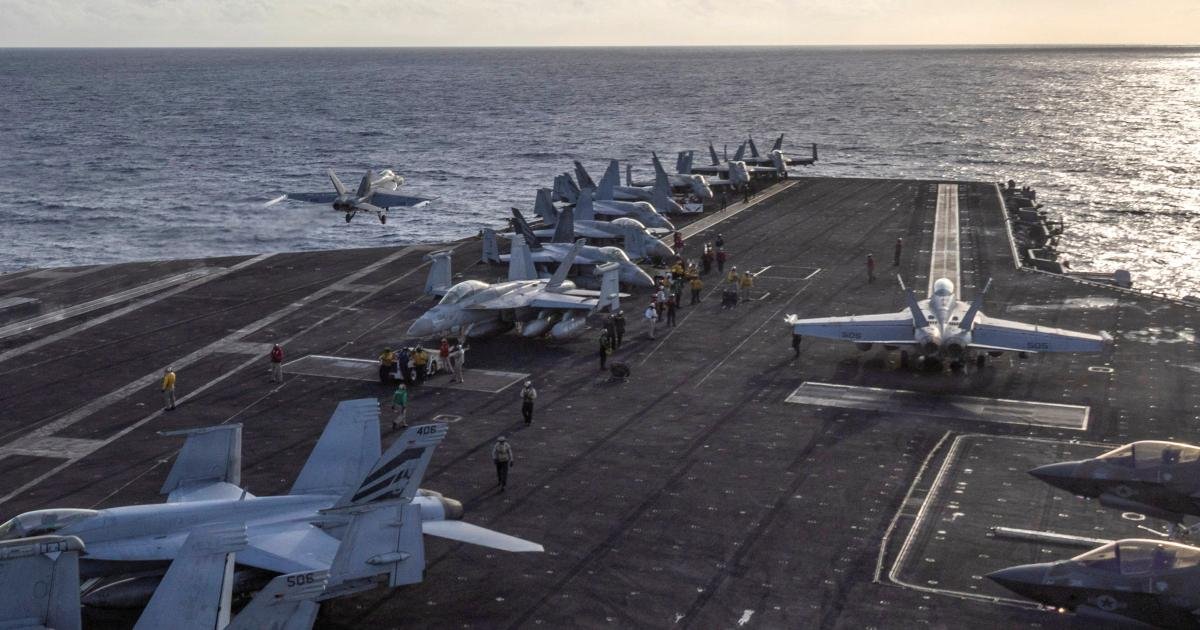
On October 8, the USS Abraham Lincoln and its accompanying strike group returned to the United States after 320 days at sea. The deployment—a near record for the modern American military—had become controversial. As the group’s ships went month after month without a port call, conditions deteriorated precipitously. Sailors reported supply shortages, plumbing issues, and water contamination. Morale dropped markedly; eight sailors even tried to commit suicide. By the time the ships finally left the Middle East, their struggles had made headlines across the country.
The travails of the Lincoln are hardly the only story about the U.S. military to generate alarm since the war in Iran began last February. Military analysts have expressed concern about other carrier groups’ lengthy deployments. They have fretted about the Trump administration’s decision to pull soldiers and weapons stationed in the Indo-Pacific out of the region and position them in the Middle East. Perhaps most of all, they have worried as the United States drains its stockpile of sophisticated munitions.
These problems all share the same root cause: the U.S. military is not built for the near-constant use it has experienced for decades. Ever since the Cold War, American defense planners have structured the U.S. armed forces to be ready to fight two major conflicts simultaneously. In practice, that means Washington has constructed a force that is designed to win short, sharp wars. For that reason, the military does not have enough units, weapons, or personnel to handle never-ending conflicts and simultaneously use its forces around the world to coerce enemies and reassure partners.
American officials are now trying to modestly increase the size of the military. More important, they are hoping that huge infusions of money will increase the capability of the existing armed forces. But making these changes will be exceptionally challenging—and they are unnecessary. The United States is a highly secure country with many capable and wealthy partners. It does not need a defense apparatus capable of fighting everywhere all at once. Instead, it would be much better off focusing its attention on a smaller set of issues and scaling down accordingly.
STRETCHED THIN
The U.S. nonnuclear forces, which consume more than 80 percent of the defense budget, are structured and sized for particular contingencies—currently, a clash with China, Russia, or both nearly simultaneously. The military’s weapons are therefore designed for maximum lethality and survivability in what military planners expect to be an unbelievably dangerous environment. To that end, the Pentagon has emphasized purchasing precise, long-range, and stealthy weapons. These are supposed to kick open the doors of enemy defenses and allow other expensive advanced platforms, such as F-35 fighter jets or B-2 or B-21 bombers, to deliver large quantities of slightly less sophisticated but still quite lethal precision weapons.
Washington has never expected these wars to last long. Instead, it imagines that under the fierce pressure such conflicts would generate, the adversary will cry uncle or the war will escalate to nuclear threats or—worse yet—nuclear use. During the Cold War, for example, the United States and its allies planned for an extremely intense, roughly 30-day conflict against the Soviet Union. Today’s military planners have probably made similar assumptions about a war with Beijing or Moscow. Highly capable conventional forces and the risk of nuclear escalation, American thinking goes, should deter an attack. If deterrence fails, U.S. planners hope to stop an enemy in its tracks and create escalation risks so great that the adversary will realize its errors and try to reverse course.
But such thinking means that Washington does not have enough resources to sustain long, great-power conflicts. At $100 million each, the F-35 fighter aircraft, a mainstay of the air force, navy, and Marine Corps, is simply not designed for mass production. Neither are the long-range stand-off missiles that would be the preferred munitions in the early days of such a war. The U.S. military has developed sophisticated theater ballistic missile defenses, but their main purpose is to defend U.S. forces and essential military infrastructure—not towns, cities, and civilian industries. They can be used for this purpose under certain conditions, but doing so quickly exhausts the supply of missiles. In a war with China or Russia, civilians in local, allied countries will need to look after themselves.
These problems have become readily apparent in Washington’s war against Iran. The United States likely thought it could rapidly overpower the Islamic Republic—at best a middle power, albeit one with great ambitions. After all, under the right circumstances, the U.S. military handily overmatches these kinds of enemies, as it did Iraq in the 1990–91 Gulf War. But Washington’s enemies have smartened up since then. They no longer simply produce smaller and less capable versions of the great-power militaries that American forces are designed to deter and combat. Instead, they have prepared themselves to take a beating and keep on fighting, even if at modest levels of effectiveness.
OVERPROMISE AND UNDERDELIVER
Overly ambitious war plans and faulty policies are not the only reason the U.S. military is struggling. Politics is also creating difficulties. Because the American people hesitate to support wars abroad, U.S. politicians will do anything to avoid casualties. That means they take all the high-end weaponry that the military stockpiles to break down great-power defenses and instead spend it profligately on regional conflicts. Similarly, they deploy scarce air defense weapons to protect allies’ towns and cities, lest those allies consider finding new partners or decide to settle a war by compromising with their enemies.
U.S. policymakers also generally overuse the military. Politicians like to accompany diplomatic messaging with action, in part because they do not believe in diplomacy anymore, which pushes them to parade or use the armed forces far more often than is warranted. When asked to act, commanders usually salute and say yes. Others simply cannot sit still. Commanders, after all, took on their roles because they wanted to command something.
The result is a worn-down military. The defense press is full of stories about ships and aircraft that are not up to standard because they have been out too long, resulting in deferred maintenance. This, in turn, creates repair problems for other units. When a ship must stay in dry dock longer than usual to receive adequate repairs, other ships must wait longer for servicing—which means their needs also grow. Ultimately, the navy has fewer fully ready combat ships available in the event of a great-power challenge. The army has similar problems, with combat and support vehicles arriving at maintenance depots in unexpectedly poor condition. In the air force, the F-35’s “full mission capable rate,” which was never great, has deteriorated from 38 percent to 25 percent since 2021. And the overall readiness of air force aircraft has declined in recent years, in part simply because of overwork.
All the while, U.S. soldiers, sailors, pilots, and marines are constantly on guard, coercing and deterring U.S. enemies and reassuring allies. This, too, creates high levels of activity that can negatively affect retention. Although the military has generally been successful at retaining senior enlisted personnel in recent years, it may soon run into difficulty. Since 2024, navy warships have repeatedly gone to sea undercrewed. The ultimate result of this overuse is that the sharp edge of the military is dulled, and the steel blade is weakened.
FIT FOR PURPOSE
U.S. defense officials are aware that they have a problem. Currently, they are trying to solve it by building a somewhat bigger and far more technologically capable military. Congress, for example, appears poised to increase the Pentagon’s so-called base budget—which encompasses what the Congressional Budget Office defines as the “enduring costs of manning, training, and equipping the military”—by over 25 percent, or to $1.1 trillion for the 2027 fiscal year. The Pentagon hopes to secure an additional $350 billion over the base budget in a subsequent bill. Defense officials also want to add over 40,000 new service members. But this is, at best, a personnel increase of three percent, which is much too small to fill the additional units needed to solve extant readiness problems. And the fancier weapons Congress hopes defense officials will buy cannot overcome the strain of constant deployments and repeated wars. The defense industrial base is barely keeping up with current demands, and recruiting large numbers of new service members would likely require offering much higher wages, which would then need to be extended to everyone else. Personnel costs would start consuming an ever-greater share of the defense budget. U.S. officials could instead opt for conscription, but that would produce a backlash.
There is, however, an alternative: scaling down. Instead of pretending that it must be able to fight two great-power wars at once, Washington should cut its policy coat to fit the available cloth. It should continue to build forces for major contingencies, such as deterring adventurism by China. But policymakers should agree to slow down other projects. Congress should task the Pentagon with reviewing the armed forces and come up with an activity budget, which would be based on an assessment of how much real military activity—flying hours, ship days at sea, training days in the field—can be undertaken without harming the readiness of the total force. It would then allocate that activity appropriately. Based on what they ought to know about the virtual attrition the military has suffered thanks to 30 years of hyperactivity, commanders should determine what level of exercises, forward deployments, and regional wars the military can actually support without doing damage to the capabilities it wishes to have ready every day to deter a great-power war and, if need be, wage one effectively. The U.S. Navy already knows the activity level that its fleet can support, which it has detailed in its Optimized Fleet Response Plan. But American presidents and defense secretaries have simply ignored this plan whenever they wanted to deploy more forces.
The activity budget should not be classified but instead should be public information, listed along with the dollar budget that the Pentagon publishes annually, voluminous summaries of which can be found at the Defense Department’s comptroller’s website. When politicians want to exceed the activity levels on which they have previously agreed, they should have to explain why and how they plan to repair the force after intense use. Commanders should think of this as an ethical issue. Every now and then, one should resign when overuse causes serious problems.
Washington should cut its policy coat to fit the available cloth.
To help lighten its load, Washington will need to hand off some responsibilities to others. This should be feasible despite the need to manage Moscow’s aggressive impulses, which are the presumed cause of one of the contingencies—a war with Russia—that drives U.S. defense planning. The principal European states have more than enough economic and technological resources to deal with Russia on their own, if they so choose. The transatlantic bargain should thus be more forthright about the limited liability that the United States is prepared to assume for the continent’s defense.
The National Defense Strategy of the Trump administration is honest about this fact, but U.S. military activity levels and deployments in Europe suggest that the United States has not truly reduced its role in Europe’s defense. The supreme allied commander of NATO is still an American, when the position should be filled by a European. Tens of thousands of U.S. troops are still based all over Europe; many should come home. Pentagon websites and those of American commands in Europe feature laundry lists of exercises and maneuvers across the continent that involve not only forward-based U.S. forces but also rotating deployments of units based in the United States. These numbers, too, should diminish.
American officials may want to be able to solve most of their global security challenges by simply buying more forces. But a much better solution is for the United States to change its grand strategy and act with greater restraint. Washington simply does not have the will or the resources to provide for both Asia’s and Europe’s defense while fighting protracted conflicts elsewhere, most recently in the Middle East. Nor, for that matter, does it need to. The United States is inherently a very secure country. It is rich, endowed with bountiful natural resources, insulated by vast oceans, and blessed with relatively weak and pliant neighbors. Only huge changes in the political constellation of power in Asia, Europe, or the greater Middle East could seriously affect U.S. security.
Washington should buy sufficient military power and stock adequate reserves of raw materials to ensure against such changes. But in general, it can afford to be less proactive. A change in grand strategy might even allow the United States to cut the defense budget. If concerns about the ballooning U.S. deficits are correct, then the Pentagon will need to help pay the bills to set things right.
Loading…
