

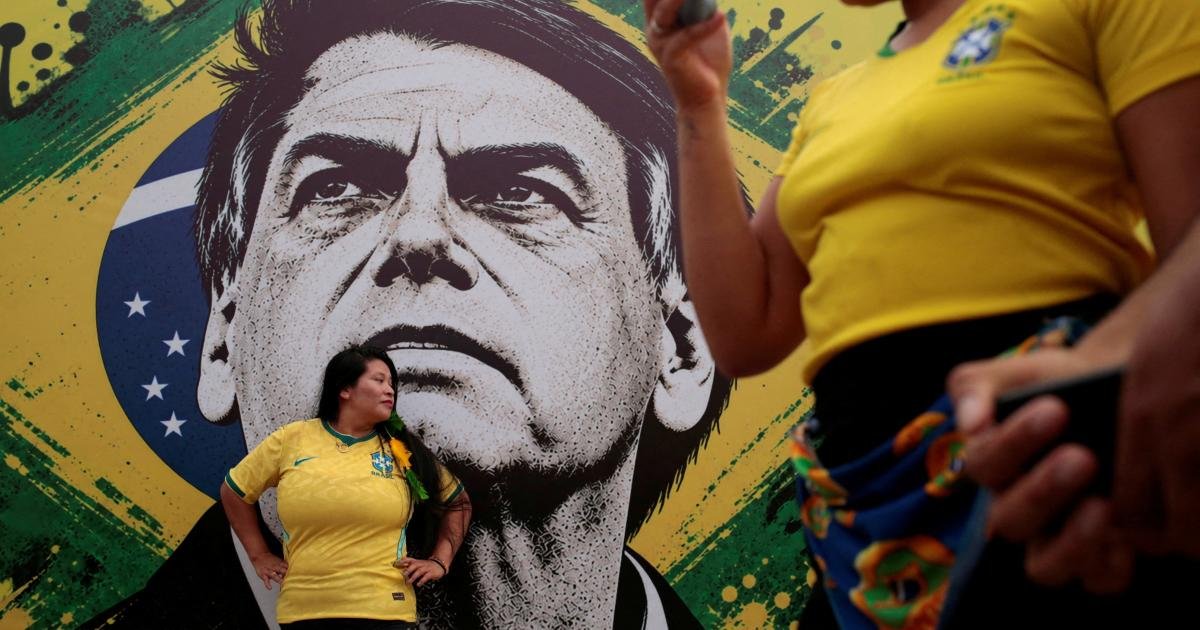
On October 5, the day after the first round of Brazil’s general elections, the country’s financial markets were euphoric. Brazil is struggling with high debt and low growth, and investors are eager for leaders to reduce budget deficits, deregulate, cut taxes, and perhaps even privatize state assets. After nearly four years under the left-wing President Luiz Inácio Lula da Silva, known as Lula, who has been slow to implement such measures, investors hope a right-wing government will create opportunities for bold reform.
Rule by the right might be exactly what Brazil gets. The far-right Liberal Party made substantial gains in the legislature, becoming the single largest party in both the Senate and the Chamber of Deputies. Its presidential candidate, Flávio Bolsonaro, the son of the notorious former President Jair Bolsonaro, led the aging incumbent, Lula, by nearly two percentage points in the first round of voting. Lula has shown himself capable of impressive political comebacks, but Flávio Bolsonaro is still the favorite in the runoff vote scheduled for October 25.
Even if Bolsonaro wins, however, the prospects for the Brazilian economy are dim. The policies he has put forward are nothing close to the substantial fiscal consolidation program that will be necessary to bring down debt and stimulate private investment, and his determination to weaken Brazil’s political institutions creates the kind of uncertainty that scares investors away. Economic growth has been sluggish under Lula, whose administration has struggled to relieve the high debt burdens afflicting the public sector and households. What would truly doom the country to economic crisis, however, is the kind of authoritarian-inspired politics that a Bolsonaro government could usher in.
CRISIS IN THE MAKING
Brazil is in serious economic trouble. The country’s sovereign debt ratio has ballooned to 83 percent of GDP, fiscal deficits leave no room for additional government spending, and high interest rates are hurting consumers and investors. Meanwhile, the Iran war has raised the price of fuel and other goods, weighing on household balance sheets already strained by high debt and leaving many Brazilians desperate for leaders who can alleviate their daily hardships.
This predicament is years in the making. Before Jair Bolsonaro was elected in 2018, his predecessor, President Michel Temer, enacted a cap on public spending to contain Brazil’s runaway fiscal problems. Temer introduced the cap as a constitutional amendment to prevent future governments from changing the spending ceiling to suit their needs. Yet Jair Bolsonaro raised the cap several times anyway, which required convincing Congress to amend the constitution. In return, the executive branch effectively ceded control of the budgetary process to the legislature.
Lula therefore inherited a system in which he had little room for fiscal adjustment, and he made few attempts to fix the problem during his term. The result was high budget deficits and persistent inflation, which forced the central bank to raise interest rates substantially. In turn, high interest rates damaged household balance sheets and lowered overall investment and growth.
PROMISES, PROMISES
If Lula were reelected, he would find it incredibly difficult to introduce new fiscal reforms and other measures to support growth. He promised to reduce spending and has proposed a comprehensive overhaul of Brazil’s tax system, which would help increase the budget surplus and reduce public debt. Yet Bolsonaro’s Liberal Party and its allies now hold a majority of seats in the Senate and the Chamber of Deputies, allowing them to block any legislation Lula might pursue.
Yet it is overly optimistic, if not completely unrealistic, to expect that Bolsonaro would fare better. Neither candidate has provided much detail during the campaign about what he would do to fix the economy. Bolsonaro has instead spoken often about “institutional reforms,” which he has said would include amending Brazil’s 38-year-old constitution to make existing labor and environmental regulations more flexible, among other changes; meddling with the Supreme Court; and granting amnesty to his father, who is serving a prison sentence for leading a 2023 coup attempt. Those steps are likely to drive away investors because stable institutions are necessary for an economy to function well. A government that undermines the judicial system and the constitution will compromise the integrity of its economic policies, no matter what those policies are or how good the reputations of the officials making them may be.
Gathering support for such an overhaul of the country’s political institutions, moreover, would require compromises that could worsen Brazil’s economic troubles. To secure enough votes in Congress to advance Bolsonaro’s priorities—for example, two-thirds of the Senate would need to approve the removal of a Supreme Court justice, and three-fifths of both houses must approve a constitutional amendment—the government would have to bring legislators outside its coalition on board. Those politicians would almost certainly demand substantial funds for their constituencies in exchange for their support, adding to the budget deficit.
Bolsonaro’s far-right movement will also be focused on holding together its recently formed coalition of governors, mayors, and voters. Much of its constituency is lower-middle-class Brazilians who rose out of poverty during the boom years two decades ago, while Lula was serving his first two terms in office. After seeing their income growth stagnate in the years since, these voters have turned to the Liberal Party, but their loyalty is new. Most are self-employed and face economic precarity. Both Bolsonaro and Lula are now trying to appeal to these voters by promising initiatives that boost income and offer household debt relief, but delivering such programs—if it is even possible—would only exacerbate Brazil’s economic woes.
A decisive turn toward illiberalism would all but assure economic disaster.
What Bolsonaro has shared about his economic policies does not inspire much confidence, either. His party has said it would reduce government spending by $40 billion, or 1.5 percent of GDP, and deliver primary budget surpluses—a measure of the budget balance that does not include interest payments. But it has not explained how it would accomplish this, nor has Bolsonaro elaborated on his vague plans for controlling the rise in public debt. Ultimately, it is unlikely that Bolsonaro can deliver on any of these promises, especially if he keeps his pledge not to cut pensions and key social programs.
Part of the problem is that the Liberal Party’s economic program lacks a viable plan for reducing costs. It proposes eliminating at least ten government ministries but has no estimate of the resulting cost savings. When Jair Bolsonaro took similar steps after he assumed office in 2019, removing cabinet positions and laying off public servants, those moves had little effect on fiscal outcomes. Other promised measures include reducing Brazil’s value-added tax, phasing out a tax on financial transactions, lowering taxes on electricity and fuel, spending $180 billion on infrastructure over four years, and building 2.5 million new homes. None of them would fix Brazil’s fiscal problems; they would only make those problems worse.
The same goes for the rest of Flávio Bolsonaro’s tax plan. His economic advisers have said they intend to reverse every tax created or raised under Lula’s finance minister, Fernando Haddad. Haddad’s tax increases were intended to shift the tax burden to high-income brackets, raise government revenue, and reduce inequalities in the tax system. These taxes have contributed to a modest increase in revenue but fell short of delivering budgetary surpluses. Bolsonaro has argued that the measures are impeding investment because they tax higher income brackets more heavily, but there is no evidence to support this idea. Instead, repealing all these tax increases would worsen Brazil’s fiscal situation. A simple calculation shows that Brazil needs to increase its primary budget balance by about six percent of GDP, either through increased revenue or decreased spending (or both), to keep its debt from rising further. That adjustment would have to be spread over at least three years, giving indebted households and firms time to change their consumption and investment patterns, to avoid a recession. Slashing taxes, however, would reduce government revenues, raising the debt.
Brazil’s high interest rates are another constraint. The central bank’s current rate is 13.75 percent, astronomical by Latin American standards, dictating interest rates everywhere in the economy. Public debt service payments alone consume some 8.7 percent of GDP. Bolsonaro would not be able to lower interest rates significantly without sparking a recession, so he would face the same problem that has plagued Lula during his latest term—few good options for containing a rapidly growing debt.
AUTHORITARIAN ECONOMICS
Neither Lula nor Bolsonaro is well positioned to solve Brazil’s economic problems. A decisive turn toward illiberalism under Bolsonaro, however, would all but assure economic disaster.
Flávio Bolsonaro has never disavowed his father’s championing of Brazil’s dictatorship, which lasted from 1964 to 1985, and his Liberal Party traces its lineage to the party that sustained the military regime. Moreover, he has pledged to release his father and his father’s associates who are in prison for staging an insurrection and a coup attempt in 2023. Flávio’s brother Eduardo Bolsonaro, a former member of Brazil’s Congress who would likely play a significant role in his brother’s government, has openly expressed his admiration for Viktor Orban’s illiberal regime in Hungary, claiming a desire to learn the “best practices” of a movement that rewrote Hungary’s constitution, reshaped its courts, silenced its press, and deployed other overtly authoritarian tactics. And the substantial far-right bloc in Brazil’s Congress supports policies to undermine institutions, including by impeaching members of the Supreme Court—a step these parties advocated even before corruption allegations emerged against several of the court’s justices. (Flávio Bolsonaro is also under investigation for his involvement in the same corruption scandal.)
Although Brazil is not at risk of returning to military rule, the former authoritarian regime serves as a warning of what could happen if a Bolsonaro administration follows its illiberal inclinations to their logical conclusion. During those two decades of military dictatorship, Brazil spent at unsustainable levels, mostly funding state enterprises, to preserve the regime’s hold on power. The country defaulted on its public debt, endured corrosive hyperinflation, and saw income inequality skyrocket. Six economic stabilization plans failed and growth stagnated. Brazil is not alone in this experience. No Latin American country that swung from democracy to authoritarian rule in the past century has benefited economically from the shift. Countries elsewhere in the world that prospered after such a transition, including some in East Asia, became less authoritarian during their economic ascent.
Brazil’s rightward shift fits a regional pattern. The common thread that unites Brazil with Argentina, Chile, and Colombia is the crude libertarian worldview that each of their far-right movements espouse. All of them talk about citizens becoming entrepreneurs free of the state. They tell voters who have unstable employment and little economic security that their policies will bring prosperity. But their populism rarely wins the confidence of investors. Like its peers, when the Brazilian far right says it can overcome the country’s substantial problems with institutional demolition and a threadbare economic agenda, what it really offers is empty promises.
Loading…
