

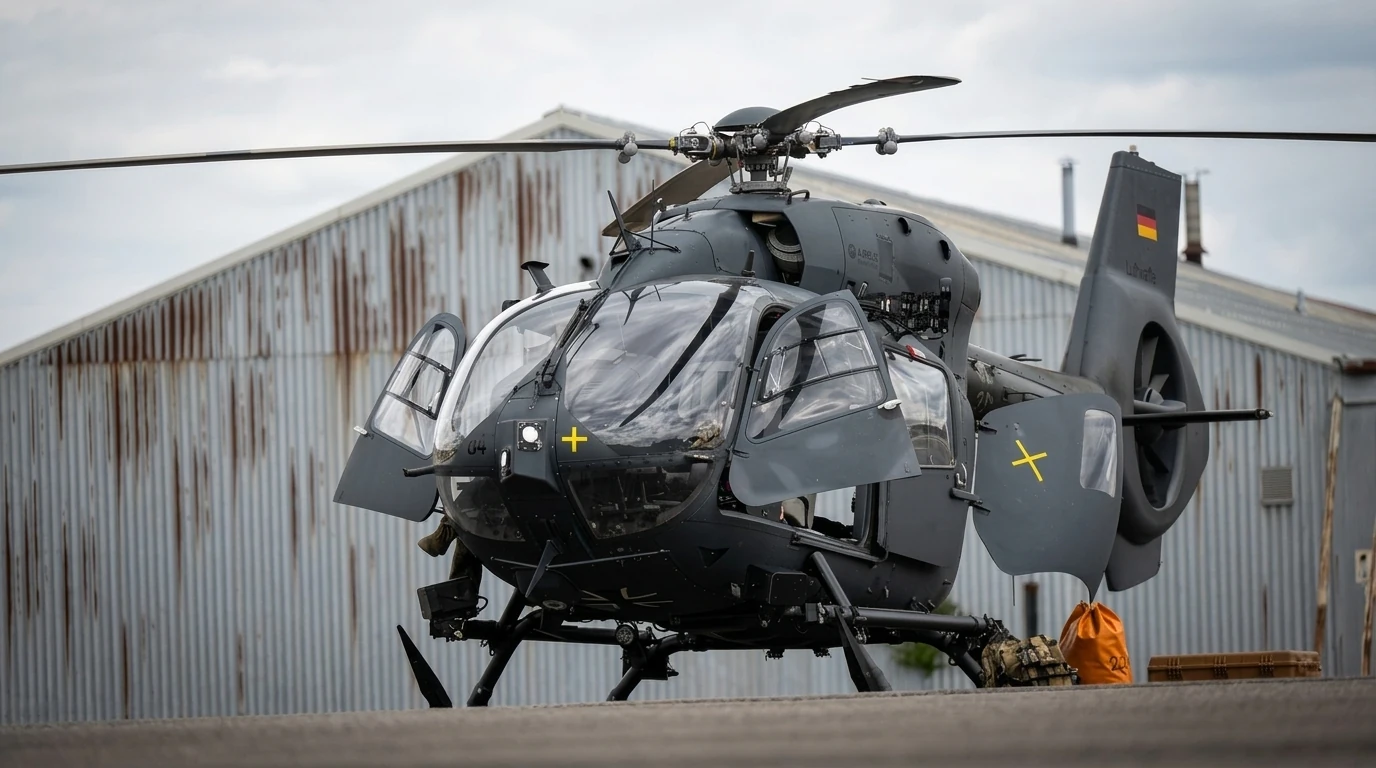
Europe doesn’t need every military helicopter to be an Apache-sized gunship. Sometimes, a smaller aircraft that can carry troops, scout ahead, and support armed missions makes more sense. That’s where the Airbus H145M is gaining attention.
Germany has become a major driver of this trend. Its expanded order for 82 Airbus H145M helicopters shows how seriously the country is investing in light military aviation.
Belgium has also increased its order, while Brunei is preparing to receive its first aircraft. These purchases point to growing interest in a helicopter that can handle several jobs without requiring a different platform for each one.
The Airbus H145M’s appeal comes from its mix of size, flexibility, and available mission equipment. It can support special operations, armed reconnaissance, light attack, and transport duties. Its modular design also lets operators tailor aircraft to different tasks, rather than treating every helicopter as a dedicated gunship.
But the growing order book shouldn’t be mistaken for proof that the Airbus H145M can replace heavier attack helicopters. A light helicopter has limits in payload, protection, and the threats it can face. Those limits matter when planners decide where to send it.
The real story is how European forces are building up their helicopter fleets. The Airbus H145M offers a flexible option for missions that don’t always justify a larger, more costly combat aircraft. Whether it delivers the right balance depends on the mission, the weapons fitted, and the threat in the area.
Airbus H145M Specifications, Speed, Range, and Payload
The Airbus H145M trades heavy firepower for a compact airframe that can carry troops, equipment, and mission systems without needing a large helicopter. Its published figures explain why it appeals to forces seeking a flexible aircraft for light combat and support missions.
Airbus lists a maximum takeoff weight of 3,800 kilograms and a useful load of 1,893 kilograms. That useful load covers what the aircraft can carry beyond its basic empty weight, including fuel, crew, passengers, and mission equipment. It isn’t the same as the weight of cargo or weapons alone.
| Specification | Airbus H145M |
| Engines | 2 × Safran Arriel 2E turboshafts |
| Maximum takeoff weight | 3,800 kg |
| Useful load | 1,893 kg |
| Fast cruise speed | 241 km/h (130 knots) |
| Maximum range, standard fuel | 637 km (344 nautical miles) |
| Maximum endurance, standard fuel | 3 hours 30 minutes |
| Maximum seating | 2 crew plus up to 10 passengers |
| Maximum sling load | 1,600 kg |
| Main roles | Armed scout, attack, utility, special operations |
The range figure needs context. Airbus quotes 637 kilometers with standard fuel tanks, but that isn’t a guarantee of combat radius. A helicopter carrying extra equipment, operating at low altitude, or spending time in a hover won’t necessarily achieve the same distance. Add weapons, external loads, or reserve fuel requirements, and the mission profile changes again.
Payload works the same way. The Airbus H145M can carry up to ten troops in a suitable configuration, but that doesn’t mean it can carry ten fully equipped soldiers, a full weapons fit, extra fuel, and every optional protection system at once. Aircraft performance depends on the actual load and conditions.
Its twin engines provide another practical advantage. They offer redundancy if one engine fails, although the aircraft’s ability to continue safely depends on weight, altitude, temperature, and flight conditions. That matters in hot weather or at higher elevations, where rotorcraft performance can fall sharply.
Read also: UH‑72 Lakota: Why the Army Still Needs This Helicopter
The numbers show the Airbus H145M’s niche. It can move people and equipment quickly, but its real value comes from matching the load and mission to the aircraft’s limits.
How Does the Airbus H145M’s HForce Weapons System Work?
The Airbus H145M can become an armed helicopter without being built solely for attack missions. Its HForce system lets operators add weapons and targeting equipment to suit the task, giving a relatively light aircraft more options on the battlefield.
HForce is more than a set of weapon mounts. It combines a mission computer, weapon controls, aiming systems, and compatible armaments. The system helps the crew aim and fire while accounting for factors that affect accuracy, including aircraft movement and the position of the weapon.
The available equipment can include different types of guns and rockets, with guided weapons supported in suitable configurations. Airbus has also demonstrated the Airbus H145M with a 12.7 mm machine gun pod, a 20 mm cannon, and unguided rockets. An electro-optical targeting system can help the crew identify and track targets, while a helmet-mounted sight lets a pilot aim by looking toward a target.

HForce is modular, so not every Airbus H145M carries the same weapons. Airbus describes different capability levels, from a helicopter prepared for later weapon installation to configurations equipped for armed scouting or light attack. Guided weapons require the relevant targeting equipment and integration, so an aircraft’s basic HForce fit doesn’t mean it can fire every weapon in the system’s catalogue.
That distinction matters when comparing military fleets. Two countries can operate the same Airbus H145M airframe but give their aircraft different combat roles. One might focus on armed reconnaissance with guns and unguided rockets, while another invests in guided weapons and more advanced targeting equipment.
The system gives the Airbus H145M useful firepower, but it doesn’t remove the limits of a light helicopter. It can’t carry the same armor, weapons load, or protection as every dedicated attack platform. HForce makes the aircraft more adaptable. It doesn’t make all configurations equal, or turn the Airbus H145M into a heavy gunship.
What Missions Can the Airbus H145M Perform?
The Airbus H145M earns its place through flexibility. A military can use it for armed scouting, special operations, troop transport, or light attack, depending on the equipment fitted. That range of tasks makes it useful when a force needs more options without buying a separate helicopter for every role.
Armed reconnaissance is one of its clearest uses. The Airbus H145M can patrol an area, help crews observe activity on the ground, and carry weapons for engagements when its mission calls for them. With suitable sensors and a compatible weapons fit, it can support ground troops while gathering information. But it shouldn’t be sent into a heavily defended area on the assumption that its small size makes it hard to hit.
Special operations place different demands on the aircraft. German forces use the Airbus H145M for special operations support, where crews may need to move small teams, insert personnel, or provide transport under tight timing and landing constraints. A compact helicopter can reach some sites that are awkward for larger aircraft, although landing space, weather, and enemy fire still shape the options.

The Airbus H145M can also handle utility and transport work. In a passenger configuration, Airbus lists space for up to ten people in addition to the two crew. It can carry supplies externally on a sling, with a published maximum load of 1,600 kilograms under suitable conditions. That capacity gives it a role in moving equipment that won’t fit inside the cabin.
Other tasks can include medical evacuation and support for security operations, depending on the operator’s equipment and procedures. The key is configuration. A helicopter set up for troop transport won’t necessarily carry the same weapons and sensors as one prepared for armed reconnaissance.
That flexibility is useful, but it has limits. The Airbus H145M can’t maximize troop space, fuel, protection, and weapons at the same time. Its value comes from choosing the right setup for the job, not pretending one aircraft can do everything equally well.
Why Is Germany Expanding Its H145M Fleet to 82 Helicopters?
Germany’s decision to order 82 Airbus H145M helicopters reflects a practical choice: build a larger fleet around a proven, light aircraft instead of relying on a small number of specialized platforms for every task.
The order began with a December 2023 contract for 62 firm aircraft and an option for 20 more. Germany exercised that option in December 2025, bringing the planned total to 82. Under the revised allocation, the German Army is set to receive 72 helicopters, while the Luftwaffe’s special forces will receive ten.
Those aircraft won’t all serve the same purpose. The Army’s Airbus H145M fleet is intended for training, reconnaissance, and light attack. The Luftwaffe’s aircraft support special operations, where crews need to move small teams and operate in demanding conditions. One family of helicopters can support both missions, but the equipment and training still need to match each role.

Germany’s choice also reflects a preference for an aircraft already in service. The Bundeswehr had experience with the Airbus H145M in special operations roles before the larger procurement began. That existing knowledge can help with pilot training, maintenance, and support, although a much larger fleet still requires new crews, spare parts, facilities, and time to reach full readiness.
The Airbus H145M should not be mistaken for a direct replacement for every German attack helicopter capability. Germany is using it as a light combat helicopter, with an emphasis on flexibility and a faster path to fielding aircraft. It can carry weapons and support ground forces, but it lacks the payload and protection of a purpose-built heavy attack platform.
The real test will be how well the aircraft performs once its crews, weapons, and support network are fully in place. An order for 82 helicopters is a clear commitment. It isn’t the same thing as having 82 combat-ready aircraft available whenever the Army needs them.
Why Are More Countries Ordering the Airbus H145M?
The Airbus H145M’s growing customer base reflects a practical demand: militaries want helicopters that can handle several roles without the cost and complexity of maintaining a separate fleet for each task. The H145M offers that flexibility, although each country’s reasons for buying it differ.
Germany is the clearest example. Its order has grown to 82 aircraft, split between Army requirements and Luftwaffe special operations. That scale shows the Airbus H145M is more than a small niche purchase. Germany intends to use it across several military functions, including training, reconnaissance, light attack, and special operations support.
Belgium has also expanded its commitment, ordering 20 Airbus H145M helicopters. Its first aircraft arrived in June 2026 as the country modernized its military helicopter fleet. The purchase gives Belgium a modern platform for tasks that range from transport and support to armed missions, depending on configuration.

Demand is not limited to Europe. Brunei has prepared to receive its first Airbus H145M aircraft, with the first delivery batch scheduled for November 2026. The purchase gives the Southeast Asian country another option for military transport and support, while showing that the helicopter’s appeal extends beyond NATO’s current rearmament efforts.
These orders shouldn’t be treated as proof that every buyer wants the same combat capability. A country focused on special operations may need different equipment from one prioritizing armed reconnaissance. The airframe provides a shared base, but mission systems, weapons, crew training, and support arrangements determine what each fleet can actually do.
The Airbus H145M’s appeal is its ability to cover a broad set of needs with one helicopter family. For countries with limited budgets or smaller forces, that can be more useful than buying a specialized attack aircraft for every armed mission. The real measure of success, however, will be how many ordered aircraft become operational, properly equipped, and ready when their forces need them.
What Are the H145M’s Strengths and Combat Limitations?
The Airbus H145M’s biggest strength is its ability to support several military missions without requiring a dedicated aircraft for each one. But that flexibility comes with a trade-off: a light helicopter cannot carry the same weapons, armor, and equipment as a purpose-built attack platform.
Its compact size helps when operating near small landing sites or moving special operations teams. The twin-engine design also provides redundancy, while the HForce system allows operators to fit weapons for armed reconnaissance and light attack. When a mission changes, crews can use different equipment configurations rather than treating every aircraft as a single-purpose gunship.

Germany’s planned fleet of 82 aircraft shows the appeal of this approach. The Army can use the Airbus H145M for training, reconnaissance, and light attack, while the Luftwaffe can assign aircraft to special operations. This gives the military a common helicopter family for distinct tasks, although each role still requires trained crews, suitable equipment, and reliable maintenance support.
The limits become clearer in combat. The Airbus H145M’s maximum takeoff weight is 3,800 kilograms, which restricts how much fuel, ammunition, armor, and mission equipment it can carry together. A helicopter configured for a long flight may have less room for weapons. One carrying extra equipment may need to trade away range or passenger capacity.
Survivability is another concern. The Airbus H145M can support armed missions, but that doesn’t make it suited to every contested airspace. Modern air defenses can threaten low-flying helicopters, and a light airframe cannot match the protection of every dedicated attack aircraft. Mission planning, intelligence, terrain, and threat suppression remain critical.
The Airbus H145M makes the strongest case when commanders use it for the jobs it was designed to perform: moving small teams, scouting, and providing light armed support.
It can add useful capacity to Europe’s helicopter fleets, but it should complement heavier combat platforms rather than replace them by default. Its success will depend on how well each operator matches the aircraft’s configuration to the mission and threat.
