

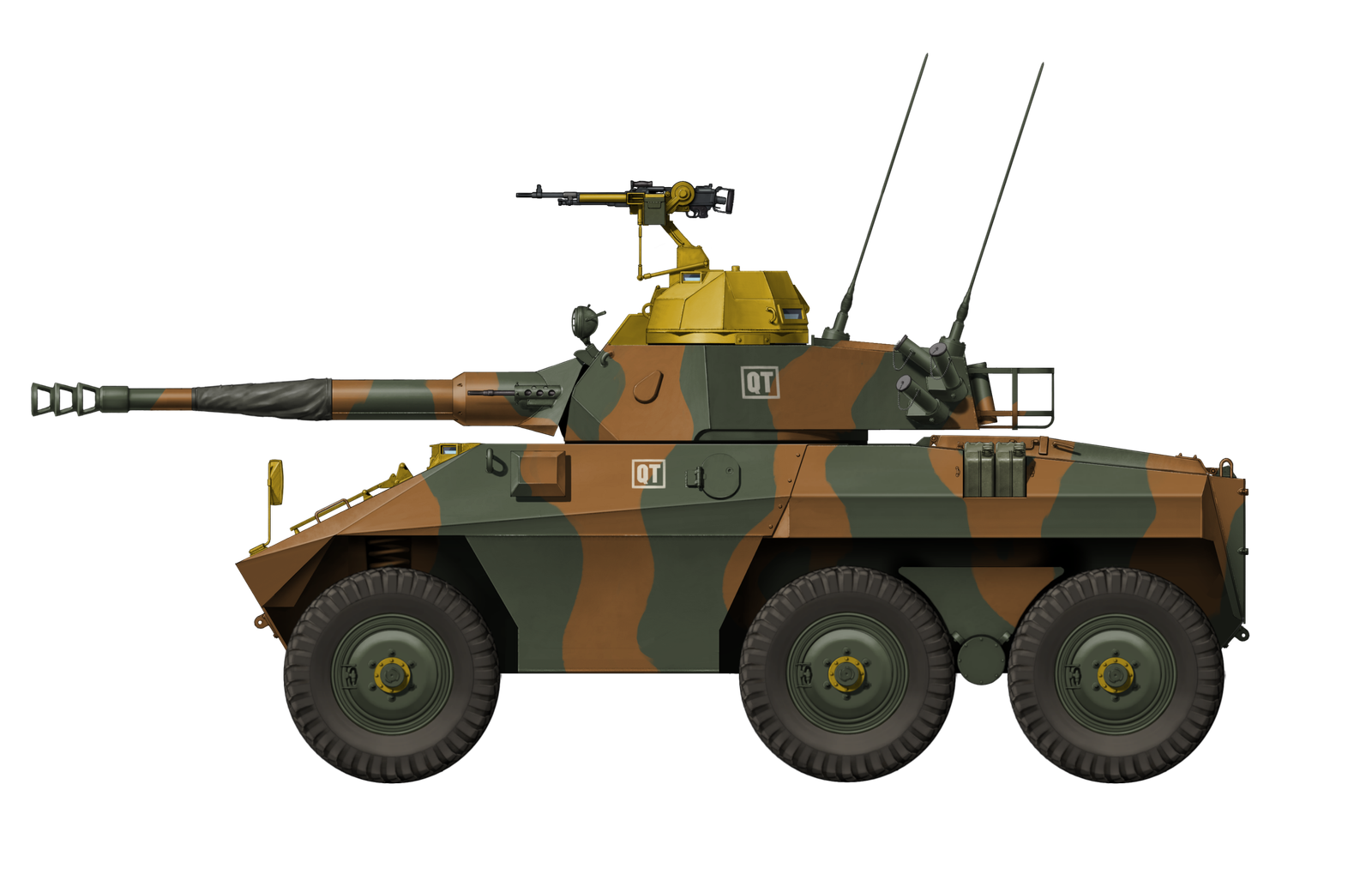
Federative Republic of Brazil (1996-1998)
Wheeled Reconnaissance Vehicle and Armoured Personnel Carrier – 1 Prototype each Built
With the collapse of Engesa in 1993, the Brazilian Army started worrying about the spare part situation for its roughly 640 EE-9 Cascavel and EE-11 Urutu vehicle fleet. To counter this and to better standardize and modernize its vehicles back to relevancy, the Army started a working group. With the goal of increasing the lifespan by another 15 years, two prototypes were made, one of each vehicle. The very first modernization attempt of the Brazilian EE-9s and EE-11s brought them up to spec with the most modern offered EE-9 by Engesa when it was still in business, including a number of upgrades to the fire-control system. However, some issues during testing and a limited budget meant the project would go nowhere.

Source: Projeto Fênix: Lições Aprendidas-Guilherme Eduardo da Cunha Barbosa

🔥What’s inside?
✔ All 12 issues in one bundle
✔ Available in PDF and EPUB formats
✔ Enjoy instant access to articles prepared by our team of dedicated writers and illustrators, covering the history of armoured vehicles from the 19th century to the present day, in-depth armored warfare analysis, rare vehicles, prototypes, and much more.
👉 Visit our online store and grab your bundle for only $46, and save $12 off the regular price of $57.89!
The EE-9 Cascavel
The story of why the EE-9 Cascavel (English: Rattlesnake) was developed can be traced back to the Second World War. Brazil sent an expeditionary force, known as the ‘Smoking Snakes’, to fight in Italy alongside the Allies. During the Italian campaign, the Brazilian forces were equipped with the 6-wheeled M8 Greyhound armored car. The Greyhound turned into a beloved vehicle for the Brazilian soldiers for its armor, simplicity and mobility, and after WW2, this love would remain embedded in the Brazilian Army.

Source:
Although Brazil enjoyed good diplomatic relations with the United States well into the 1970s, the first steps to break free from the United States, from an army materiel point of view, started in 1967. The United States had become increasingly involved with the Vietnam War, and, as a result, could not supply Brazil with the cheap equipment it once did. As such, it was decided that the Brazilian Army would instead try to develop their own armored vehicles.
One of these was the EE-9 Cascavel, which was passed on to Engesa for production after the Army had developed a number of prototypes. The EE-9 was a 6 x 6 wheeled vehicle initially armed with a 37 mm, but would be armed with a 90 mm on suggestion of the Portuguese. While being the spiritual successor of the M8 Greyhound, two of the main innovations of the EE-9 were the usage of the Boomerang suspension, which enabled it to cross much more difficult terrain, and the incorporation of bimetallic armor, which offered improved protection over homogenous steel. Engesa managed to secure an export deal with Libya for 200 EE-9s in 1974, and, soon after, would receive an order for an additional 200 vehicles. From there, the EE-9 became Engesa’s flagship product, as they would sell it to multiple South American states as well.
The use of the EE-9 Cascavel by Libya and its export success managed to get the attention of Iraq. After three weeks of negotiations, Engesa managed to secure the export contract for 364 EE-9s and 148 EE-11s on May 5th 1978. Iraq would be the first to receive a new model of EE-9, known as the EE-9 M4. In contrast to previous models, the EE-9 M4 used an MT-643 transmission which could handle the more powerful Detroit Diesel 6V53 212 hp engine. In addition, the hull featured a number of redesigns, like the integration of the headlights in the lower hull plate instead of the installation on top of the upper front plate. The most significant change was the redesigned ET-90 turret, known as ET-90 II, which was able to incorporate night vision sights.

Source: Brazilian Engesa EE-9 Cascavel 6×6 at war 1977-2020
The EE-11 Urutu
The Urutu was Engesa’s armored troop transport, designed in collaboration with the Brazilian Navy. The vehicle was designed from the ground up to be amphibious, and was approved in 1972 after successful testing in various conditions, including open sea, for which it was modified with multiple snorkels, propellers, and a wave breaker.
Pre-production began in 1973, using the same Boomerang suspension, engine, and transmission as the EE-9 Cascavel. This vehicle managed to achieve large sales in Iraq, Libya, and most of South America, but the Urutu would never reach the same success as the Cascavel. Both the Cascavel and Urutu were upgraded throughout their production runs with different engines, transmissions, and brakes, as well as different hull designs. The Urutu was operated by a driver and commander, and could carry 10+2 fully-equipped infantrymen.
In addition, it could be equipped with a multitude of different turrets, including a redesigned Cascavel turret. The Anti-Aircraft Urutu, for instance, was made by mounting a twin 20 mm autocannon armed turret with a radar. Apart from the turrets, the Urutu could also receive various optional components, like an automatic fire suppression system, amphibious equipment, and nuclear, biological, chemical (NBC) protection, all at the client’s discretion.

Source: Angelo Meliani
The Fall of Engesa and its Consequences
One of the most significant moments in the history of the Brazilian defence industry was the bankruptcy and subsequent closing of the company Engesa. Engesa had been the most well known defence company, manufacturing the EE-9 Cascavel, EE-11 Urutu, and developing the EE-T1 Osório Main Battle Tank. Due to overreliance on Iraq as its main customer, general mismanagement of money and the reasonably expensive development of the Osório (about US$150 million), Engesa filed for bankruptcy virtually the moment it became public that Saudi Arabia would buy the M1A1 Abrams and not the Osório.

Source:
Subsequent attempts to save the company from bankruptcy would also fall through, as the total debt of the company had reached US$600 million by 1993. After having been life-lined since 1985, with one-third of the company owned by a government in the middle of Brazil’s worst financial crisis and with no improvement in sight for the company in sales perspectives, there was simply no viable alternative than pulling the plug.
This would however create a number of long-term issues. Engesa had manufactured and provided the maintenance and spare parts supplies for 1,738 EE-9 Cascavels and 888 EE-11 Urutus, of which 415 Cascavels and 230 Urutus were in service with the Brazilian Armed Forces, with 6 EE-9 M4s used by the Brazilian Marine Corps. While the spare part supplies were bought up during the bankruptcy auctions by legacy companies, such as Universal and Columbus, some components were simply not manufactured anymore. An excellent example was the end of the production of bullet proof tyres, which caused a tyre shortage when the Brazilian Army sent just 16 vehicles to join the UNAVEM III mission (3rd United Nations Verification Mission in Angola). This led to cannibalizing tyres from other Engesa vehicles until the Brazilian Army switched over to locally manufactured truck tyres, like the Colombians before them.
Standardization and Modernization
As such, with the demise of Engesa, but also the improved financial situation of the country in 1994-1995 when it stabilized from the Latin American Debt Crisis, the Brazilian Army initiated a number of projects to modernize and overhaul its Armed Forces. These would include, among others: the acquisition of cheap tanks (as the acquisition budget was still fairly limited); the first steps towards the Guarani program; and the attempt to standardize and modernize the EE-9 and EE-11 fleet.
At the time, the Brazilian Army had 157 old EE-9 M2 Cascavels manufactured from 1976 to 1981, 37 EE-9 M6s manufactured in 1982 and 215 EE-9 M7 Cascavels manufactured from 1983 until 1988. While the M6 fleet was about 80% similar to the M7 fleet, the EE-9 M2 fleet still had a manual transmission, drum brakes and dual voltage systems, among other missing components. The EE-11 fleet was fairly similar, with the 20 EE-11 M5 and the 45 EE-11 M7 being fairly similar to each other, but with 155 EE-11 M2 having the same differences as the EE-9 M2, but with a Mercedes manual transmission instead of a Clark. The difference in components would further complicate logistics, although the Brazilian Army was perhaps somewhat saved by the simple yet reliable nature of the Engesa vehicles.

Source: Author’s collection and
In addition, the Brazilian Army had bought the most barebones EE-9 Cascavels one could buy. With no laser rangefinders (with the exception of a handful), no passive day/night sights, and not the best engine option, the Brazilian vehicles are among the worst EE-9s in service worldwide. With that, a modernization would have significantly boosted the relevance and longevity of the platform on the South American continent, bringing them up to acceptable modern standards of AFVs.

Source: Janes Armour & Artillery Upgrades 1995-1996
As a result, the Grupo de Trabalho – Viabilidade Técnica da Modernização de Urutu e Cascavel (GT-VTMUC, Working Group-Technical Viability Modernizing the Urutu and Cascavel) was formed in 1996. The main objectives were to establish the differences between the various models, solve the spare part and standardization problems and obtain a service life extension of 15 years. The focus seems to have heavily been on the EE-9 M2 and EE-11 M2 vehicles due to their old age and increased derivation from the later more modern models. The Group concluded, after a technical-economic and feasibility study, that a standardization of all models was preferred to obtain a high degree of interchangeability.
A tender was held in 1996, which was won by the company Q.T. Engenharia e Equipamentos Ltda. For the modernization, an old EE-9 M2 and an EE-11 M2, which were directly obtained from Engesa’s bankruptcy, were made available.
Q.T. Engenharia e Equipamentos
The company Q.T. Engenharia e Equipamentos Ltda from Barueri, in the state of São Paulo, came forward with proposals in a tender of 1996, although the project supposedly dates back to 1995. Q.T. Engenharia e Equipamentos Ltda had extensive experience in the civilian off-road market, but its owner, discharged reserve Colonel Walter Finato Catharino, had significant experience in the military industry. Walter Catharino was an engineer at the Brazilian Army Instituto Militar de Engenharia (Military Engineering Institute), ending up working on many of the earliest local Brazilian designs, such as the EE-9, EE-11, and X1 prototypes during the late 1960s and the early 1970s.
Eventually, Walter Catharino seems to have founded the company Q.T. Engenharia e Equipamentos Ltda in 1976, although according to Paulo Bastos, he also worked for Biselli, which had participated in the X1 program, and for Engesa. It would not be unlikely that Walter Catharino would have worked as a consultant through his company for the defence industry while using all the know-how he had gained from working on the Cascavel, X1, and the Sherman modernization programs for his civilian company. This experience of Walter Catharino with the EE-9 Cascavel and his knowledge of the defence industry in general, paired with his connections with the Army, likely managed to get him the contract.
The Q.T. Modernization
As was the goal, the modernizations (from here on out designated as the EE-9 and EE-11 Q.T.) would carry over a lot of interchangeable main components, but also a few unique ones for the respective vehicles. Both vehicles received an unspecified automatic transmission, park brake, transfer case, disc brakes, central tyre inflation system, planetary reduction on the wheels, and a seeming side mirror redesign. In addition, they received a new engine, with Guilherme Eduardo da Cunha Barbosa claiming they had selected the OM-366 engine and Expedito Carlos Stephani Bastos claiming the engine was 280 hp (instead of 172 hp on the old OM-352A engine).
However, the OM-366, in its most uprated form, came in at 240 hp instead. It could be that some more militarised uprating could have been achieved or either source is not completely accurate. From an image the author was able to obtain through a contact, the engine block installed does resemble an OM-366 engine. In case the engine was limited to 240 hp in the form of the OM-366LA, the MT-643 transmission could have been reused and not have to be replaced on the EE-9 M7 or EE-11 M6, but this is speculation.

Source: Major João Paulo
In addition, the commanders on both vehicles received an OG-P101 periscope sight from the Italian company Officine Galileo. The sight used a second generation light image intensifier tube for night vision, it had an elevation range from -10° to +70°, with the x1 magnification giving a field of view of 26°x10° and the x8 giving 9°. The drivers on both vehicles received the Italian MES (Meccanica per l’Elettronica e Servomeccanismi, Mechanics for Electronics and Servomechanisms) VG/DIL 186-B1 day/night scope. It used a binocular VO/IL 186 for night vision, a daytime coupled MES 82/1 model and interface system for the optics. The field of view was 38° horizontal and 30° vertical with 1x magnification.

Source: Janes Armour & Artillery Upgrades 1995-1996
In addition, the EE-9 Cascavel received an Atreos Laser Fire-Control System (FCS) by Officine Galileo. This sight integrated a third-generation image intensifier sight with a computer controlled graticule and a x10 magnification day sight. The mirrors were mechanically linked to the main armament and it used an integrated British GEC-Marconi laser rangefinder. The Atreos FCS offered a digital ballistic computer unit with a keyboard, which read out elevation data and a sensor package for crosswinds and attitude. The computer generated traverse and lead angles according to the ammunition type and the measured range, with a computation range from 400 m to 3,500 m, which was far more than enough, as the maximum range of the standard HEAT (high-explosive anti-tank) round was 2,000 m and the effective range was 1,000 m.

Source: Janes Armour & Artillery Upgrades 1995-1996
The EE-9 M2 ET-90 turret did not originally come with an ET-7.62 commander’s cupola. As such, an upper structure was welded on to mount such a turret and further adjustments were made to both the cupola and the gunner’s periscope location to allow for the installation of the new sights. This was also the case for the ET-7.62 cupola on the EE-11 Urutu. These adjustments would have needed to be made on all EE-11s and EE-9s as well, with the likely exception of the addition of a turret upper structure for the EE-9 M6 and EE-9 M7, as they came with the ET-7.62 cupola as standard. In addition, the gunner’s hatch was also altered so that it would fold open towards the front of the turret instead of towards the rear, as originally on the EE-9 M2 ET-90 turret.

Source: Author’s collection
The EE-11, being amphibious, received larger propellers and a more robust wavebreaker. The altered components and construction were painted in yellow and the prototypes were produced and delivered in 1998 and presented at the AGSP (Arsenal de Guerra de São Paulo, São Paulo War Arsenal).
Source: Projeto Fênix: Lições Aprendidas-Guilherme Eduardo da Cunha Barbosa
Fate
During testing, the design faced a few issues, such as overheating and breakage of the front wheel drive components. If this was caused by a poor design or the usage of the oldest hulls is something to be debated. When the author spoke to personnel carrying out the current EE-9NG modernization, they mentioned that only the EE-9 M6 and EE-9 M7 could be modernized, supposedly due to the age and design of the components. It could be that the necessary changes simply were too much for the old and simple earliest generation of service EE-9 vehicles. In addition, the high costs involved meant that the project could not get the funding it needed to go through. As a result, the vehicles were collected by the AGSP, where they would remain.

Source: Author’s collection
Overall, the Q.T. modernization would have brought the Brazilian vehicles in line with the most modern options offered by Engesa when it went bankrupt, with a few improvements. Notably, he increased engine power and the Atreos fire-control system would pull it ahead. The latter especially brought improvements in offering fire-control functionality and corresponding compensation, as the EC-90 gun was relatively inaccurate at longer ranges due the low velocity of the ammunition. When Engesa was still in business, it did offer an SS-123 sight which integrated a laser rangefinder, but it is unclear if Engesa ever offered it with a computerized fire-control system or ever installed one for its customers. It seems all customers just went for a standalone SS-122 day/night sight without an integrated laser rangefinder but one mounted on the EC-90 barrel instead.

Source: ET-90 II manual
Currently, the location of the modernized vehicles is unknown. The EE-9 is as far as is known still at the AGSP. The author visited the AGSP in September 2023 to look at the EE-9NG modernization, but also to look for the Q.T. vehicle. Sadly, all sights were taken out, which may suggest that these had only ever been on loan. In addition, no transmission seems to have been installed. Later on, a contact, Major João Paulo, would also take some images of the engine bay for the author in late October.

Source: Author’s collection
While the modernization did not go further, the idea of modernizing the EE-9 never went away however, with the company Equitron designing an EE-9 modernization in 2014. These modernizations would later also install a new turret in the form of the TORC-30, armed with a 30 mm autocannon. Still, the Equitron vehicle lost the contract to the EE-9NG proposal from Akaer, which was more conservative by not carrying out extensive hull modifications to house the new engine. This Cascavel modernization would be presented in prototype form in November 2023 and offered a better engine, thermals, fire-control system, improved electrics, and, eventually, mount two MSS 1.2 AC ATGMs (anti-tank guided missiles).

Source:
With the cancellation of the Q.T. modernizations, the Brazilian Army would instead initiate Project Fênix. Project Fênix entailed an extensive maintenance and overhaul program, initially for a combined fleet of 200 EE-9 and EE-11 vehicles, but eventually grew to about 350 vehicles out of the entire 409 EE-9 and 230 EE-11 fleets. A production line was set up in 2001 at the AGSP, which overhauled the fleet between 2001 and 2012. The Urutus refurbished under Project Fênix were designated as Urutu II.

Source: Projeto Fênix: Lições Aprendidas – Guilherme Eduardo da Cunha Barbosa
Conclusion
The modernization was an ambitious project, but sadly suffered from the fate of many Brazilian projects, either being cancelled or altered due to a low budget. The modernization would have brought the barebones EE-9s of the Brazilian Army up to the most modern standard in service with all EE-9 and EE-11 operators. It would have significantly helped with standardization, but through Project Fênix, the Brazilian Army managed to keep the vehicles in service either way.
The idea of modernizing the Cascavel never truly left the Brazilian Armies mind however, as it is embarking yet again on a modernization program of the EE-9, known as EE-9NG. Incorporating very similar upgrades as the Q.T. modernizations, but with turret drives, thermal sights, ATGMs, and modern electrics as well. How this project will end up remains to be seen, as it is yet to pass the pre-production stage.
What the EE-9NG program at least did better fundamentally over the Q.T. program is the usage of locally developed subcomponents and systems, like the fire-controls, instead of buying off the shelf components, which was one of the weaknesses of the Brazilian defence industry. What is at least known, is that it is almost certain the Brazilian EE-9 Cascavel will see service until 2040 and maybe even beyond.


| EE-9 Q.T. | EE-11 Q.T. |
| Dimensions (L-W-H) | 6.22 m (with gun) x 2.59 m x 2.3 m (20.4 feet x 8.5 feet x 7.5 feet) | 6.15 m x 2.59 m x 2.7 m (20 x 8.5 x 8.85 feet) |
| Total weight | 11 tonnes (12.1 US tons) | 13 tonnes (14.33 US tons) |
| Crew | 3 (driver, commander, gunner) | 2+11 (driver, gunner, and 9 passengers) |
| Propulsion | Likely Mercedes OM-366LA with either 240 hp or 280 hp | Likely Mercedes OM-366LA with either 240 hp or 280 hp |
| Speed (road) | Likely unchanged 95 km/h (59 mph) | Likely unchanged 95 km/h (59 mph) |
| Operational range | Likely unchanged 750 km (466 miles) | Likely unchanged 600 km (370 miles) |
| Armament | 90 mm EC-90 7.62 mm N model F-1 (coaxial) 7.62 mm N model F-1 (cupola) | 7.62 mm N model F-1 (cupola) |
| Armor | Hull Bimetal Front 16 mm (0.63 inch) Side 8 mm (0.32 inch) Rear 8 mm (0.32 inch) Top 6.5 mm (0.26 inch) Floor 6.5 mm (0.26 inch) ET-90 turret All-round 16 mm (0.63 inch) Top 8 mm (0.32 inch) | Hull Front 12 mm (0.5 inch) Sides 8 mm (0.3 inch) Rear 8 mm (0.3 inch) Cupola All-round 8 mm (0.32 inch) |
| Produced | 1 | 1 |
