

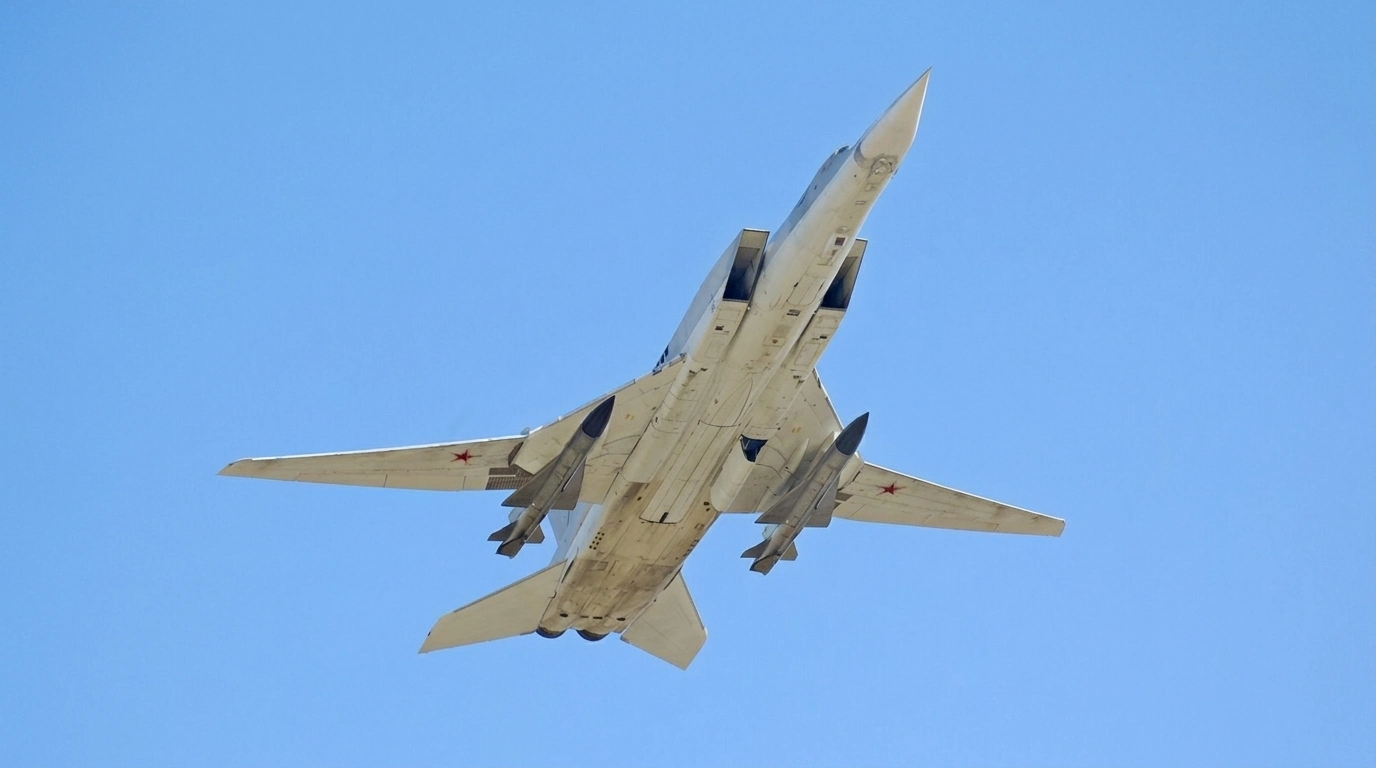
A missile traveling at more than twice the speed of sound is dangerous. Give it a warhead weighing close to a ton, and the threat becomes far more serious. But Russia’s Kh-22 missile has a weakness that its raw numbers often hide: it was built to attack large ships, not strike small targets on land.
That difference matters. A weapon designed to hit an aircraft carrier can cause enormous damage when it strikes a city. Yet speed and explosive power alone don’t make a missile accurate, and they don’t guarantee that it will reach its target.
Russia has used the Kh-22 during its war against Ukraine, including attacks that killed civilians and damaged civilian buildings. Its high speed and steep attack profile also make interception difficult for some air defense systems. These traits have kept an old Soviet weapon relevant decades after its first flight.
So, how dangerous is the Kh-22 missile today? The answer depends on what it carries, where it strikes, and whether defenders can stop it in time. Its destructive power is real, but so are its limits.
Understanding both sides reveals why this aging missile remains a serious threat, and why calling it unstoppable misses the point.
What Is the Russian Kh-22 Missile?
The Kh-22 was built for one demanding job: destroying large enemy warships before they could threaten Soviet naval forces. That original mission explains much about the missile’s size, speed, and weaknesses today.
Developed in the Soviet Union during the Cold War, the Kh-22 entered service in the 1960s. NATO gave it the reporting name AS-4 Kitchen. Soviet planners expected it to attack aircraft carriers and other major surface ships, which could absorb substantial damage before sinking.
A carrier also presents a much larger target than a building, bridge, or command post. That distinction becomes important when examining the Kh-22’s use in Ukraine.

Why did the Soviet Union need such a large missile?
The U.S. Navy’s carrier groups posed a serious problem for Soviet forces. Their ships had layered defenses, including fighter aircraft, radar systems, and ship-based missiles. A conventional attack aircraft might struggle to get close enough to launch its weapons.
The Kh-22 offered a different approach. A Tu-22K bomber, and later aircraft in the Tu-22M family, could launch the missile from a distance. Its rocket engine then drove it toward the target at supersonic speed.
The missile’s large airframe also gave it room for a powerful warhead and the fuel needed for long-range flight. Those features suited attacks on major ships, but they came with a cost: the weapon was heavy, complex, and poorly suited to every target type.
What does the AS-4 Kitchen name mean?
AS-4 Kitchen is NATO’s reporting name for the Kh-22 family. Russian sources commonly use the designation Kh-22, also written X-22 when the Cyrillic letter is transliterated differently.
The family includes variants with different guidance systems and warhead options. Some were designed to home in on radar signals, while others used different guidance arrangements for attacking ships.
That variation matters because not every Kh-22 has the same capabilities. Treating every missile in the family as identical can lead to misleading claims about its accuracy or performance.
Why does an old Soviet missile still matter?
Age alone doesn’t make a missile harmless. The Kh-22 remains dangerous because its speed, heavy payload, and launch profile can place a severe burden on air defenses.
But its original purpose also exposes its limits. A weapon optimized to strike a large ship isn’t automatically well suited to hitting a specific building. That mismatch helps explain why the Kh-22’s battlefield record is about more than raw destructive power.
Kh-22 Missile Specifications: Speed, Range, and Warhead
The Kh-22’s greatest strength is the amount of destructive power it can carry at high speed. Its size and rocket engine allow it to deliver a heavy warhead over long distances, giving defenders little time to react once the missile approaches.
But the numbers need context. Published specifications vary by variant, launch conditions, and source. A maximum range quoted for one version shouldn’t automatically be applied to every Kh-22 in service.
Key Kh-22 missile specifications
| Feature | Reported specification |
| NATO reporting name | AS-4 Kitchen |
| Origin | Soviet Union |
| Entry into service | 1960s |
| Missile length | Approximately 11.6 meters |
| Launch weight | Approximately 5,800 to 6,000 kg |
| Maximum speed | Around Mach 3.5 to Mach 4, depending on variant and flight profile |
| Range | Commonly reported at roughly 300 to 600 km, depending on variant |
| Propulsion | Liquid-fueled rocket engine |
| Warhead | Conventional high-explosive or nuclear, depending on variant |
| Main launch aircraft | Tu-22M family bombers |
These are approximate reference figures, not a single verified specification sheet for every missile. The Kh-22’s long body and heavy fuel load reflect its original role as a long-range anti-ship weapon.
How fast is the Kh-22 missile?
The Kh-22 is commonly reported to reach speeds around Mach 3.5 or higher under suitable flight conditions. Mach 1 is the speed of sound, which changes with air temperature and altitude. That means Mach 3.5 is not one fixed speed in kilometers per hour.
At such speeds, the missile can cover large distances quickly. Defenders may have only a short window to detect, identify, track, and engage it, especially if radar coverage is limited.
Speed alone, however, doesn’t make interception impossible. Detection range, flight altitude, radar quality, and the interceptor’s capabilities all affect the outcome.

How powerful is its warhead?
The Kh-22 can carry a conventional warhead weighing around 1,000 kg in some configurations. Certain versions have also been associated with nuclear warheads. The exact payload depends on the missile variant.
A heavy conventional warhead can cause severe blast damage and structural failure, especially when it strikes a populated area. The missile’s own mass and speed also contribute to the impact, although the damage depends on the strike angle, target structure, and detonation conditions.
How far can it travel?
Commonly cited range estimates vary from roughly 300 km to 600 km across variants and launch profiles. Those figures shouldn’t be treated as guaranteed combat ranges. The launch aircraft’s altitude, speed, missile variant, and flight path all affect how far it can travel.
The key point is that the Kh-22 allows Russian bombers to launch from a distance rather than fly directly over the target. That can reduce the aircraft’s exposure, even though the missile itself remains vulnerable to capable air defense systems.

How Destructive Is the Kh-22 Missile?
A Kh-22 strike can destroy a large section of a building, trigger fires, and kill people far beyond the point of impact. Its danger comes from the combination of a heavy warhead, high speed, and the risk of using a weapon designed for naval targets against land-based sites.
The missile can carry a conventional warhead weighing around 1,000 kg, depending on the variant. That’s an enormous payload for a single weapon. When it detonates inside or near a structure, the blast can damage walls, floors, support columns, and nearby buildings.
But the final result depends on where the missile hits. A strike against an open area won’t produce the same effects as one inside a crowded apartment block. Building materials, the angle of impact, and the location of the explosion all influence the damage.
Why can a Kh-22 strike cause so much damage?
The warhead is only part of the story. A missile traveling at several times the speed of sound also carries substantial kinetic energy. Its impact can cause severe physical damage, while the explosive charge adds a powerful blast.
Inside a building, that blast can throw debris through rooms and damage structures away from the point of impact. Fires may spread through damaged electrical systems, gas lines, or nearby combustible materials. In a densely populated area, the danger extends well beyond the intended target.

The Kh-22’s original anti-ship role helps explain its destructive design. Large warships have thick structures and multiple compartments, so Soviet planners wanted a missile capable of inflicting serious damage on a major vessel. Against a civilian building, that same payload can be devastating.
Does destructive power mean high accuracy?
No. This is where claims about the Kh-22 often become misleading.
A large warhead can make a missile destructive without making it precise.
The Kh-22 was designed to engage large targets, and its older guidance technology limits its suitability for attacks that require pinpoint accuracy. Reported accuracy figures vary by variant and conditions, so a single circular error probable figure shouldn’t be treated as universal.
A missile can hit a target area and still miss the specific object its operator intended to strike.
Why the distinction matters in Ukraine
The consequences are clear in documented attacks on Ukrainian cities. When a Kh-22 strikes an apartment building or shopping center, the combination of blast damage and uncertain accuracy can put civilians at grave risk.
The real measure of its danger isn’t just how large its warhead is. It’s what happens when that destructive power meets a populated area, particularly when the weapon lacks the precision needed to reliably hit a specific point.
Can Air Defense Systems Intercept the Kh-22 Missile?
The Kh-22 is difficult to intercept, but it’s not unstoppable. Its high speed, flight altitude, and steep approach can make an engagement harder for air defense crews, especially when radar coverage is limited or warning comes late.
The key is to understand that interception involves more than firing a missile at an incoming target. Defenders must detect the threat, track its path, predict where it will go, and launch an interceptor capable of reaching it in time. Every step takes seconds that may not be available.

Why is the Kh-22 hard to stop?
Speed is a major factor. A missile traveling at around Mach 3.5 covers ground rapidly, reducing the time between detection and impact. If the missile approaches from a direction with poor radar coverage, defenders may have even less warning.
Altitude also matters. The Kh-22 can follow a high-altitude flight path before descending toward its target. This can complicate an engagement because the missile’s position and trajectory change throughout the flight.
But speed alone doesn’t determine whether a missile can be intercepted. Radar performance, the quality of tracking data, the interceptor’s speed, and the geometry of the engagement all play a part.
Can Patriot systems shoot down the Kh-22?
Ukraine has received the U.S.-made Patriot air defense system, which is designed to engage aircraft and certain missile threats. Its radar and interceptor missiles give Ukrainian forces a stronger ability to challenge fast incoming weapons.
However, claims about specific interceptions need careful checking. Ukrainian officials have reported intercepting Kh-22 missiles, while Russian missile attacks have continued to cause damage. Public reports don’t always provide enough technical detail to independently confirm the circumstances of each engagement.
It’s also wrong to assume that every Patriot configuration can defeat every missile under all conditions. The system’s performance depends on the interceptor used, radar coverage, engagement geometry, and the tactical situation.
Why not intercept every incoming missile?
Air defense systems have limited interceptors and can’t protect every location at once. Crews must weigh the threat to cities, military sites, energy facilities, and other critical targets. Even a capable system faces hard choices when several missiles arrive from different directions.
The practical lesson is simple: the Kh-22 creates a serious air defense challenge, not an impossible one. Its speed can shrink the window for action, but a well-positioned defense with suitable sensors and interceptors may still stop it.
Russia’s Kh-22 Missile in the Ukraine War
Russia’s use of the Kh-22 in Ukraine has exposed the gap between a missile’s original purpose and the consequences of using it against land targets. Designed to strike large warships, the weapon has also been used in attacks that devastated civilian areas.
The most troubling issue isn’t simply the missile’s age or explosive power. It’s the combination of a heavy warhead and limited accuracy when the weapon is used against targets that demand precision. When a missile misses its intended aim point by a significant distance, the consequences can extend to homes, shops, and people with no role in the fighting.
The Kremenchuk shopping mall strike
On June 27, 2022, a Russian missile strike hit the Amstor shopping mall in Kremenchuk, central Ukraine. The attack killed at least 20 people, according to early official reports, and caused widespread destruction.
Ukrainian authorities said Russian forces used Kh-22 missiles in the attack. Russia disputed aspects of the account and made claims about the intended target. The strike drew international condemnation because the mall was a civilian site and people were inside when it was hit.
The incident showed how devastating a heavy missile can be when it strikes a populated area. It also highlighted why investigators must distinguish between the weapon used, the intended target, and the actual impact.
The Dnipro apartment building strike
On January 14, 2023, a Russian missile hit a residential apartment block in Dnipro. The attack killed dozens of people and left many more injured. Ukrainian officials identified the weapon as a Kh-22.
The strike became one of the clearest examples of the missile’s human cost. An apartment block is not a warship, and a weapon built to attack large naval targets carries obvious risks when used in a dense urban setting.
The incident also drew attention to Ukraine’s difficulty in intercepting Kh-22 missiles at the time. Ukrainian officials said the country’s air defenses lacked the ability to reliably shoot down this type of missile with the systems then available.
Why does Russia keep using the Kh-22?
Older missiles can remain useful when a country has stocks of them and aircraft capable of launching them. Their use may also force an opponent to spend valuable time and resources tracking incoming threats.
But continued use doesn’t prove that the weapon is ideal for every mission. The Kh-22’s design reflects Soviet-era assumptions about attacking large ships, not the demands of precision strikes in cities.
For Ukraine, the lesson has been harsh: even an old missile can remain a serious threat when its speed and payload outmatch the defenses protecting a target. For civilians, the consequences are measured not in Mach numbers, but in lives lost and homes destroyed.
