

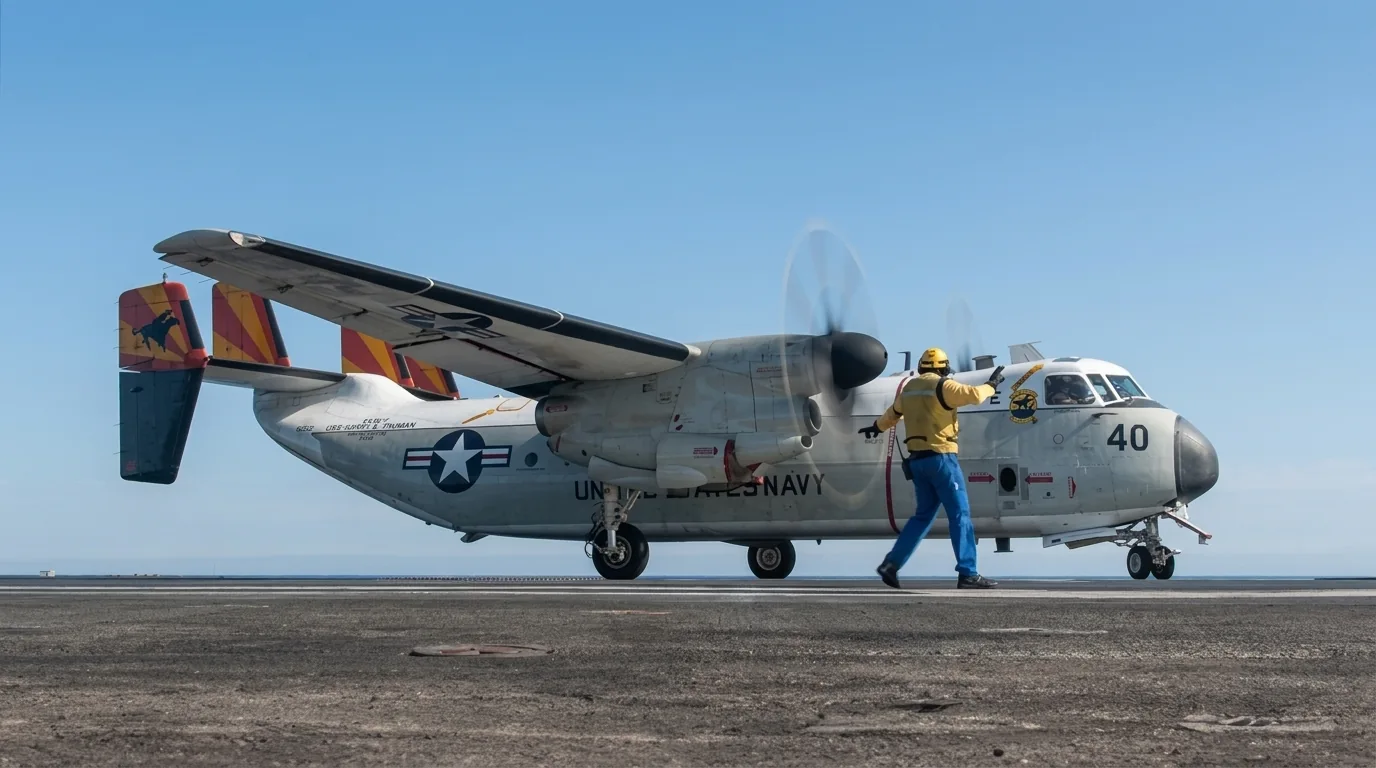
A fighter jet carrier can run out of a critical part long before it runs out of fuel. That’s where the C-2 Greyhound earned its place in the US Navy.
For decades, this twin-engine turboprop carried urgent cargo from shore bases to aircraft carriers operating far from land. Its deliveries included mail, spare parts, medical supplies, and even jet engines needed to keep carrier aircraft flying. A missing component could leave an expensive aircraft grounded, so getting the right item aboard quickly mattered more than the transport plane’s age or looks.
The C-2 Greyhound wasn’t built to win airshows. It was built to solve a stubborn problem: how do you move bulky, time-sensitive cargo onto a ship that keeps moving, often hundreds of miles from the nearest airfield?
Its answer combined a large rear cargo ramp with the ability to launch from a carrier catapult and recover aboard using arresting gear. That made it a specialist in a job few other aircraft could perform in the same way.
But the C-2 Greyhound’s story has changed. After more than six decades of carrier logistics, the Navy ended its carrier operations in June 2026. Its final in-service flight followed in July, as the CMV-22B Osprey took over the Carrier Onboard Delivery mission.
Understanding the C-2 Greyhound means looking beyond its cargo capacity. The aircraft shows how a carrier strike group depends on a supply chain that must keep working while the ship is at sea.
What Was the C-2 Greyhound and Why Did the Navy Need It?
The US Navy needed an aircraft that could connect a carrier at sea with the supplies waiting on land. The C-2 Greyhound filled that gap, giving carrier groups a way to receive urgent cargo without returning to port.
Before the Greyhound, the Navy used the smaller Grumman C-1 Trader for its Carrier Onboard Delivery (COD) mission. But carrier air wings grew more complex, and the demand for spare parts and larger equipment increased. Moving a few people or small packages was one thing. Delivering bulky aircraft components was another.
The C-2A Greyhound, developed from the E-2 Hawkeye airborne early warning aircraft, offered a larger fuselage and a rear cargo ramp. That design choice mattered. Crews could load heavy items through the back instead of forcing everything through a narrow side door. The aircraft could also carry passengers, mail, medical patients, and other supplies in the same basic mission profile.
Its role was practical rather than glamorous. A carrier might have fuel, weapons, and a full flight deck, yet still lose aircraft availability because a key part remained at a shore base. The Greyhound helped close that gap by moving urgent items directly to the ship.
The scale of the mission was clear even in the 1980s. From November 1985 to February 1987, VRC-24 delivered about two million pounds of cargo, another two million pounds of mail, and transported 14,000 passengers. Those figures show that COD was not a side task. It was a steady logistics link supporting daily carrier operations.
The C-2 Greyhound served for decades, but its value came from a simple idea: keep the carrier supplied while it stays at sea. That reduced the need to interrupt operations just to collect parts or personnel.
How Did the C-2 Greyhound Deliver Supplies to Aircraft Carriers?
The C-2 Greyhound turned a shore-based supply run into a direct delivery to a moving ship. The trick was making an ordinary cargo flight work with the unusual demands of carrier aviation.
A typical mission began at a shore airfield, where ground crews loaded cargo through the aircraft’s large rear ramp.
The C-2 Greyhound could carry priority spare parts, mail, passengers, medical patients, or bulky items such as replacement jet engines. Inside, a cargo cage and restraint system helped secure loads against the forces of carrier operations. Once the aircraft was ready, its crew flew out to meet the carrier at sea.
Then came the part that separated the C-2 Greyhound from a standard transport plane.

The aircraft launched from the carrier using a catapult. This system accelerated it along the flight deck, helping it reach flying speed within the ship’s limited runway length. Returning was just as demanding. The pilot had to line up with the flight deck and catch an arresting wire with the aircraft’s tailhook. The wire brought the C-2 Greyhound to a stop over a very short distance.
There’s little room for a casual approach. The carrier moves, the deck is short, and weather can complicate both launch and recovery. The crew had to manage the aircraft, cargo, and timing while working within those limits.
Once the C-2 Greyhound landed, the rear ramp allowed crews to unload supplies directly on the flight deck. That reduced handling time and helped the carrier receive urgent items without heading back to port. The aircraft could then be prepared for another flight, depending on the mission and operating conditions.
The Navy also listed an unusual option: the rear ramp could open in flight for airdrops of supplies or personnel. But its main value was simpler. The C-2 Greyhound brought what the carrier needed, then got back out of the way so flight operations could continue.
C-2 Greyhound Specifications, Range, and Cargo Capacity
The C-2 Greyhound was built around one demanding job: carry a useful load to a carrier, then land on a flight deck barely longer than a city street. Its performance figures make more sense when viewed through that mission, rather than compared with larger land-based cargo aircraft.
The C-2A used two Allison T56-A-425 turboprop engines. These drove propellers suited to the repeated takeoffs and landings required in carrier service.
The aircraft could cruise at about 260 knots, with a reported maximum speed of roughly 343 knots. Its range was around 1,000 nautical miles, enough for many ship-to-shore supply runs, although the actual mission depended on payload, weather, and operating conditions.
| Specification | C-2A Greyhound |
| Aircraft type | Carrier onboard delivery transport |
| Engines | 2 × Allison T56-A-425 turboprops |
| Length | 56 ft 10 in |
| Wingspan | 80 ft 7 in |
| Maximum takeoff weight | 57,500 lb |
| Cruise speed | About 260 knots |
| Maximum speed | About 343 knots |
| Range | About 1,000 nautical miles |
| Maximum payload | Around 10,000 lb |
| Passenger capacity | Up to 26 |
| Crew | 4 |
| Service ceiling | 30,000 ft |
The C-2 Greyhound’s cargo capacity was more useful than its speed alone. A carrier might need a replacement component quickly, and the aircraft could move that item without waiting for a ship to return to port. Its rear loading ramp also made bulky cargo easier to handle than it would be in a transport with a smaller access door.

These figures need some context. Maximum payload, passenger capacity, and range are not necessarily available at their highest values on the same flight. A heavy load can affect how far the aircraft can travel, while the carrier’s position and flight conditions shape the practical mission radius.
The key point is that the C-2 Greyhound was not designed to haul the largest possible load over the longest distance. It was designed to deliver a useful load within the tight limits of carrier operations.
How Could the C-2 Greyhound Carry Jet Engines and Urgent Cargo?
The C-2 Greyhound could carry cargo that a carrier needed to keep its aircraft flying, including bulky jet engine components that were awkward to move through standard transport doors. Its rear loading ramp made that possible, turning the aircraft into more than a mail plane.
The ramp gave ground crews a direct way to load and unload large items. Inside the fuselage, cargo restraints helped secure equipment during flight and the demanding transitions of carrier operations. This mattered because heavy cargo cannot simply sit loose in a transport aircraft. It must remain secure through acceleration, turbulence, and landing forces.
Jet engines were among the C-2 Greyhound’s most useful loads. A carrier’s aircraft might need an engine or major component from a shore facility, but sending a ship back to port would take far longer than flying the part out. The C-2 Greyhound could bridge that gap, helping maintenance teams return aircraft to service sooner when the required equipment was available on land.

The same flexibility supported less dramatic, but equally necessary, tasks. The aircraft transported spare parts, mail, passengers, and medical patients. Its cabin could be arranged around the mission, allowing the Navy to use the same aircraft for different types of urgent transport rather than dedicate separate platforms to each task.
The C-2 Greyhound could also conduct airdrops through its rear ramp. That capability expanded its options, although carrier delivery remained its central role. It was not a replacement for strategic airlift, nor could it carry every component a carrier might need. Its value lay in moving selected loads quickly between shore and ship.
That distinction is easy to miss. The C-2 Greyhound did not need to carry an entire aircraft engine shop. It needed to deliver the right item before a maintenance delay became a longer readiness problem. In carrier aviation, that can be the difference between having an aircraft available and keeping it parked on deck.
What Challenges Limited the Aging C-2 Greyhound Fleet?
The C-2 Greyhound’s biggest challenge near retirement wasn’t a lack of cargo space or speed. It was keeping an aging aircraft supplied with working parts as its planned service life stretched further than expected.
The Navy had already invested in extending the aircraft’s life. Its Service Life Extension Program strengthened key parts of the airframe and replaced wiring, adding 5,000 flight hours and 1,100 carrier landings and takeoffs to the aircraft’s planned limits.
That work helped keep the fleet flying, but it couldn’t solve every maintenance problem. A stronger airframe still depends on working components, skilled technicians, and a supply chain that can provide replacements.
The auxiliary power unit (APU) became a clear example. This small unit helps start the C-2 Greyhound’s main engines and supports ground work, especially where ground equipment is limited. By late 2025, the Navy faced a shortage of serviceable APUs, with many parts no longer available through normal supply channels. The units themselves were more than 30 years old.

The problem became serious enough that Fleet Readiness Center East had to rebuild a repair capability that had been inactive for years.
Technicians used a known working APU borrowed from USS George H. W. Bush to check their test equipment, then developed new test instructions. From an initial batch of 40 units marked unserviceable but potentially repairable, two were cleared for use. Further work restored more units to the supply chain.
That’s the less glamorous side of military readiness. A transport aircraft can be structurally sound and still become difficult to operate when one old component has no easy replacement. The Navy’s repair effort bought the Greyhound more time, but it also showed how much support an aging fleet can demand.
The C-2A’s retirement wasn’t caused by the APU shortage alone. The deeper issue was the cost and effort required to sustain a specialized aircraft while the Navy prepared its replacement. Keeping the mission running meant maintaining not just the aircraft, but the whole support system behind it.
Why Did the Navy Replace the C-2 Greyhound With the CMV-22B Osprey?
The Navy replaced the C-2 Greyhound because the CMV-22B Osprey can deliver supplies in more places, not just aboard aircraft carriers. That extra flexibility changes how a carrier strike group can receive urgent cargo while operating far from shore.

The biggest difference is how the aircraft takes off and lands. The C-2 Greyhound needed a carrier catapult for launch and an arresting wire for recovery. The Osprey can rotate its engine nacelles upward and take off or land vertically, much like a helicopter. In forward flight, its rotors turn to act like propellers, letting it cruise like a turboprop aircraft.
That gives the Navy options the Greyhound never had. The Osprey can deliver cargo to a carrier, but its vertical flight capability also supports transfers to other suitable ships and forward locations. A carrier group can distribute supplies beyond the flight deck instead of relying on another helicopter to move everything onward.
The CMV-22B was also adapted for the Navy’s long-range delivery role. It has extra fuel capacity, a high-frequency radio for communication beyond line of sight, and cabin lighting designed to help crews handle cargo. According to Naval Air Systems Command, it can carry up to 6,000 pounds of cargo or personnel over a range of 1,150 nautical miles.
There’s a trade-off, though. The C-2 Greyhound was a fixed-wing transport built around carrier delivery, while the Osprey’s tiltrotor design adds mechanical complexity. Vertical flight also brings different limits on weight and performance than a rolling takeoff. The Osprey’s stated maximum payload and range shouldn’t be treated as figures it can always achieve together.
Still, the Navy chose more than a direct replacement. It chose an aircraft that can connect shore bases, carriers, and other ships with fewer limits on where it can land. For a force spread across a vast ocean, that flexibility can matter as much as cargo capacity.
