

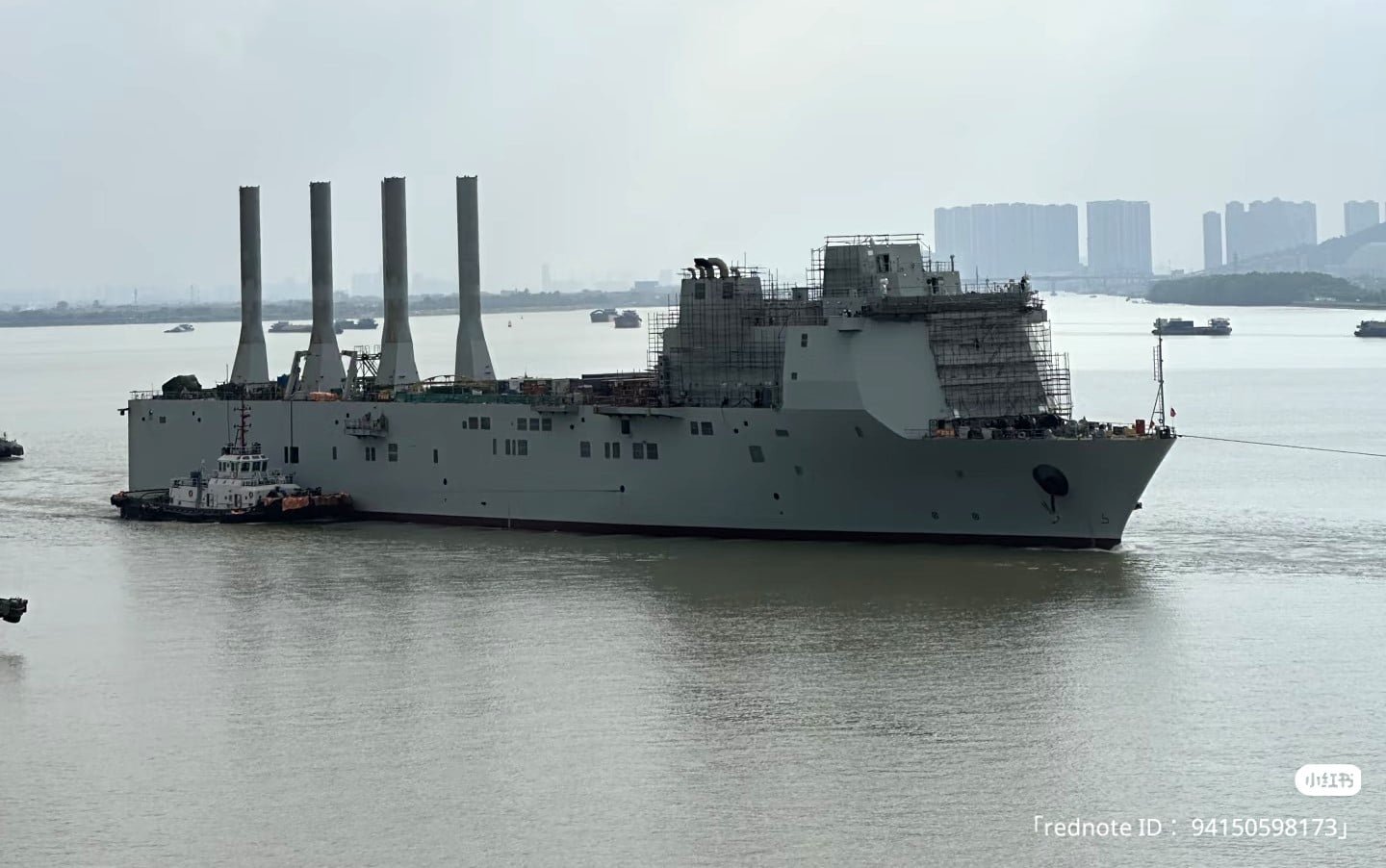
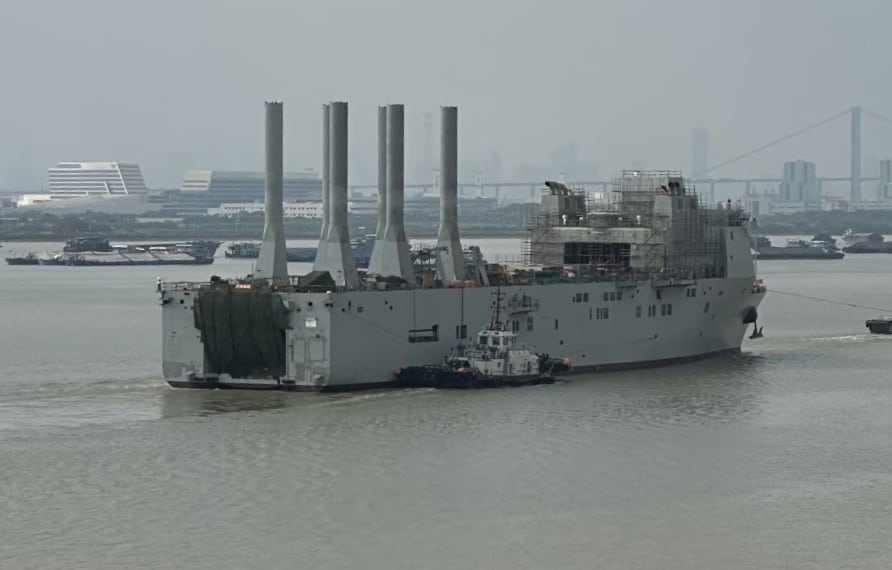
New imagery circulating on social media has revealed a second new naval auxiliary vessel for PLAN. Observers speculate the design serves as a Chinese UUV mothership, capable of supporting very large drones through onboard equipment. Naval News provides a brief outline on what the pictures in question add to our existing knowledge of this intriguing development for the Chinese Navy.
The photos in question are stills taken from two very short video reels shared originally on Chinese social media, specifically Weibo. The new pictures quickly spread onto other sites and forums, including “X”, formerly Twitter. The authenticity of these reels remains to be confirmed. Checks with multiple AI detection tools suggest the material is genuine, although superficial “enhancements” cannot be ruled out.
The footage shows several tugboats towing the new auxiliary vessel. The ship carries extensive scaffolding and is still missing all sensor and communication equipment. The location is the Pearl River in Guangzhou, specifically a section near the Panyu district, as the distinct GAC HQ for research and development, known as GAEI headquarters, is visible in the background. One plausible origin of this new vessel is the COMEC shipyard associated with Huangpu Wenchong, on Longxue Island further downstream. However, both the identity of the builder and the destination for further fitting-out work need to await additional imagery for confirmation. At least two other yards belonging to Huangpu further up-river are plausible candidates to finish the fitting-out work. One of these is Huangpu’s primary yard for a wide range of naval vessels, including frigates, surveillance vessels, the Zubr-class LCAC designated as the Type 728 in China, and a recently revealed trimaran submersible.
Naval News previously reported on a new type of presumed Chinese UUV mothership under construction at Hudong, Shanghai. That ship, with a length slightly exceeding 200 metres, features twelve distinct lifting masts at the stern. The assumed purpose of this mechanism is to vertically move a cradle integrated into the ships’s welldeck-like stern. Notional dimensions of this cradle as observed at the yard in Shanghai would enable the device to carry large payloads with a length of up to 50 metres for launch and recovery at sea. Satellite imagery suggests that China is evaluating at least two very large UUV designs between 35 and 45 metres. Such a size renders these vessels the largest known military UUVs in the world.
Similar role but different design for the two suspected motherships
The new ship now seen in Guangzhou does differ from the unit in Shanghai in several points. The hull appears shorter and narrower, producing an overall smaller vessel. Initial observation suggests a length closer to 150 metres. The jack-up masts at the stern are of a different configuration. Instead of twelve masts, two abreast, at different height like on the Shanghai-built ship the Guangzhou unit only features six extended masts of similar height in a similar two abreast-layout. Both ships share a raised forward deckhouse accommodating the bridge at the front and a large opening leading into a hangar-like area at the rear.
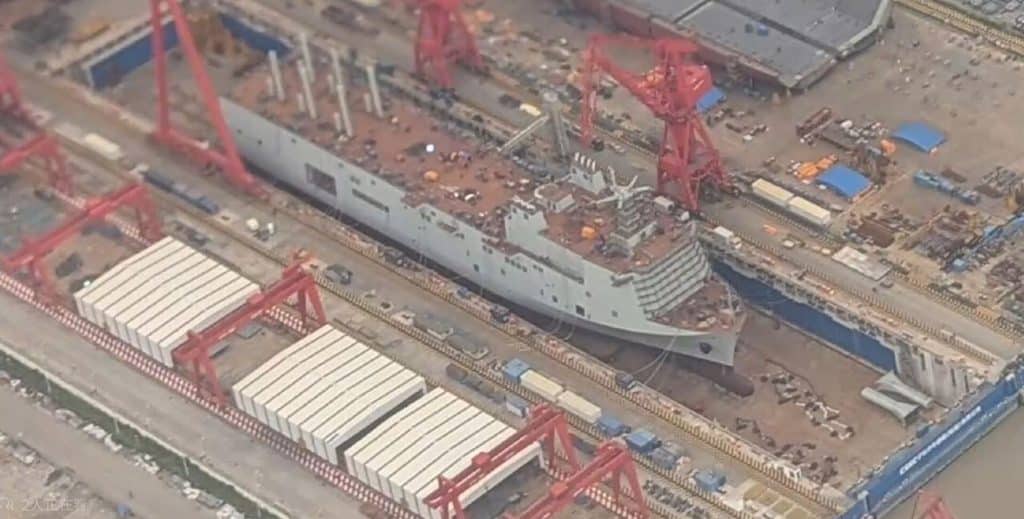
Propulsion mirrors the Shanghai-unit, with side by side smokestacks for diesel engines at the rear of the forward deckhouse. The appearance of the engine exhausts shows minor differences between both vessels, likely owing to differences in total installed power. The Guangzhou-built design includes a relatively conventional hull with an inward cant on the upper hull limited to the deckhouse. Meanwhile the vessel in Shanghai shows a distinctly inwards angled upper hull beginning near the bow and extending over the entire length of the ship. Both ships feature an opening similar to a well deck gate at the stern.
Guangzhou shipyard busy supplying a wide range of support vessels to PLAN
The suspected shipyard for the second Chinese UUV mothership is COMEC, formerly known as GSI. The yard has engaged in significant activity building a range of auxiliary vessels for the Chinese Navy over the last few years. Most notable among these are two sets of amphibious barges the yard assembled since around 2024. Observers associate these designs with a support role for a notional amphibious invasion of Taiwan.
COMEC also continues to build fleet replenishment ships for PLAN, including a second batch of Type 903A AOR. Most recently the yard launched the first hull of a new design of supply vessel. This AOR is similar to but larger than the two Type 901 fleet replenishment ships supporting Chinese carriers. A second hull of this type with a displacement of around 65,000 tons now appears to be under construction at the yard as well. Other recent projects include two new types of submarine support vessels, an experimental carrier-like flattop hull apparently intended for evaluation of UAVs and the third unit of the Type 920 hospital ship, commissioned in 2025.
The purpose of this new auxiliary is likely going to leave room for speculation for a considerable time. The Chinese military is rarely in the habit of sharing significant amounts of information on new construction projects. This is particularly the case for more dedicated or unusual roles. Further assessment needs to await more detailed imagery in order to clarify the intended purpose of these bespoke vessels with the Chinese Navy.
